Crystal Lake Epoxy Flooring has spent more than 20 years on epoxy flooring in Woodstock and the surrounding county, and on a Woodstock slab the first thing we look at is not the color chart. It is the mark already on the concrete: a white chalky line along a joint, an orange bloom near a wall, a patch where an old coating has let go. Each of those marks records something that happened to the slab, and covering one without reading it is how a new floor fails along the same line.
That habit matters more here than in many towns, because the usual explanation for a crusty or rust-stained floor does not fit a home on city water. Woodstock draws its supply from wells, but the water is treated for iron and hardness before it reaches a faucet. So when we find mineral residue on a garage, basement or shop floor, we start from the idea that something other than the tap put it there and work toward an answer.
What follows is how we approach that work: what the city does to its water, what white and orange stains usually mean on a treated-water slab, how a diagnosis becomes a written scope, and what local permit practice asks for. None of it replaces a test, and we say so at every step.
What Woodstock does to its well water before it reaches your floor
Six wells and two treatment plants
According to the City of Woodstock’s 2024 Annual Water Quality Report, the city pumps from six wells, 110 to 189 feet deep and all inside city limits, feeding two water treatment plants. The report is blunt about the raw supply: it carries excessive amounts of iron, manganese, carbon dioxide and hydrogen sulfate. The city’s Drinking Water page adds that this groundwater holds more iron and hardness than Lake Michigan water, which is why it is treated before it is pumped out.
At the plants, aeration strips the carbon dioxide and hydrogen sulfate and oxidizes the iron and manganese so filtration can catch them. The water then runs through a softening process and is chlorinated, fluoridated and dosed with polyphosphate before distribution. The finished iron reading for 2024 was 0.027 ppm.
Why most homes skip a second softener
Because iron removal and softening happen at the plant, the Drinking Water page states that most residents do not find it necessary to provide additional softening in their homes. Sodium in the finished water ran 150 to 230 ppm in 2024, and the report lists part of its source as use as a water softener, which is the plant doing that job before the water arrives.
For a flooring contractor, that changes the short list of suspects. In a town where nearly every basement has a softener and an iron filter, a crust near the utility corner often traces back to a leaking brine tank or a dripping discharge line. On a Woodstock home on city water, that explanation is less likely, though not ruled out.
We do not read any of this as city water helping or hurting a floor. It only narrows the questions we ask when a slab shows mineral staining.
Looking for epoxy-flooring closer to Carpentersville? See Carpentersville Epoxy-Flooring.
White crust and rust stains on a treated-water slab
Efflorescence points to moisture moving through concrete
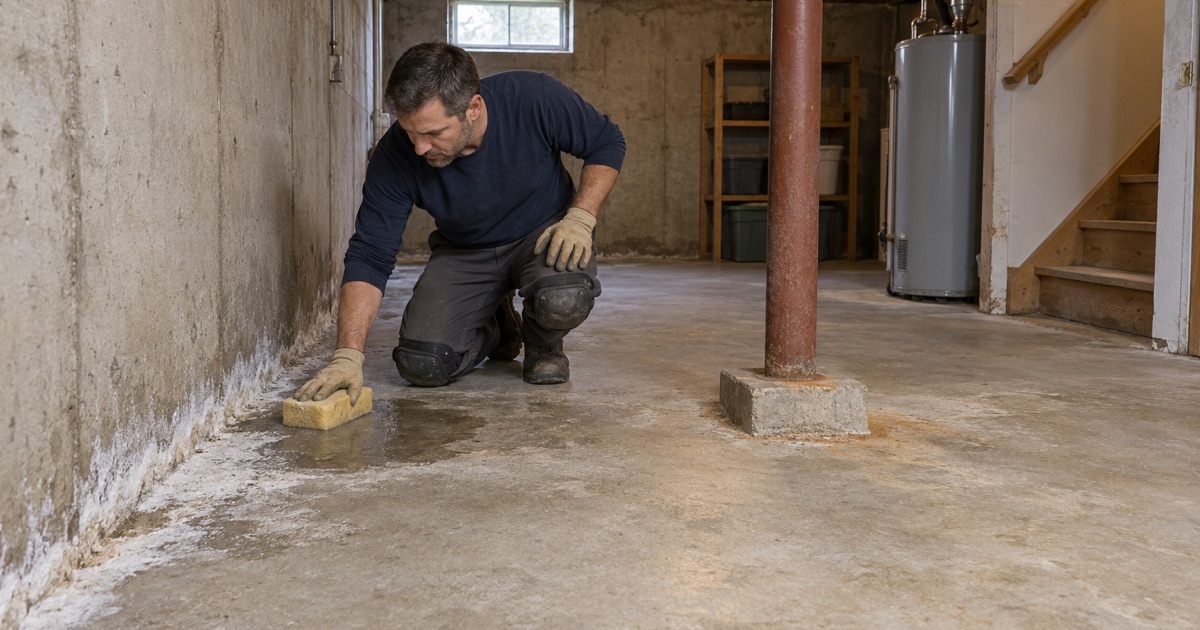
The white, chalky crust that collects along cracks, control joints and the base of foundation walls is usually efflorescence. It forms when salts dissolve in liquid water moving through a slab and crystallize at the surface as that water evaporates. The salts come from the concrete, the soil and whatever the water picked up along the way, and the crust is what they leave behind.
What efflorescence tells us is that water is traveling through that concrete, at least some of the time. That is the part that matters for a coating, because epoxy laid over a slab with moisture coming up through it can lose its bond, blister or lift. Brushing the crust away removes the sign but not the cause, so we treat a clean spot that was crusted last spring as a moisture question that is still open.
Rust-colored stains when the city already filters out iron
An orange or brown stain on a city-water floor deserves the same skepticism. With iron taken out at the plant, the tap is an unlikely source, so we look elsewhere: steel left sitting on the slab, rusting shelving or tool chests, a corroded water heater pan, reinforcing steel close to the surface, or iron-bearing water seeping in from outside. Garage floors add another candidate, since winter slush and grit tracked in on tires carry their own mix of minerals.
Some of these causes are cosmetic and grind out with the rest of the surface. Others, like steel corroding near the top of the slab or water entering at a wall joint, point to a repair that has to happen before any coating goes down. We do not guess which one we are looking at; we say what we suspect, and then we confirm it.
When a home still runs its own equipment
Some owners keep a softener installed by a previous owner or run one by preference, and a property on its own private well is a different case entirely. Where we find that equipment, a leaking tank or discharge line moves back onto the list, and we check the plumbing before blaming the slab. The point of the diagnosis is to match each stain to its actual source, whatever that turns out to be.
From stain to plan: deciding whether a Woodstock slab is ready
Reading the slab before we quote
Before a number goes on paper, we walk the floor and read it: cracks, joints, old coating, crust and stains, and where each sits relative to walls, drains and doors. A stain pattern that follows a wall line tells a different story than one scattered under where a car parks. When the slab needs crack repair, joint work or replacement before it can carry a coating, we say so plainly instead of folding the problem into a finish that will not hold.
Woodstock’s housing runs from the older blocks around the courthouse square to subdivisions built in the 2000s, so the floors we see vary just as widely. An older basement slab may have little or nothing under it to slow moisture, while a newer garage was poured under a recent code. Neither age settles the question; the slab in front of us does.
Testing comes after the diagnosis
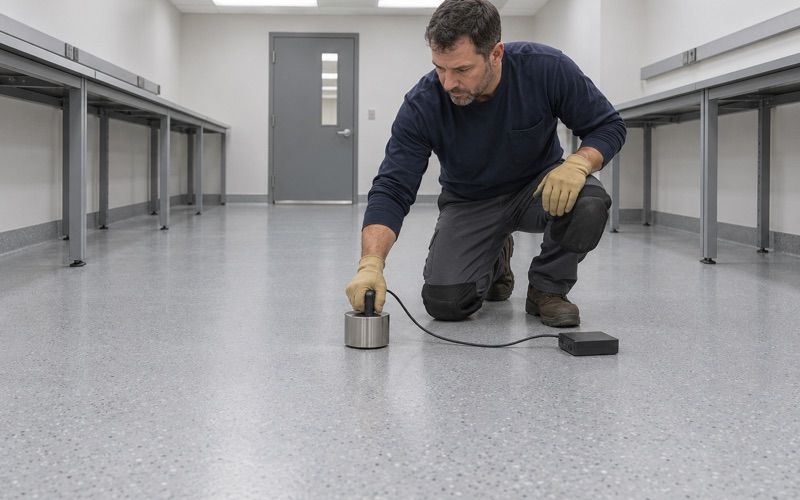
Once we know what a stain probably means, moisture testing turns that suspicion into a number. It is a line item in our scope on garage, basement and shop floors alike, not an add-on sold after a coating has already blistered. Where a reading is needed, we use calcium chloride emission testing under ASTM F1869 or in-situ relative humidity under ASTM F2170 rather than relying on a taped plastic sheet.
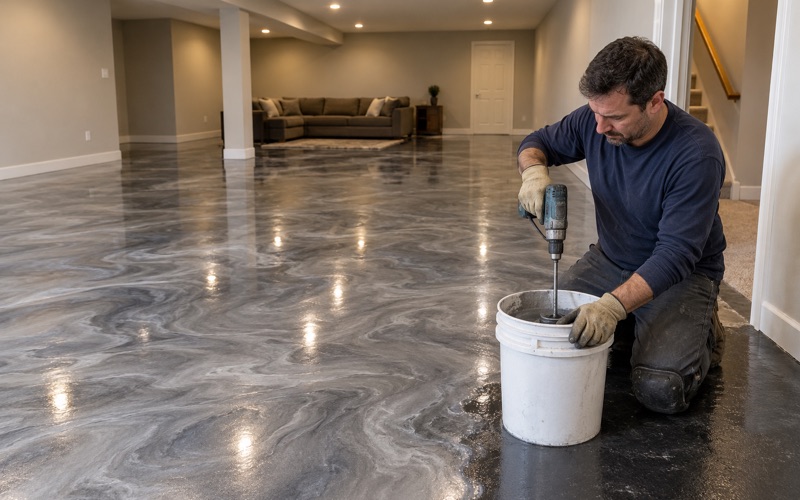
Manufacturers set their own moisture gates, and some state plainly that their epoxy is not to go down over rising moisture. When the readings fall outside what the chosen system allows, the plan changes: a moisture-mitigation primer, a repair at the source, or a recommendation not to coat yet.
Grinding, the system and the warranty
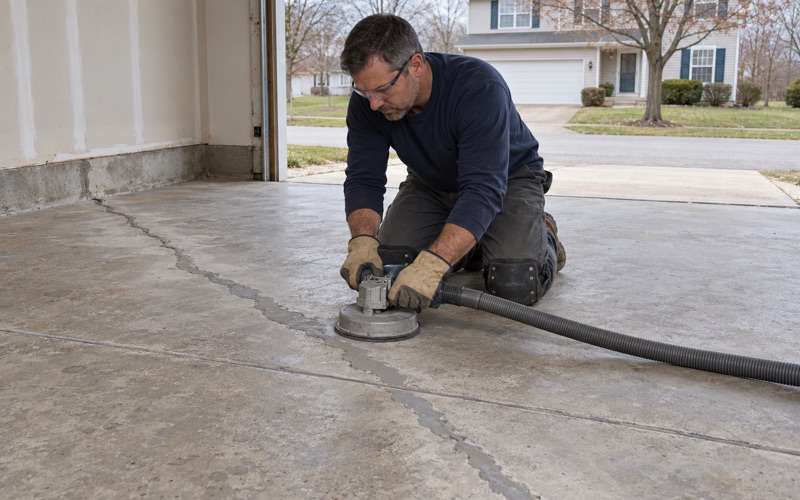
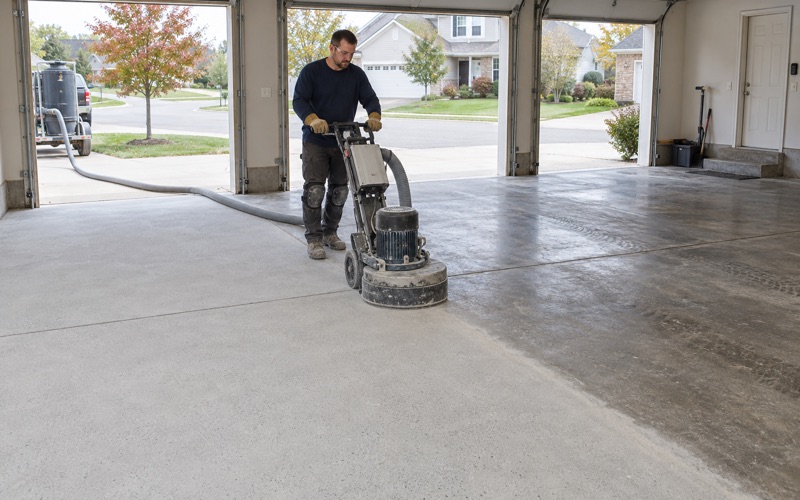
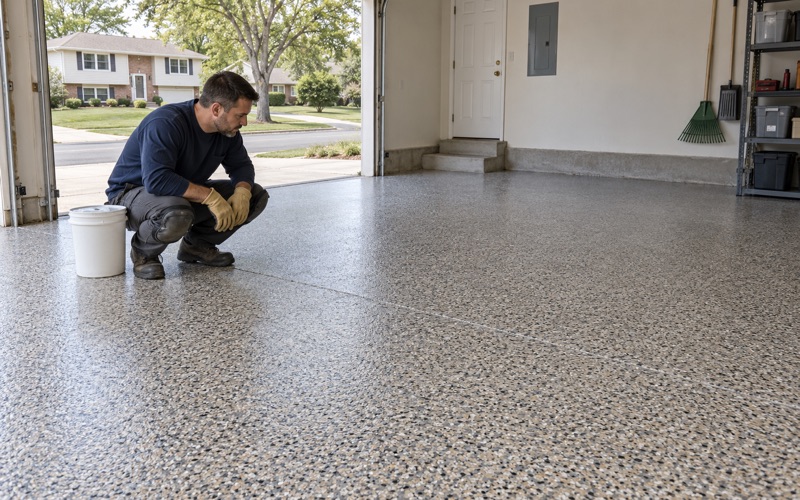
Every slab we coat is opened mechanically with a diamond grinder or shot blaster, never acid etched, and grinding takes off the stained top layer along with any loose crust. Dust is collected at the grinder rather than rinsed toward a floor drain or storm inlet. The proposal then names the product, the system build and the finished thickness, priced per square foot for that system, so what we quoted can be checked against what went down.
We also read out the warranty exclusions before the job is sold, and moisture is the first one named. A coating is not waterproofing and does not stop water moving through a slab; if a basement has a water problem, it gets handled where the water comes from. Saying so up front costs us the occasional job and spares a homeowner a peeling floor.
Woodstock permits, contracts and paperwork
No city contractor registration
The City of Woodstock states on its Building Permits and Inspections page that contractors do not need to be licensed or registered by the city to work there. Electricians, plumbers and roofers are the exceptions, filing a copy of their license and a letter of intent with a permit application. Illinois issues no state license for flooring or coatings work either, so there is no license card for a homeowner to ask us for.
What protects a homeowner instead is the paperwork. Every home job we take gets a written contract and the state’s Home Repair: Know Your Consumer Rights pamphlet before work starts, as the Illinois Home Repair and Remodeling Act requires. We also confirm our insurance and any local business requirements before a job goes on the calendar.
Garage pours and finish work
Woodstock builds to the 2021 International Residential Code with city amendments, and its garage handout requires a building permit for every garage, with two inspections: a pre-pour slab inspection before concrete goes in, and a final. If a garage slab is being replaced or a new garage is going up, that pre-pour step sits in the schedule before we ever see the concrete.
Whether a coating on an existing floor needs its own permit is a question for the Development Services Department’s Building and Planning staff at City Hall, 815-338-4305. Basement build-outs go through a separate Miscellaneous Permit Application, so when a coating is one piece of a larger finishing project, we check how the city wants it handled. We ask before we start rather than assume.
Kitchens, shops and timing
Restaurant, tavern and food-service floors go through the McHenry County Department of Health, which is headquartered in Woodstock on North Seminary Avenue. Its plan review asks for floor, coving, wall and ceiling finishes room by room, so we specify the floor system for that review before the permit is issued. Shop and warehouse floors are scheduled around the hours a building has to keep running, including overnight and weekend windows.
Every system we install stays within the Illinois limit on VOC content for floor coatings, a rule that binds the installer as well as the maker in a county that sits inside the Chicago ozone nonattainment area. Curing is scheduled against slab temperature and dew point rather than the calendar. An unheated garage at the edge of a McHenry County winter sometimes has to wait for spring, and we tell you that when we quote.
- 20+ Years on Local Concrete
- Moisture Testing in Every Scope
- Written Per-Square-Foot Quotes