Crystal Lake Epoxy Flooring has installed epoxy flooring in Wood Dale and across northern Illinois for more than 20 years, and on commercial work here the first question is rarely about color. It is about time: how long a bay or shop floor must sit empty before it carries work again. On a building that runs most of the week, that answer shapes the job before any product is chosen.
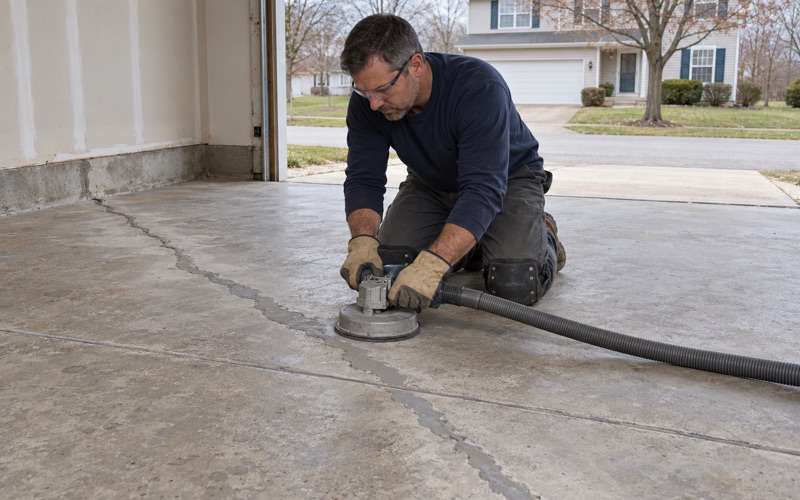
We answer it on paper. Each proposal names the product, the system build and the finished thickness, and beside them sits the manufacturer’s own cure and traffic schedule, so an owner plans closures from the same figures the crew works to. Every slab is opened first with a diamond grinder or shot blaster, never with acid.
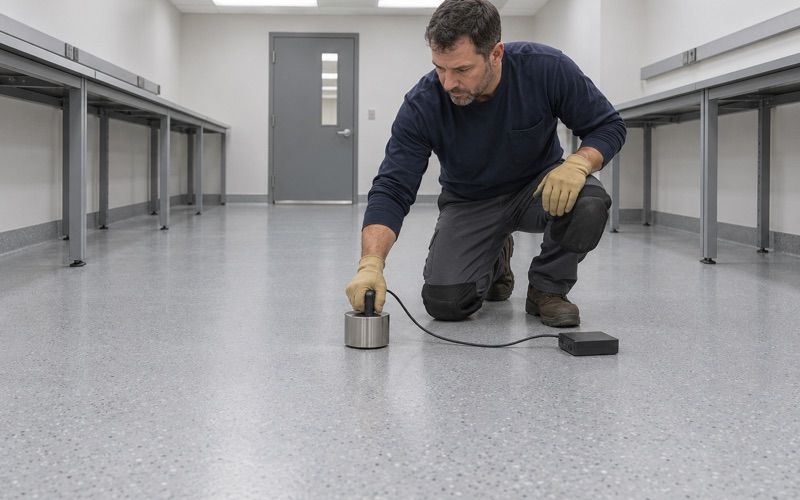
Curing is planned against what the slab itself is doing, meaning its temperature and the dew point spread at the surface, rather than against a date on the calendar. On a fast-turn floor that habit carries more weight than anywhere else. A coat that would be ready Monday in a warm room may still be soft in a cold one.
A Kenworth Shop on Mittel Drive That Runs Two Shifts
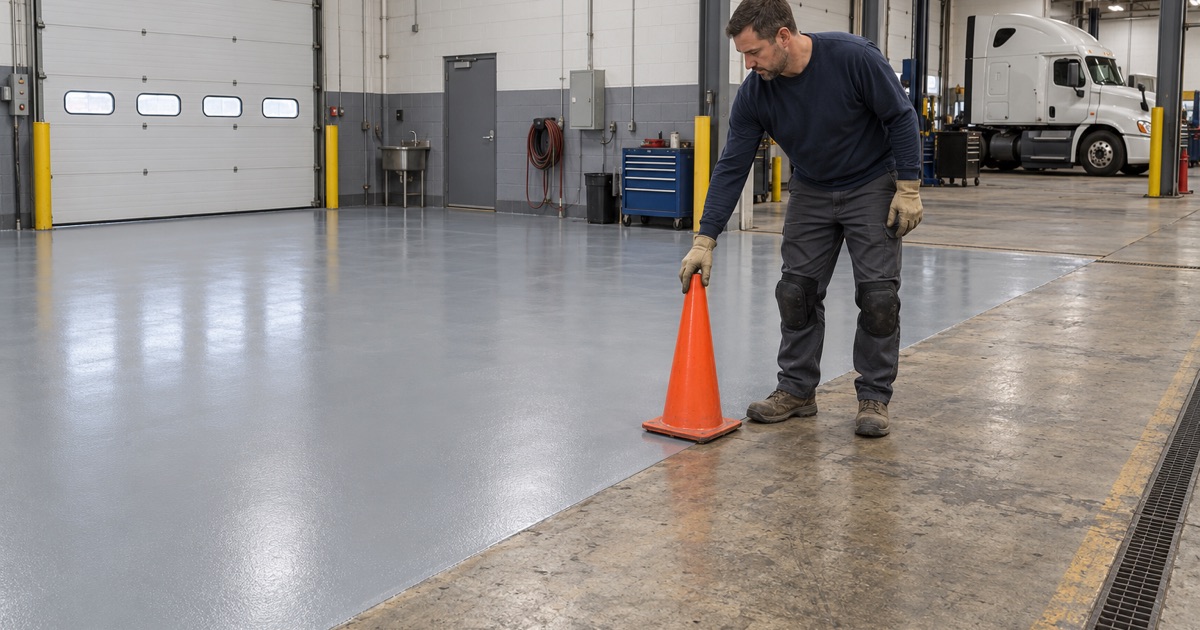
The clearest local example of a floor with almost no downtime is a heavy-truck service department. CIT Trucks lists its Kenworth dealership at 101 Mittel Drive, by Wood Dale Road, and its own page says the Bensenville store is moving to a full-service facility in Wood Dale. We have no relationship with CIT and have not seen its floors; we use its posted hours because they show, in plain numbers, the problem every busy shop in town shares.
Posted hours that leave one real gap
Parts and service are posted from 7:00 a.m. to midnight on weekdays and from 7:00 a.m. to 3:30 p.m. on Saturday, with Sunday closed. Read as a coating schedule, that leaves a single long break each week: Saturday afternoon to Monday morning, which comes to 39.5 hours.
Those 39.5 hours are not all coating time. Moving equipment out, grinding, vacuuming, patching, priming and waiting out each recoat interval all come off the top, and so does the time the last coat needs before anything rolls onto it. What remains is the true margin, and on many systems it is thin or gone.
Why a weeknight does not work
On weekdays the service department is dark only from midnight until 7:00 a.m., about seven hours. That can be enough to grind and patch a small area, but it is not enough for a system that has to accept a truck the following morning. So in a two-shift building the weeknights serve as prep time at best, and the coating itself belongs on the weekend.
Shops with the same pattern are spread through the city’s industrial streets, from fleet garages to equipment yards to machine shops. The arithmetic changes with each set of posted hours, but the method of working from the longest closure backward does not.
Looking for epoxy-flooring closer to Winfield? See Epoxy-Flooring in Winfield.
Reading the Vehicle-Traffic Line on a Data Sheet
Every resin floor system has a technical data sheet, and somewhere on it is a line for foot traffic and a separate line for vehicles. For a truck shop, the vehicle line is the one that decides whether Monday works. It is also the line owners most often skip, because the faster foot-traffic figure is printed first.
The same family, very different numbers
Polyaspartic topcoats are sold as the fast option, and some are. One 80 percent solids polyaspartic sheet we have read gives 24 hours for vehicle traffic at 72 degrees and 50 percent relative humidity. Another polyaspartic kit chart, measured at 77 degrees, lists foot traffic at 4 to 6 hours but vehicle traffic at 5 to 7 days.
Both products carry the same chemical name on the label, and their published vehicle-traffic times differ by about a factor of five or more. That is why we choose a fast-turn system from its return-to-service line rather than its color card or its category. A commercial guide we have read also warns that putting tires on a topcoat at 24 hours when it needs 72 invites hot tire pickup, which lifts the coating in the wheel paths.
Cold slows cure, and heavy trucks find it
Every figure above is stated at a warm room temperature, and the sheets say so. The 24-hour sheet itself notes that cure times are approximate, depend on temperature and humidity, and that extreme cold may slow them. A service bay whose overhead doors have been opening all week in a northern Illinois winter can hold a slab well below 72 degrees, and the published schedule stretches accordingly.
The traffic that meets the fresh coat also matters. A loaded Class 8 truck is about the heaviest thing a newly cured floor will ever see, carried on tires that may be warm from the road. So we measure the slab and the dew point before we commit to a Monday reopening, and if the numbers do not support it, we say so before the weekend starts rather than after.
What the proposal shows
For a shop that has to reopen on a schedule, the quote lists the exact product, every coat in the build and its finished thickness, and then copies the manufacturer’s foot-traffic, recoat and vehicle-traffic lines beside the conditions they were measured at. An owner can hold that page next to the data sheet and see that nothing was rounded in our favor.
We also note where the bay is likely to differ from those test conditions, such as a slab that sits near an often-opened door or one that holds the cold from a winter week. Where that difference could push the vehicle-traffic time past Monday morning, the proposal says so in a sentence rather than leaving it to be discovered at 7:00 a.m. on the first shift.
Bay-by-Bay Phasing Over Successive Weekends
When a shop cannot close for a week, the floor gets coated in pieces. We split the building into zones that can each be emptied for one weekend while the rest keeps working, and we sequence them so the trucks always have a path to the doors.
Planning each weekend
One weekend might cover one bay, or two, depending on the system and the slab temperature. Prep starts as soon as the bay empties on Saturday afternoon, and the coats go down on Sunday with the recoat window watched closely, since one fast sheet we have read requires abrading and cleaning if its 12-hour recoat window is missed. The schedule is written to the slowest step, not the fastest.
The edges between zones need planning too. Each weekend’s coating stops at a clean, ground termination line or at an existing joint, so the next weekend’s work ties in without a lip that a jack or creeper would catch. Shop owners see the full zone map and dates before the first weekend, so dispatch can plan around it.
Keeping an uncured bay closed
A bay that has not reached its published vehicle-traffic time stays coned off on Monday, even if it looks finished and feels hard. Touch-dry and truck-ready are different stages, and the gap between them is where most fast-turn failures begin. We tell the service manager which bays are open and which are not before the first shift arrives.
Nothing about this is a promise that a given slab reopens at a given hour. Cure and traffic times are the makers’ published figures at their stated conditions, and a real floor in a real building may run longer. Our job is to read those figures honestly against the room and plan the weekends so no bay is driven on early.
Faster product or more weekends
There is a real trade-off between a fast-return coating and a slower one with a longer track record under heavy wheels. A system whose vehicle line reads in days rather than hours can still be the right floor for a truck shop, but it means fewer bays per weekend and a longer campaign overall. A fast-return system covers more floor in each window, yet it leaves less room for a cold slab or a missed recoat.
We lay both options out with their weekend counts so the shop can weigh downtime against the floor it wants to live with. Some owners split the difference, using the faster system in the bays that turn the most trucks and the slower one where a bay can sit out an extra weekend.
Before the First Weekend in Wood Dale
A phased shop floor still starts with paperwork and a look at the concrete. Wood Dale’s permit side and the slab’s own condition both set limits on what a weekend can hold.
Registration with Community Development
The City of Wood Dale requires contractors in the building trades to register with its Community Development Department before a permit issues. Registration carries a certificate of insurance with $2,000,000 in public liability coverage naming the City of Wood Dale as certificate holder. Illinois issues no state license for floor coating, so we confirm the city’s own rules before a job is put on the calendar.
Registration is the contractor’s job, not the shop owner’s, and we finish it before the first weekend is booked. Wood Dale sits in Addison Township, DuPage County, but building permits here run through the city’s own Community Development office.
Reading the slab before quoting
Shop slabs carry years of oil, coolant and tire traffic, and many have cracks, spalled joints or worn patches from earlier coatings. We walk the floor before quoting, read every crack, joint and old coat, and say plainly when a section needs repair or replacement before it can hold a coating. A slab that cannot be fixed in the available weekends gets its own schedule.
Moisture testing is part of the written scope rather than an add-on after a failure, and warranty exclusions are read out before the job is signed, with moisture named first. Grinding dust is collected at the machine and never washed toward a floor drain, which matters in a shop where the drains already carry everything else. The coatings themselves are chosen within the Illinois VOC limit, which binds the installer as well as the maker.
- 20+ Years on Local Concrete
- Moisture Testing in Every Scope
- Written Per-Square-Foot Quotes