Crystal Lake Epoxy Flooring has spent more than 20 years installing epoxy flooring in Winfield and the surrounding western suburbs, and some of the jobs we plan most carefully are in homes where someone is being cared for. When a household keeps medical oxygen in the house, a garage or basement floor has to be scheduled around that equipment from the first visit. We ask about it at the estimate, not on the morning the crew pulls into the driveway.
The answer shapes the whole scope. It decides which room the oxygen sits in while we work, which primers and cleaners are allowed on site, how air moves through the house and when anything can be set back down on the new surface. The coating system is the same quality either way; what changes is the sequence and the product list.
We install floors and we are not a medical supplier, so the oxygen company’s written instructions govern everything about the equipment itself. Our job is to keep the floor work from running into those instructions, and to put the plan in writing before anyone starts.
A Hospice Employer Whose Care Happens at Home
Traditions Hospice on County Farm Road
The village’s annual comprehensive financial report for fiscal 2024 lists Traditions Hospice of Winfield among Winfield’s principal employers, with 70 people. Its address, 1N131 County Farm Road, sits inside the village in a multi-tenant office building rather than an inpatient unit. The office is a base, and the care itself goes out to where the patients are.
Medicare’s coverage page describes hospice as care usually provided where you live, whether that is a house, an assisted living facility or a nursing home. In Winfield, 91.9 percent of occupied homes are owner-occupied, so for many local families where you live means a house with an attached garage and a basement. Those are exactly the rooms people call us about.
What That Tells a Floor Installer
We have no relationship with the hospice and no knowledge of what equipment any patient uses. What the employer table does tell us is that care at home is an ordinary part of life in this village, alongside home health and long-term lung or heart care, all of which can bring oxygen cylinders and a concentrator into a house. So every walk-through we do here includes one plain question about medical equipment in the home.
Families in that position usually have little patience for a project that sprawls across rooms and weeks. That is a reason for us to plan tightly, keep the work zone small and give a fixed sequence of days. It is never a reason to shorten a cure time.
Looking for epoxy-flooring closer to Beach Park? See Epoxy-Flooring Services in Beach Park.
Oxygen in the House and Why a Floor Job Runs Into It
What the Supplier’s Instructions Say
Apria’s patient and caregiver instructions for cylinder and concentrator systems explain that oxygen vigorously accelerates combustion. They tell users to keep the equipment and tubing at least five feet from any source of heat, never to put grease or oil on it, and to keep it away from flammable materials, naming oil, grease, aerosols, paints, gasoline and solvents. Fire-service copies of the national medical-oxygen tip sheet repeat the same five-foot clearance.
The same sheet says cylinders must be secured from falling or rolling at all times, stored lying down and unstacked or upright in a base or cart. It also warns against keeping oxygen equipment in a small or unventilated storage area such as a closet, because venting oxygen could create a fire hazard. Those two instructions matter as much as the list of materials when a room is about to be emptied for a floor job.
The Garage and Basement Are Where Those Materials Meet
Read that list of materials from a coating installer’s side and the overlap is obvious. Paints, aerosols and the gasoline can are what an attached garage already holds, and a floor project adds degreasers, cleaning wipes, primers and, in some systems, solvent-borne coats. A basement utility room is often small and poorly ventilated, which is the storage condition the instructions rule out.
Spare cylinders tend to end up wherever there is open floor, and in many houses that means the garage or the basement. A concentrator sits near an outlet with a long run of tubing reaching into the living space. A floor job that does not ask where all of that is kept can put the crew’s materials and the household’s oxygen in the same room.
Grinding, Degreasing and Power Tools
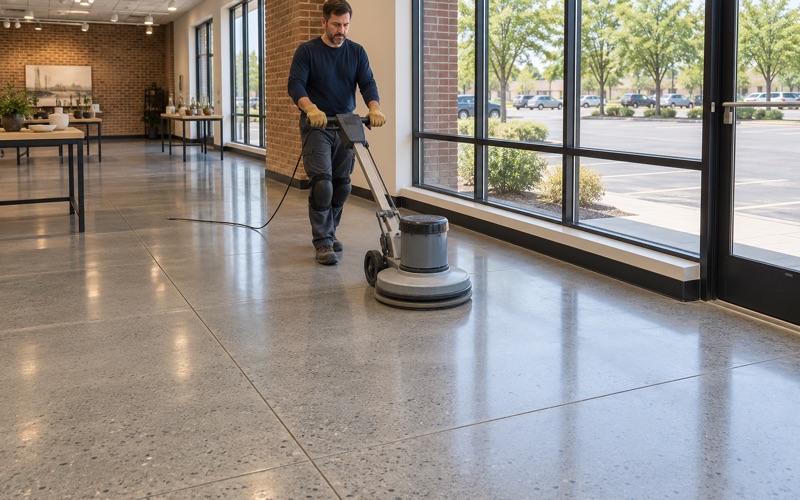
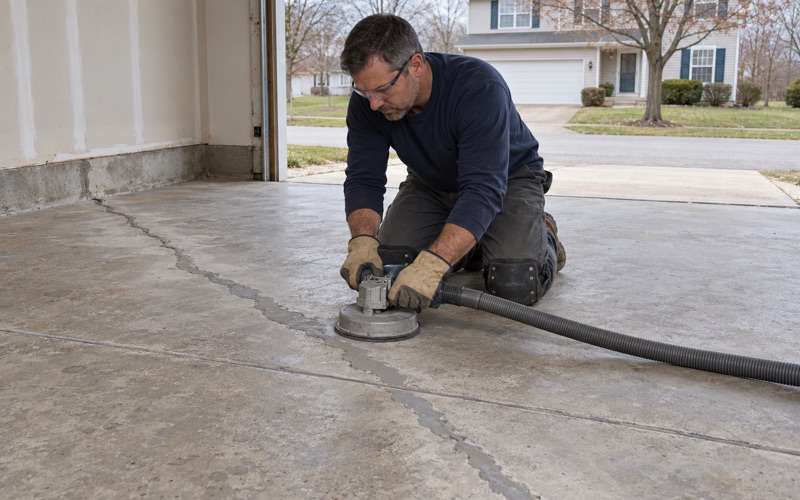
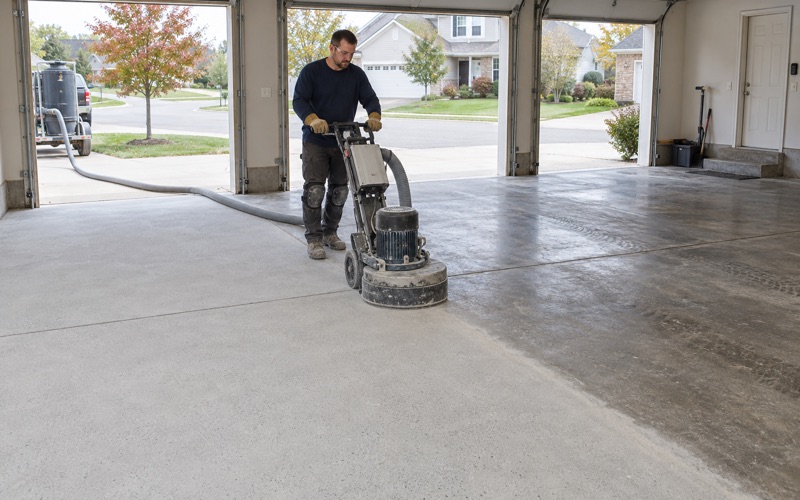
We open every slab mechanically, with a diamond grinder or shot blaster, and capture the dust at the machine instead of acid etching. That equipment draws heavy power, warms up in use and raises fine dust, which is one more reason oxygen equipment belongs well outside the room and not tucked behind plastic in a corner. Old oil and grease stains on a garage slab also have to be degreased and ground out before epoxy will bond, and those cleaners are part of why we ask.
Moving the Oxygen, Routing the Tubing and Choosing Low-Solvent Products
Before the First Work Day
At the estimate we ask where the concentrator runs, where spare cylinders are kept and whether any supply lives in the garage or basement we are coating. The family then arranges, with their supplier, a spot for the equipment outside the work room and outside the path the exhaust air will take. Moving cylinders from the garage into a hall closet would trade one problem the instructions name for another, so the new spot has to meet the supplier’s own storage rules.
We do not move, secure or adjust oxygen equipment ourselves; the household or the supplier does that, and we set the start date around it. As on any home job here, the written contract and the state’s consumer-rights pamphlet are in the homeowner’s hands before work begins.
Tubing, Doors and Air Paths
Tubing that normally crosses a mudroom or runs down basement stairs gets rerouted for the work days so no line lies near the floor being prepared or coated. We exhaust to the outdoors through the overhead door or a basement window, away from any window or door that opens into the rooms where the patient spends the day. Doors between the work zone and the house stay closed, and the crew uses the garage or an outside entrance rather than walking through the living space.
Where the concentrator shares a wall outlet circuit with the garage, we plan our power draw so the household’s equipment is never the thing that gets unplugged. Grinders and vacuums run from a circuit the family has agreed we can use, and every cord stays inside the work zone.
Low-Solvent and Water-Based Choices
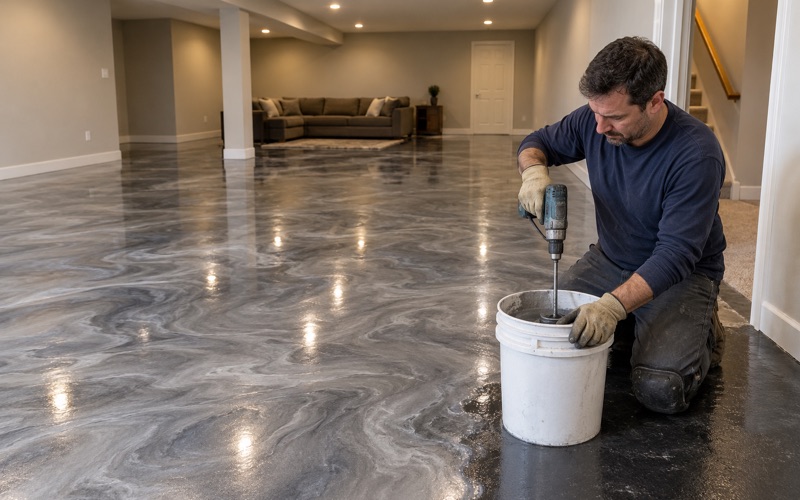
In a home with oxygen we steer the system toward water-based primers and low-odor high-solids or 100% solids epoxy body coats, and away from solvent wipes and solvent-borne primers wherever the slab does not truly require them. Every product stays within the Illinois limit on VOC content for architectural coatings, set in the Illinois Administrative Code, Part 223, which binds the applicator as well as the maker. A polyaspartic topcoat is chosen only when its odor and cure profile fit the household’s schedule.
The proposal names each product, the system build and the finished thickness, so a family can show the list to their oxygen supplier and ask questions before we arrive. To be plain about it, a floor coating does nothing for oxygen or fire safety. The product choice exists to keep solvents out of a house where the supplier has already flagged them as a hazard.
Winfield Slabs and When the Floor Can Hold Equipment Again
The Typical Winfield Garage
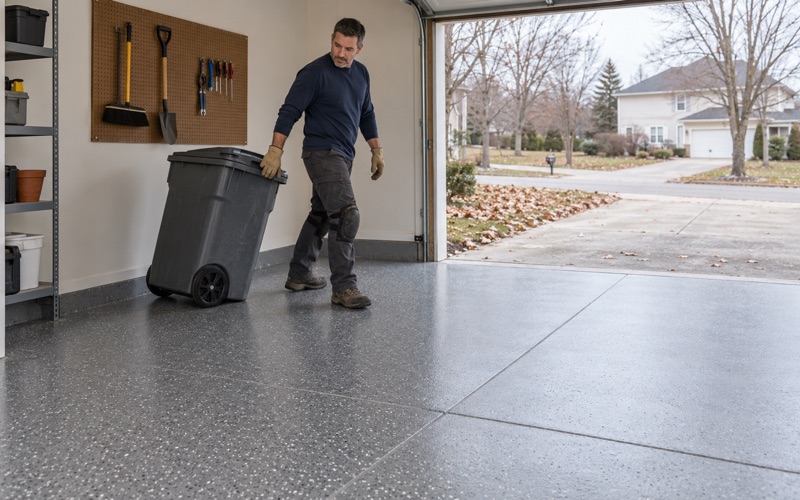
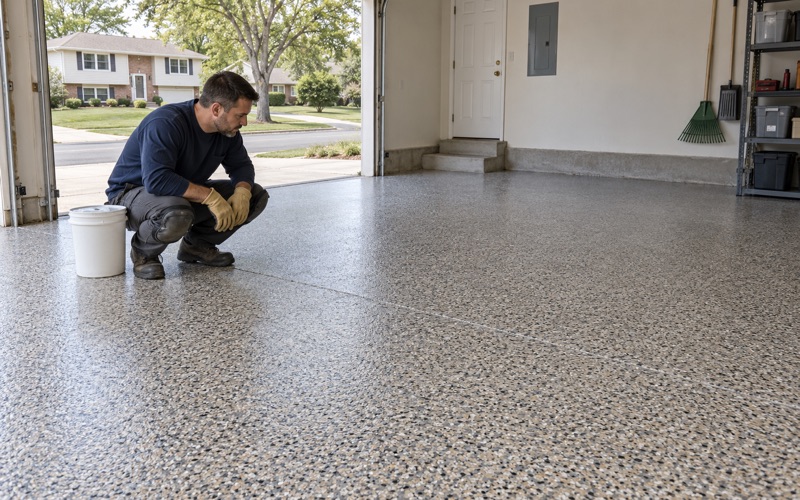
About two thirds of Winfield’s homes were built in 1980 or later, and the 1980s are the single largest decade, so the common first coating here goes onto a builder-grade slab 35 to 45 years old. Roughly one owner-occupied home in five is a townhome, where a shared-wall garage may need an association’s approval before an outside crew starts. We read the cracks, joints and any old coating before we price the job, and if a slab needs repair first, we say so.
The Village of Winfield requires contractors to register before working in the village, and we confirm that registration before a job is scheduled. Fire code questions belong to the Winfield Fire Protection District, a separate special district rather than a village department.
Moisture First, Then Cure Time
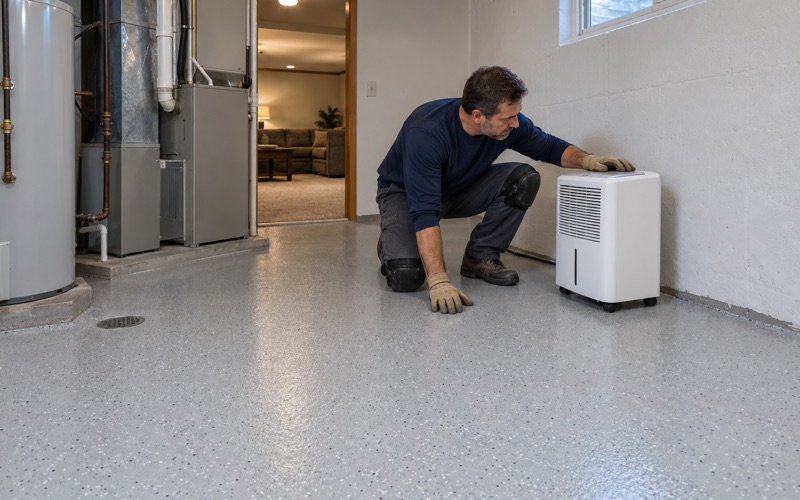
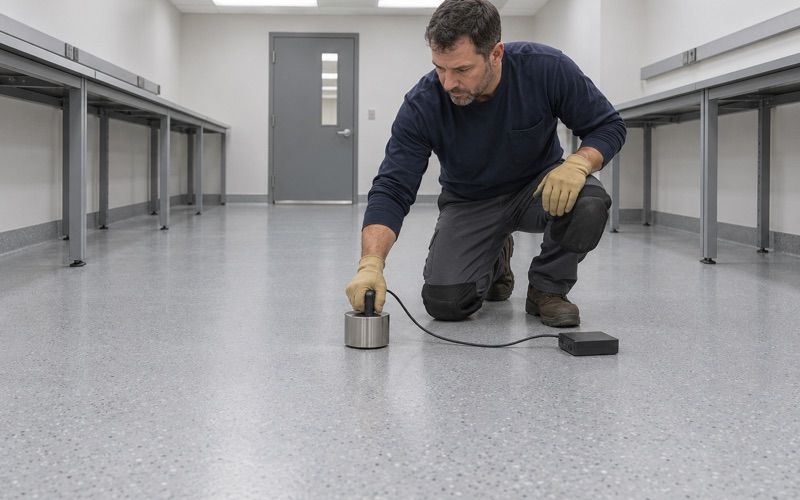
Moisture testing is a line item on every garage and basement slab we quote, because a damp slab under a sealed coating blisters no matter who lives upstairs. With the DuPage River running through the village, basement work starts with where any water is coming from, and we tell homeowners that a coating is not waterproofing. Curing is scheduled against slab temperature and dew point, and in an unheated garage in deep winter the honest answer is sometimes spring.
Putting Equipment Back on the New Floor
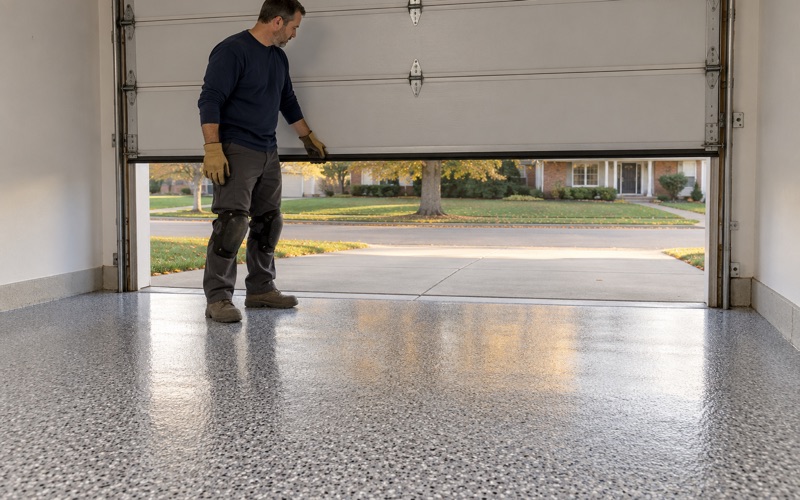
No cylinder, cart or concentrator goes back onto the floor until the maker’s full cure time has passed, which runs well beyond the point where the surface can be walked on. A cart’s small wheels and a cylinder base press a lot of weight into a small area, and a coat that is still curing will take the mark. We give the family written dates for light foot traffic, for storing equipment and for parking a vehicle.
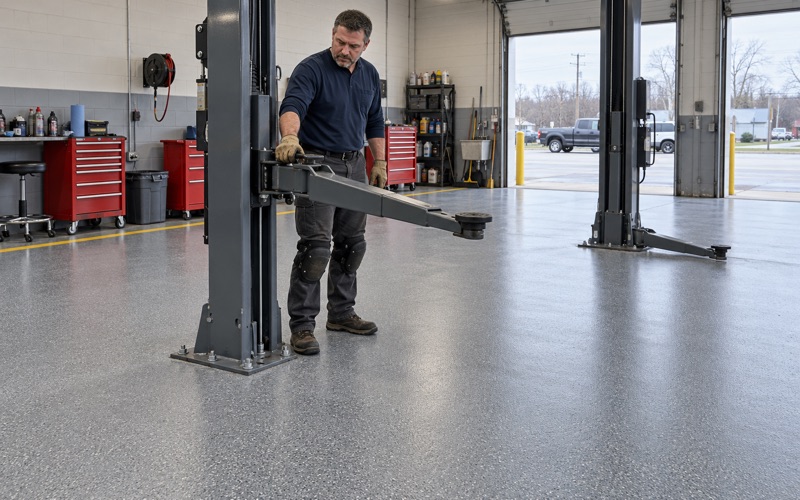
When the oxygen equipment returns, it goes back under the supplier’s rules, not ours: secured, five feet from heat, and away from the gasoline can and the paint shelf. A smooth, sealed floor is easier to sweep and keeps a garage tidier, but it is still only a floor. The oxygen instructions decide where everything sits.
- 20+ Years on Local Concrete
- Moisture Testing in Every Scope
- Written Per-Square-Foot Quotes