Crystal Lake Epoxy Flooring brings more than 20 years of work to epoxy-flooring in Wauconda, and some of the most useful advice we give starts with where a coating should not go. A building is rarely one floor. It is a set of rooms with different jobs, and some of those jobs are better served by wood that can be screwed into, patched and repainted than by a hard resin film.
That split matters most in rooms that many different people use. A shared space takes hard treatment from people who will never see the invoice, so its floor has to be planned for the roughest user rather than the most careful one. Getting the material right for each surface is cheaper than repairing the wrong one every season.
This page follows one example of that thinking through a single building type: a school auditorium that is also rented out, the stage at its center, and the concrete behind the curtain. The same reasoning carries straight into a home garage or basement workshop, which is where most of our residential calls begin.
A Community Auditorium and What Its Stage Floor Is Built to Take
One stage, many crews
Wauconda is a Lake County village of 14,084 residents as of the 2020 census, and its public high school is part of Wauconda Community Unit School District 118. Wauconda High School, at 555 North Main Street, posts auditorium rental information on its school page, with rental fees and the district rental contract linked for groups that want to book the room. The district also lists its own theatrical and musical events, so the auditorium serves both the school’s productions and community rentals.
We have not read those rental terms or seen the stage, and the district is not a customer, so what follows describes how rooms like this generally work. A stage used this way sees a steady turnover of crews. A school production builds a set and strikes it, an outside group loads in for a weekend, and a concert follows with its own gear and layout.
A floor meant to be used up
Theater technicians treat the top of a working stage as something designed to wear out. A technical director writing in 2013 about laying a Masonite deck called the tempered hardboard top layer, on stages that will have many sets built on them, a sacrificial top layer that is inexpensive, flat and durable. He painted the sheets on both sides, held them down with few nails, and replaced the entire top layer of his main venue after 11 years of heavy use.
An Illinois district’s own board memo describes the same approach. In July 2022, Glenbrook High Schools District 225 wrote that the old stage at Glenbrook South had worn from the various stage sets screwed into the base over time, and recommended a hardboard face laminated to a plywood substrate so set pieces could be secured without damaging the surface. The memo adds that the new deck is painted black and can be repainted as needed. That is another school in another town, but it shows what a stage floor in a hard-working auditorium is meant to be.
Looking for epoxy-flooring closer to Pingree Grove? See Epoxy-Flooring Services in Pingree Grove.
Why the Stage Deck Stays Wood and Stays Repaintable
Screws in, screws out
The whole purpose of a hardboard-on-plywood deck is that it accepts fasteners and gives them back. A set wall is screwed down for a run and unscrewed at strike, and the holes are filled and painted over before the next show. When a sheet is too chewed up to keep, it is lifted out and a new one goes in without disturbing the rest of the stage.
Flat black paint is the other half of that system. A stage floor is painted to disappear under the lights, and it gets rolled again whenever scuffs and spilled scenic paint build up. A wear surface that a crew can refresh in an afternoon with ordinary paint and a roller is doing exactly the job it was designed for.
Why a resin film works against that design
A cured epoxy or polyaspartic film is a hard, continuous layer, and on concrete that is its strength. On a stage deck it becomes a liability: every screw driven through it can crack or chip the coating around the hole, and the film is built to bond once and last, not to take a fresh coat of latex every few productions. Repairing a damaged resin surface means grinding and recoating a section, which is far more work than swapping one panel of hardboard.
So when someone asks us about coating a stage, a riser or a similar wood work surface, we say plainly that it is not a resin job. We do not build stages or rigging, and we would rather point an owner back to the people who maintain the deck. Our part of an auditorium is the concrete around it.
Where Resin Does Belong: The Concrete Behind the Curtain
Scene shop and paint area
Behind a typical school stage is a scene shop, where flats are framed, lumber is cut and scenery is painted. That floor is usually bare or sealed concrete, and it takes sawdust, dropped tools, wet paint, cleanup solvents and stacked lumber. An unsealed slab soaks up every spill and sheds dust into whatever is being built on it, which is the case for a seamless resin floor in that room.
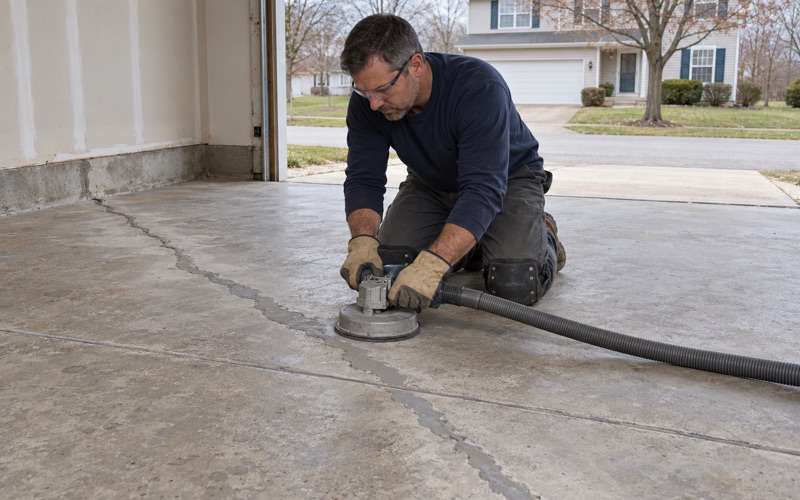
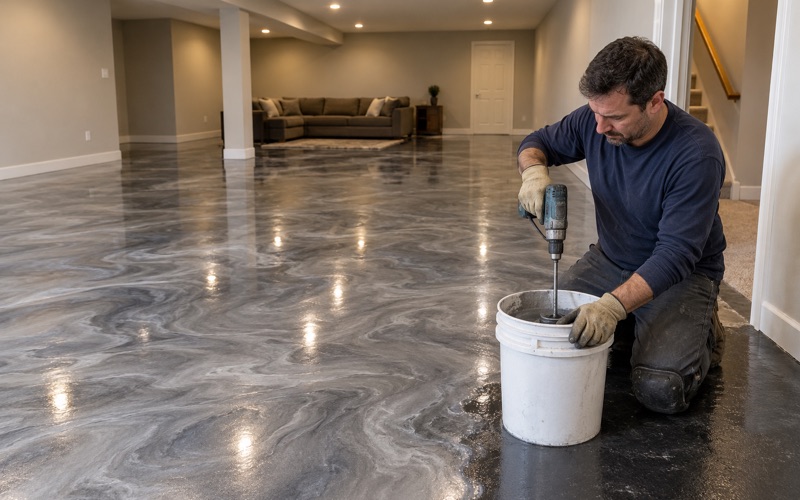
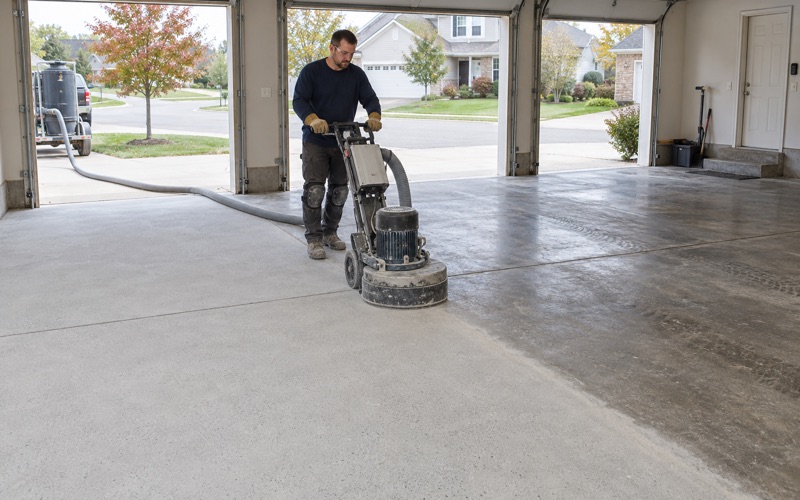
In a scene shop we would typically look at a 100% solids epoxy body with a quartz aggregate broadcast for texture, finished with a chemical-resistant topcoat. The slab is opened first by diamond grinding or shot blasting, with the dust captured at the machine, because a coating laid over smooth troweled concrete is how a shop floor starts to peel. Our written proposal names the product, the layers and the finished thickness, so a facilities manager can hold the finished floor against the quote.
Loading door and backstage halls
The loading door is where the weather comes inside. Scenery, road cases and rented equipment arrive through it, and in a Lake County winter so do slush, rock salt and calcium chloride carried in on boots. A coating at that door has to stand up to deicers and standing meltwater, and it needs enough grit in the topcoat to stay walkable when it is wet.
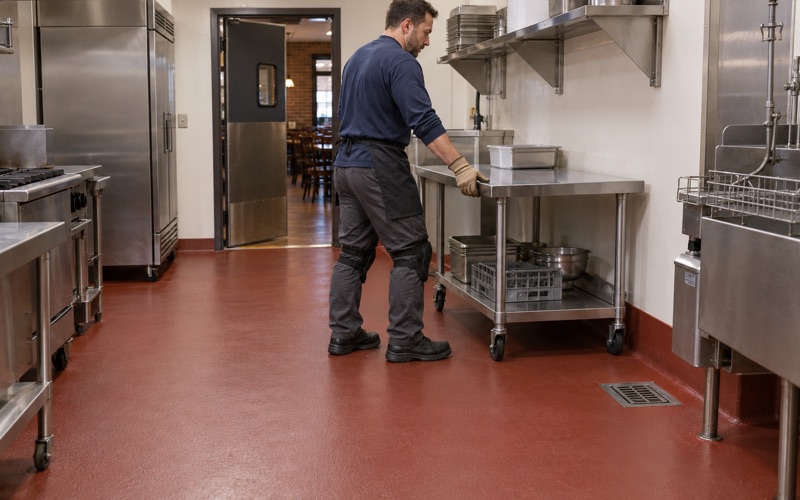
Backstage corridors and dressing rooms see lighter but constant traffic: quick costume changes, makeup spills, cleaning crews and performers moving fast in low light. A light-colored, seamless floor there is easy to mop, shows what has been spilled, and makes the edge of a step or doorway easier to see. The custodial and storage rooms nearby hold paint cans and cleaning chemicals, and they earn the same sealed surface.
Working around a busy calendar
An auditorium that serves both a school and outside renters rarely sits idle for long. Floor work behind the stage has to fit between productions, rentals and the academic year, which usually means summer, long breaks, or weekend and overnight windows. We set cure times by slab temperature and dew point rather than by the calendar, so the concrete is ready when the next crew arrives at the loading door.
The Same Split at Home: Wood Work Surfaces Over a Coated Slab
Benches, platforms and the garage floor
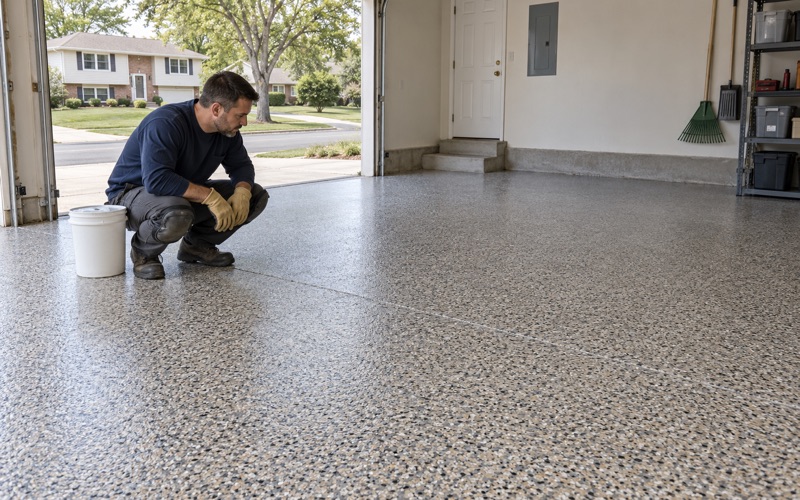
About three in four occupied homes in Wauconda are owner-occupied, and in many of them a garage or basement doubles as a workshop. The question in that shop is the same one an auditorium raises: which surfaces are meant to be worked on, and which are meant to be protected. A plywood workbench top, a built-in storage platform or a child’s play stage is a wood wear layer, just like a theater deck.
Those wood surfaces should stay wood, because they take screws, clamps and paint and can be replaced when they wear out. The concrete beneath them is what gets the coating, and the order of work matters. We coat the slab first and let it cure fully, then the bench or platform goes back in, anchored through the cured film rather than set down early and coated around.
Reading the slab before we quote
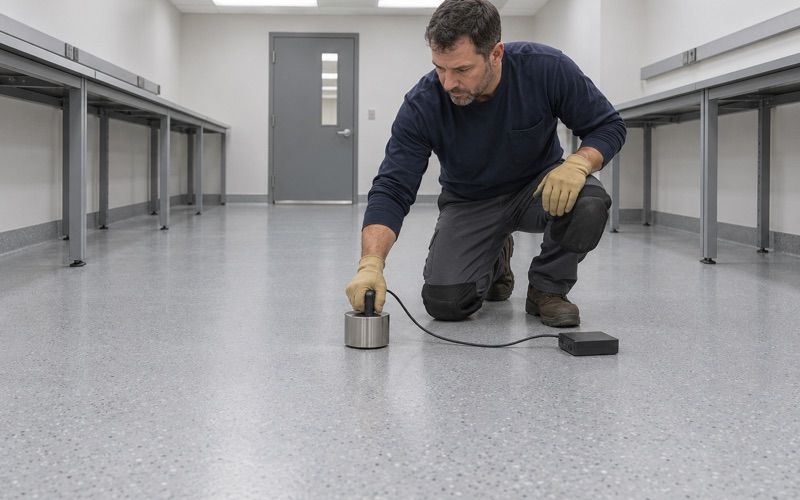
Before pricing a garage or basement shop, we look at the cracks, the joints and anything already on the concrete, and we tell an owner when the slab needs repair before it can take a coating. Moisture testing sits in the written scope from the start, since a slab that pushes vapor will lift whatever is on top of it. In a basement we begin with where the water is coming from, and we are clear that a coating does not waterproof a floor.
A home job comes with a written contract and the state’s consumer-rights pamphlet before anyone starts work. The price is per square foot for the system we actually propose, and the warranty exclusions are read aloud before the sale, with moisture first on that list. The coatings we use fall within the Illinois limits on VOC content, which bind the installer as well as the manufacturer.
Permits and paperwork in the village
Wauconda handles its own building and community development, separate from the county. Illinois issues no state license for flooring or coating work, so before a job goes on our schedule we confirm the village’s own registration, bond and insurance requirements. That check takes a phone call, and it keeps a garage floor from stalling halfway through over paperwork nobody asked about.
- 20+ Years on Local Concrete
- Moisture Testing in Every Scope
- Written Per-Square-Foot Quotes