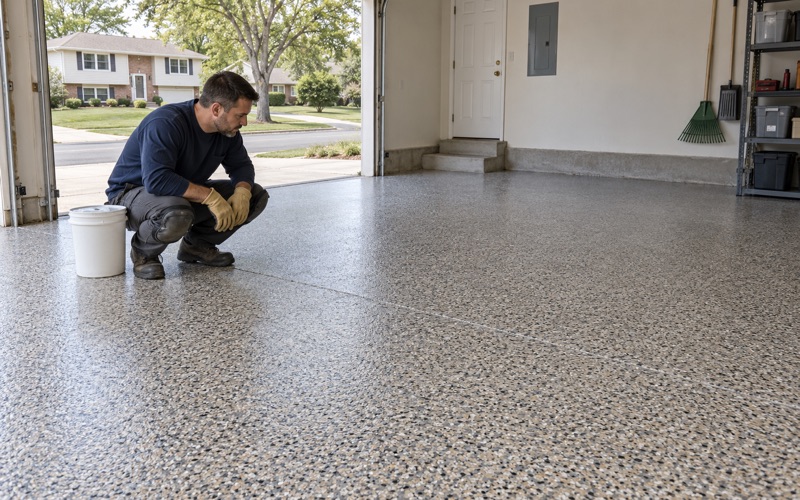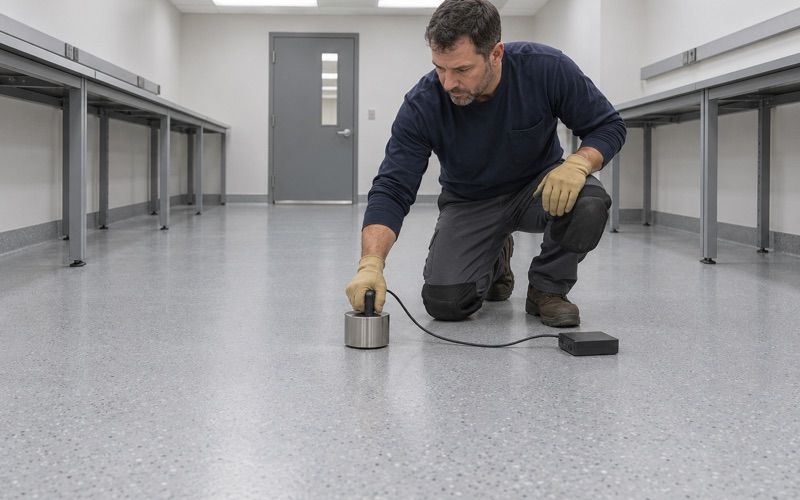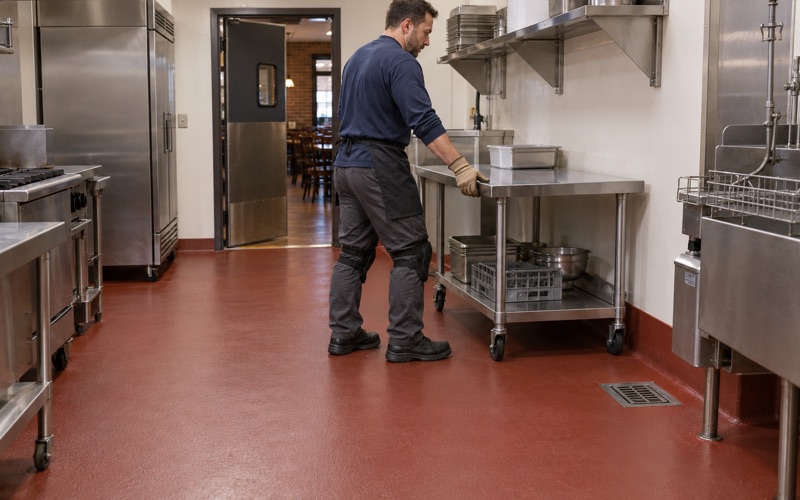
Crystal Lake Epoxy Flooring handles epoxy flooring in Warrenville with more than 20 years of slab work behind us, and on some jobs the coating is the easy part. What decides how a project runs is who will be breathing the air while the old floor comes up and the concrete is ground open. In a building where people with weakened immune systems are treated, that question outranks color, finish and schedule.
Our crews open every slab with a diamond grinder or shot blaster rather than acid, which means floor preparation always makes dust. On an ordinary garage that dust is a cleanup chore. Around people undergoing chemotherapy, the same dust is something a facility plans around before a single tool is plugged in.
This page covers how we think about that kind of work here: the medical campus that makes it a local question, what federal infection-control guidance says about floor removal, which steps of a resin job actually raise dust, and what changes when the person at risk lives in the house rather than visits a clinic. We give no medical advice, and we do not write or sign off on a facility’s risk assessment. We work inside the one the facility already has.
A Cancer Center on Weaver Parkway and Why Its Dust Rules Matter
What sits at 4405 Weaver Parkway
Northwestern Medicine Cancer Center Warrenville occupies 4405 Weaver Parkway, inside the city limits in the Naperville Township part of Warrenville. Its location page describes an infusion center with private and open chemotherapy rooms, an on-site infusion pharmacy and lab, imaging, and a radiation oncology department. The Proton Center stands in the adjacent building, and supportive oncology services sit nearby on the same parkway.
We have no relationship with the center and have not seen its floors. We name it because it makes a type of building concrete for Warrenville readers: a place where people in active cancer treatment spend long hours, and where renovation dust has to be treated as a clinical concern rather than a housekeeping one.
Aspergillus and the people who cannot clear it
Aspergillus is a common mold whose spores ride on ordinary indoor dust. The CDC Guidelines for Environmental Infection Control in Health-Care Facilities say construction, renovation and repair markedly increase airborne Aspergillus spore counts inside those buildings. Most healthy people inhale these spores without consequence.
The same guidance places patients undergoing chemotherapy in its high-risk group for aspergillosis, alongside stem cell transplant recipients and other immunocompromised patients. That is why a floor project near infusion rooms is not judged by how quiet or fast it is. It is judged by how much dust escapes the work zone.
Flooring removal is named, not implied
The CDC document does not leave flooring to interpretation. Its list of construction and repair projects that call for barrier structures includes the removal of flooring and carpeting, next to windows, doors and casework. A resin floor installed where another floor already exists begins with exactly that kind of removal.
So when a medical building decides to put a seamless coating in a utility corridor, a storage room or a service area, the tear-out and the preparation fall squarely inside the guidance. The coating itself comes much later and is far less of a concern.
Looking for epoxy-flooring closer to Lakewood? See Epoxy-Flooring in Lakewood.
Barriers, Negative Pressure and HEPA Collection
The risk assessment comes first
The guidance calls for an infection control risk assessment before repairs begin, to identify who could be exposed and how much containment the work needs. In a hospital or cancer center that document belongs to the facility and its infection-prevention staff. Our role is to read it, price the containment it requires, and follow it on every shift.
That changes how our proposal reads. Alongside the product, system build and finished thickness we already name in writing, a medical-building quote lists the barrier type, the air handling, the collection equipment and the hours we are allowed to work, so the facility can check each item against its own assessment.
Sealed walls and negative pressure
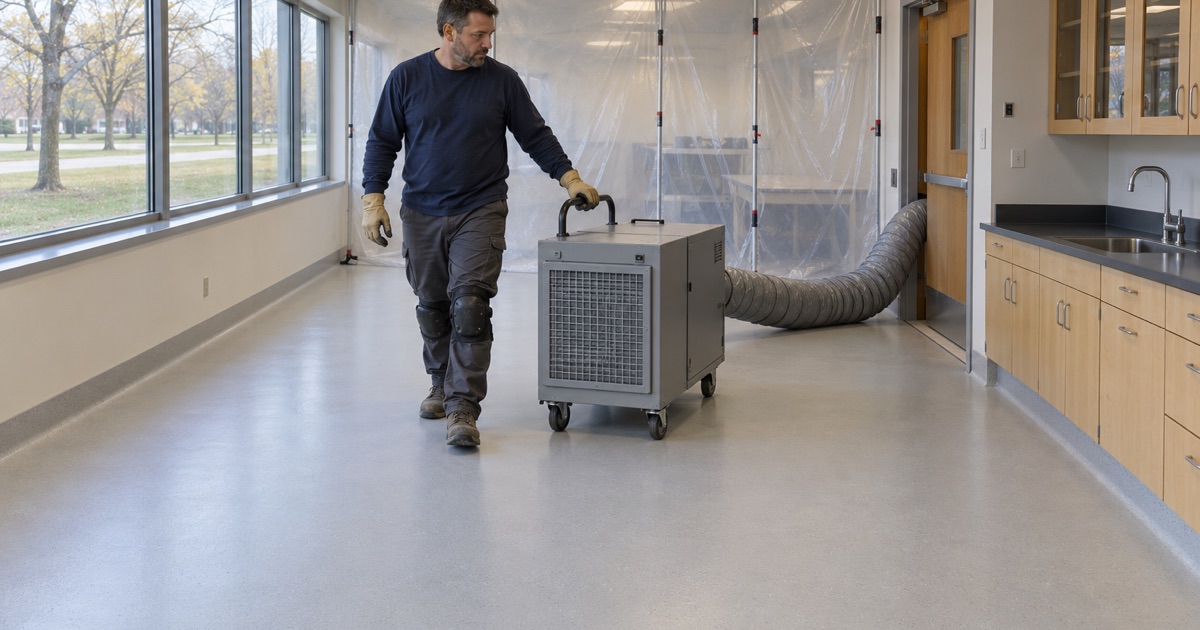
For longer projects the guidance describes rigid barriers, completely airtight and sealed from ceiling to floor. Pressure is set so the contained work area sits under negative pressure, meaning air leaks into the zone rather than out toward patient areas. Portable industrial-grade HEPA filtration runs in the construction zone or the space beside it.
In practice our crew does not simply hang plastic and start grinding. The barrier is built and inspected, the pressure differential is confirmed, and only then does the first machine start. If the facility’s monitoring shows the zone has lost negative pressure, grinding stops until it is restored.
Tacky mats, wet mops and covered carts
Dust also leaves on boots and on debris. The guidance asks for tacky mats at the construction zone entry, wet mopping of the zone and every area construction workers use, and debris that is misted and covered before it is carted away. Dry sweeping a corridor outside the barrier would undo the containment inside it.
Debris removal is timed as well. CDC says to schedule it for periods when patient exposure to dust is minimal, so our bagged material waits in the zone until corridors are empty rather than rolling past a waiting room.
Tear-Out and Grinding Are the Dusty Steps
Where the dust actually comes from
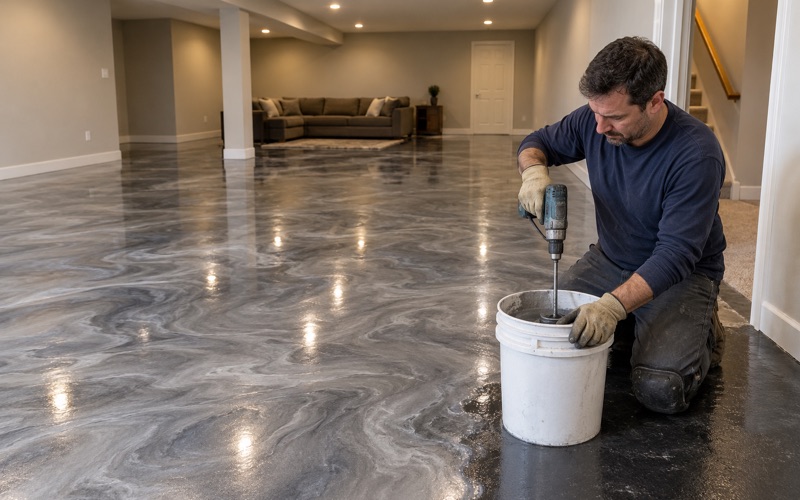
On a typical resin job, three steps make nearly all of the dust: pulling the old flooring and adhesive, grinding or shot blasting the concrete to an open profile, and routing out cracks and joints for repair. Mixing and rolling epoxy, broadcasting quartz or flake, and applying a polyaspartic topcoat produce odor and a little sanding residue, not clouds of concrete fines.
That is why we will not treat a coating job as low-risk just because the finished floor is quiet. The assessment has to be written around the loudest, dirtiest day, which is almost always the first one.
Collection at the grinder, not after it
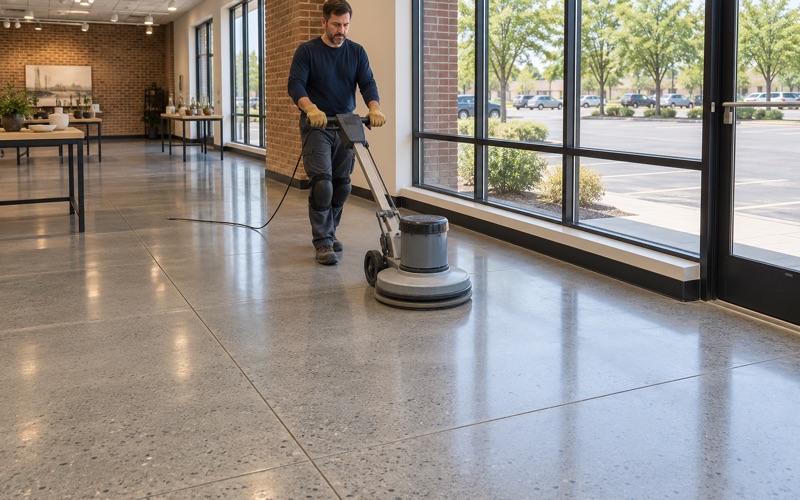
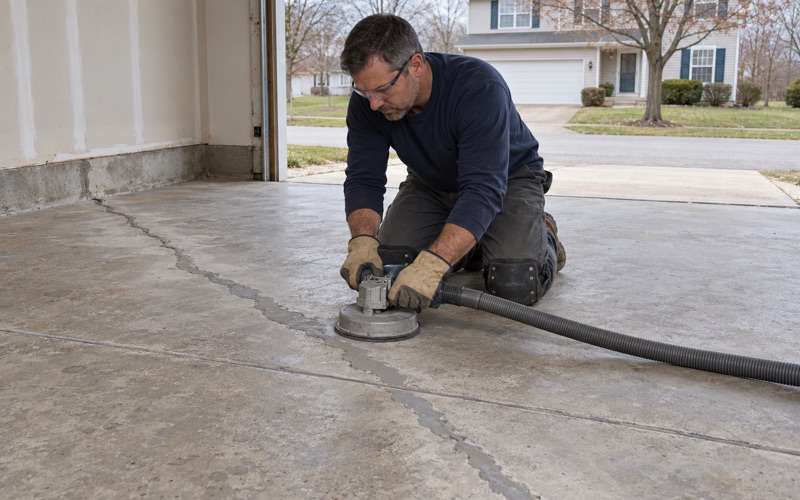
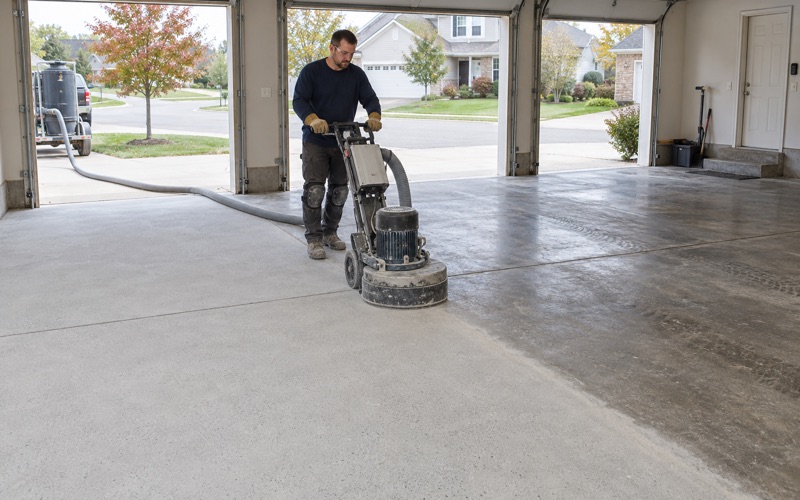
Our grinders run with vacuum shrouds feeding HEPA-filtered collectors, so dust is captured at the diamond rather than swept up later. Under negative-pressure containment that collection does a second job, keeping the load on the room’s air scrubbers low enough that they hold the zone clean. Edges and corners get shrouded hand tools rather than open angle grinders.
Collected dust is bagged inside the barrier and leaves in sealed containers. It is never washed toward a floor drain, which matters in any building but especially in one where a wet slurry can dry back into dust on the wrong side of the wall.
Fitting the work into closed hours
The cancer center’s location page lists weekday hours and says the site is closed weekends, from Friday evening until Monday morning. For a building with that pattern, the natural window for tear-out and grinding is the weekend, when no patients are in the infusion rooms. Coating can follow inside the same window if the slab is dry and warm enough to cure.
Commercial and institutional floor work in the city also passes through the Warrenville Fire Protection District, which reviews non-single-family building and occupancy permits. We confirm early what that review needs, because a closed-weekend window cannot absorb a permit question that surfaces on Saturday.
When Someone at Home Is on Chemotherapy
The same logic, a smaller room
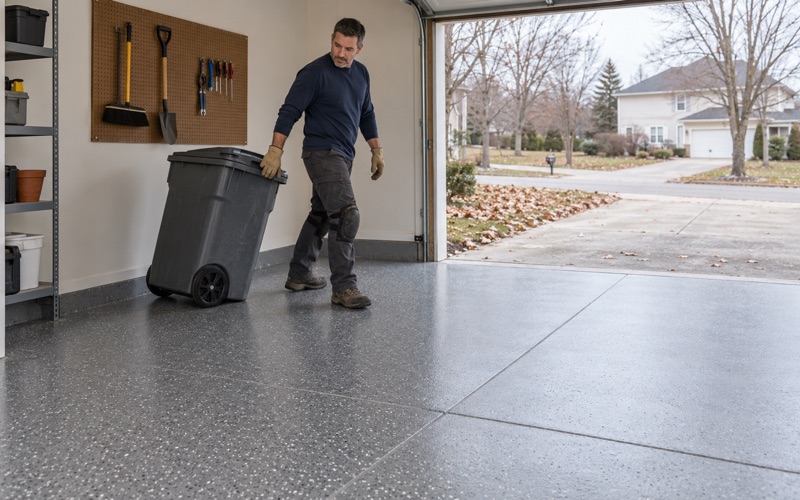
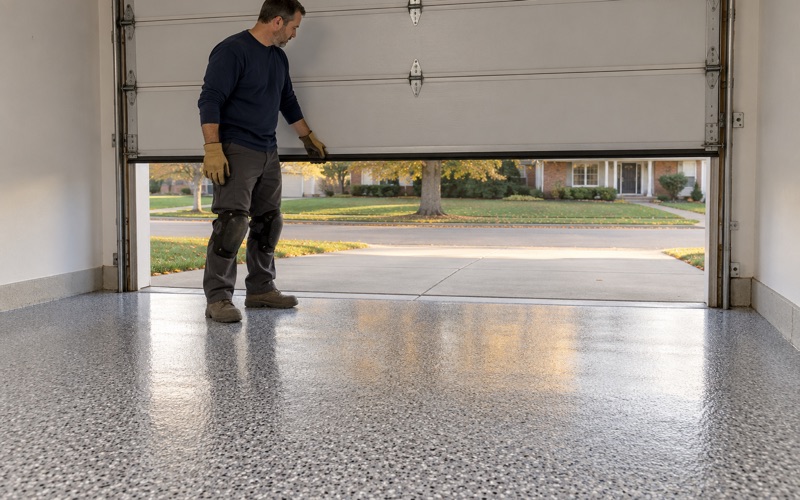
Many patients finish a day of treatment and go home to a townhome or a house with an attached garage, and Warrenville has an unusually large share of attached housing. A garage in that stock often shares a wall with the living space and sometimes with a neighbor. When a household member is on chemotherapy, grinding that garage floor deserves the same thinking as a clinic job, scaled down.
We tell homeowners plainly that we are not medical advisors and that the treating oncology team is the right source on exposure. What we can control is the dust: where it is captured, which doors stay closed and how the space is cleaned before anyone walks through it.
Containing a garage or basement job
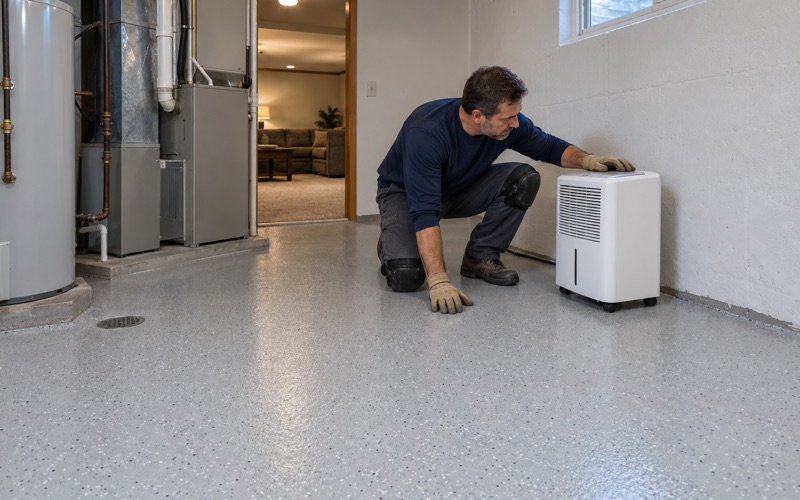
For a home job in that situation we seal the door into the house and any attic hatch with plastic and tape, run the grinder’s HEPA collector, and keep a negative air machine exhausting the garage to the outdoors while we work. A tacky mat goes at any door we must use, and the floor is wet-wiped rather than blown out at the end of the day. Basements get the same treatment, with the stairway sealed off at the top.
Timing helps too. Where possible we schedule the grinding day for when the patient can be away from the house, and we talk with the family about whether the furnace should run during the work, since a forced-air return near the garage door can pull dust inside.
What a coating will and will not do
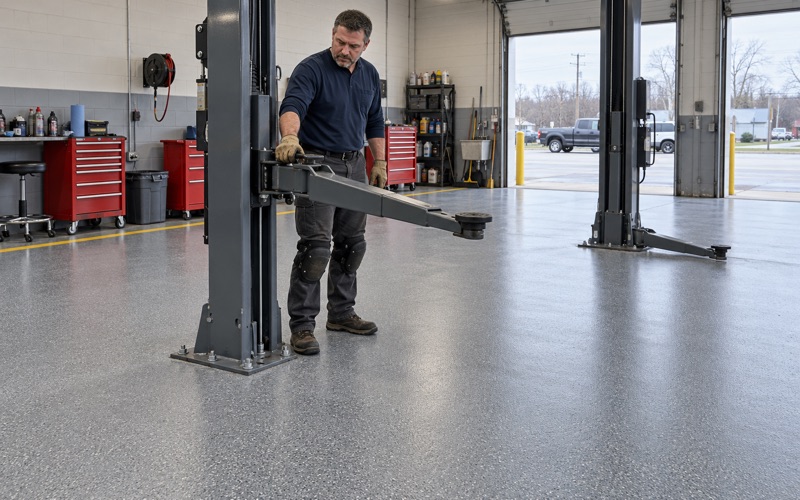
A finished epoxy or polyaspartic floor is easier to clean than bare concrete, but it is not an infection-control measure on its own. The federal guidance is about controlling dust during construction, and our job is to run the noisy part of the project so that dust stays where it belongs.
Before any home job we still hand over the written contract and the state’s consumer-rights pamphlet, test the slab for moisture, and read out the warranty exclusions with moisture first. A family with someone in treatment does not need a return visit to fix a blistered floor, so we would rather find the problem on the first one.
- 20+ Years on Local Concrete
- Moisture Testing in Every Scope
- Written Per-Square-Foot Quotes