Crystal Lake Epoxy Flooring has spent more than 20 years on epoxy flooring in Salem Lakes and the wider lake country, and the floors we think hardest about here are the ones just inside a door. An entry slab takes whatever people carry in on their shoes, their clothes and their skin. In a lake village during the summer, that list includes insect repellent, and the label on a repellent can has something specific to say about coated surfaces.
That is why this page spends less time on color charts and more on where people stand when they spray. A resin topcoat is a painted surface in the plain sense of the word, and a label that warns about painted surfaces is a reason to plan the entry rather than a reason for alarm. We build that planning into the floor layout before the first kit of material is opened.
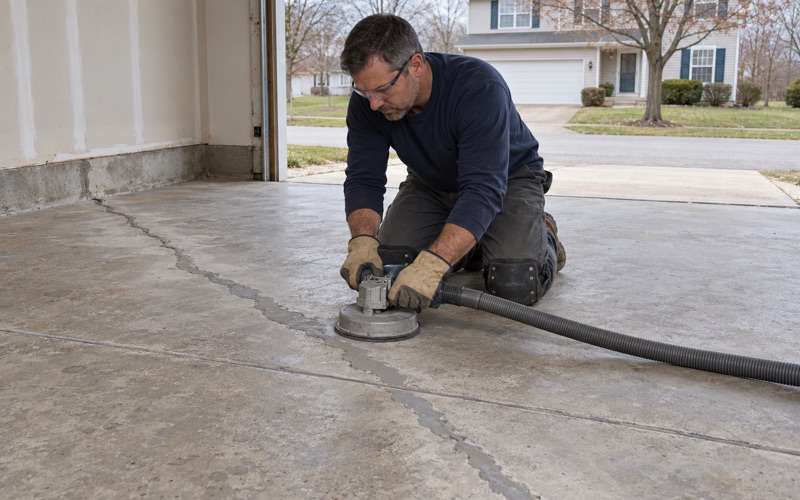
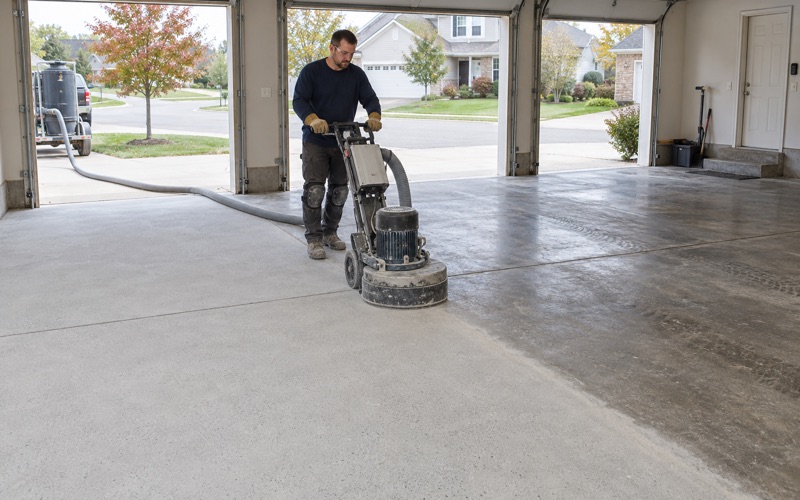
The groundwork does not change from one slab to the next. We open the concrete mechanically with a diamond grinder or a shot blaster instead of acid, carry moisture testing as its own quoted line, and write the product, the system build and the finished thickness into the proposal so the floor can be checked against the paper.
A Summer Camp on Camp Lake Road Since 1924
Wonderland’s long summers
The Salvation Army’s Wonderland Camp sits at 9241 Camp Lake Road, an address the US Census Geocoder places inside the Village of Salem Lakes. It began in 1903 as a Fresh Air Camp and officially opened on July 4, 1924, which makes it far older than the village around it. The village itself was formed only on February 14, 2017, when the Town of Salem and the Village of Silver Lake merged.
The camp describes over 700 lodging accommodations in year-round heated and air-conditioned buildings, among them Wonderland Lodge, a dining hall, the Sharp Activity Center and the Sandpiper building, now run as a hotel facility. Its 2025 summer season ran from June 10 to July 18, with a kids camp, a family camp, a teen camp and a senior camp for guests 55 and over. Teen Camp lists hiking, rock climbing and zip-lining, which is to say a great deal of time spent outdoors among the trees.
What we are and are not saying about the camp
We have never worked on Wonderland’s floors, and we have not read its rules on repellent or its housekeeping practice. The camp appears here because it shows a pattern clearly: a building full of people heading outside in June and July, many of them reaching for bug spray on the way out. That pattern repeats in lodges, retreat buildings and lake cabins across the village, and it is the pattern a floor plan should answer.
Camp buildings also run on a calendar with little slack in it. A lodge entry coated in the shoulder season has to be fully cured before the first group arrives, so we schedule cure time against slab temperature and the dew point spread at the surface rather than by counting days. When a building sits unheated through the cold months, we say plainly that the work has to wait.
Looking for epoxy-flooring closer to Sycamore? See Sycamore Epoxy-Flooring.
What a DEET Label Says About Painted or Varnished Surfaces
Reading the surface warning
A repellent label is not marketing copy; it is the registered text the EPA accepted for that product. The master label for Coleman 25% DEET Insect Repellent Spray, accepted on March 3, 2025, says the spray will not damage nylon, cotton or wool. It goes on to say it may damage some synthetic fabrics, plastics, watch crystals, leather, and painted or varnished surfaces.
Older DEET labels carry a similar caution, naming furniture finishes and painted surfaces. None of this means DEET always harms an epoxy floor, and no coating can honestly be promised immune to it. It does mean a floor that will catch repellent overspray falls in the category the label is warning about, and we treat it that way from the first site visit.
Why a resin topcoat counts
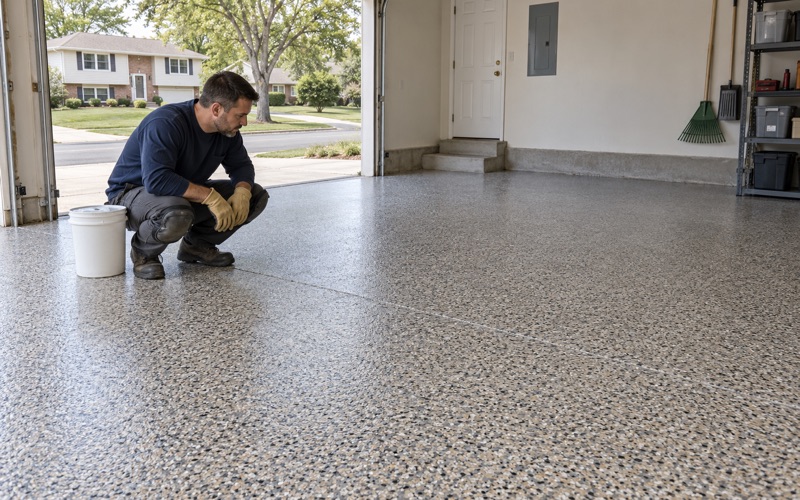
A garage or entry system usually finishes with a clear topcoat over the base coat and any vinyl flake or quartz aggregate broadcast. Whether that top layer is 100% solids epoxy, a polyaspartic or a polyurea, it is a film-forming finish lying on the concrete, which is exactly what paint and varnish are. Anything that lands on the floor meets that film first.
Chemical resistance varies by product and formulation, so we do not lean on any single maker’s chart as a general answer. The question we ask is narrower: what does the maker of the specific topcoat on this job say about DEET exposure, and if its literature is silent, what does a spot test show?
Running a spot test
Where the product data does not address repellent, we place a small amount on a cured sample board or an out-of-the-way corner of the finished floor and leave it for a set period. We then look for softening, clouding, tackiness or a loss of gloss before the entry opens to traffic. The result goes into the job notes, so the owner knows what the finish was checked against.
Outdoor Use Only: Spray Spots, Drips and Treated Clothing
Where the spray spot belongs
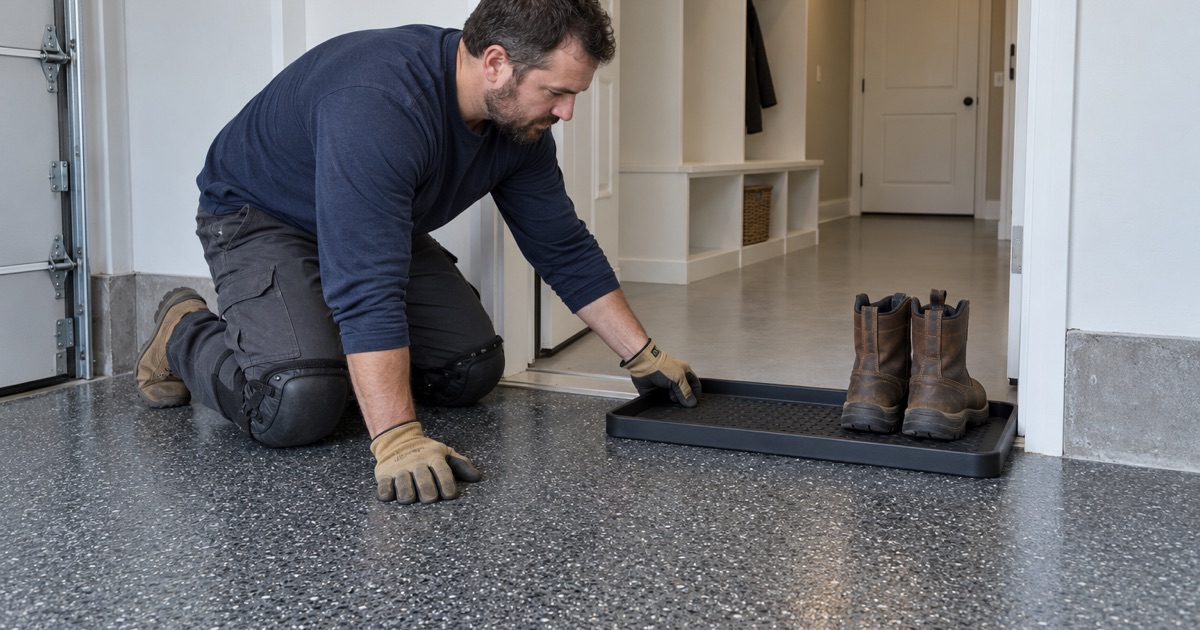
The same Coleman label is plain about location: for outdoor use only, and do not spray in enclosed areas. A floor plan that follows those words puts the spray point outside the door, on a porch or step, or at the very least on a replaceable mat instead of the coated slab. We mark that spot on the layout with the owner, along with the walk-off zone that leads from it to the threshold.
This is not advice about how anyone uses repellent, which belongs to the people wearing it and the directions on their own can. It is a decision about where the overspray lands. A mat can be swapped after a season, while a clouded patch in a topcoat means sanding and recoating a whole field so the gloss still matches.
Drips and residue at the door
Some repellent will still find the floor, carried on hands, shoes, gear bags and the hems of sprayed sleeves and pant legs. The care note we leave with a camp-style entry is short: wipe drips up when they are seen rather than letting them sit, and keep a cloth and a mild cleaner by the door for it. The longer any chemical rests on a finish, the more chance it has to mark it.
Benches and boot racks help more than people expect. When campers sit to change shoes on a bench set over a mat, the residue from treated clothing ends up on the mat rather than on the open floor. A low shelf for spray cans outside the door keeps a dripping nozzle off the coating as well.
Picking the topcoat for a repellent entry
For an entry that sees repellent all summer, the topcoat decision comes before the color decision. We name the topcoat by product in the proposal, check its maker’s guidance on DEET, and run the spot test when that guidance does not answer. Where an owner wants more margin, the entry zone can take an extra topcoat layer that is renewed on its own, shorter schedule.
None of that helps on a weak bond. The slab under an entry is ground to the ICRI CSP profile the system calls for, cracks and joints are read before we price anything, and when a slab needs repair before it can be coated, the owner hears it from us in writing.
Lake Cottages and Mudrooms: The Same Rule at Home
Seasonal homes on the lakes
Salem Lakes takes in 2.81 square miles of water, with communities such as Camp Lake, Cross Lake, Voltz Lake and Lake Shangrila inside its borders. Census estimates count 274 homes in the village held for seasonal, recreational or occasional use. A cottage mudroom or back entry lives through the same summer routine as a camp lodge, only with fewer people and a smaller floor.
A seasonal home also tends to sit unheated through the winter. A coating applied in that stretch will not cure as it should, so we plan cottage work for a window when the slab and the air can be held in range, and we tell owners plainly when a job belongs in spring.
Garages, mudrooms and walkout entries
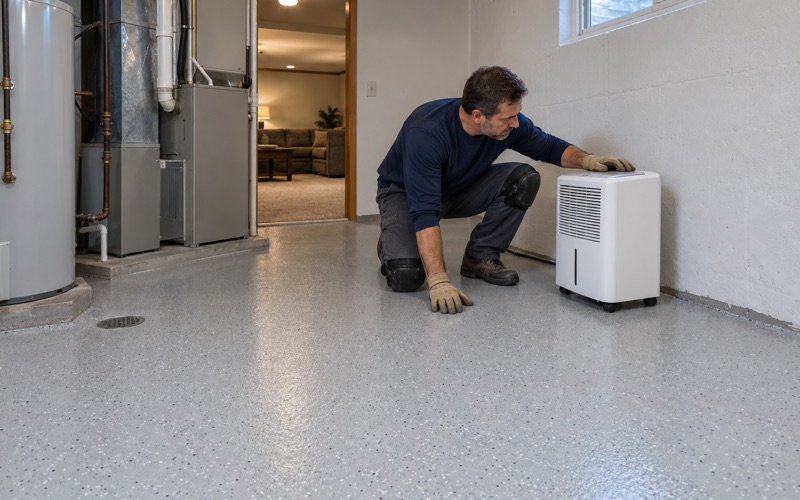
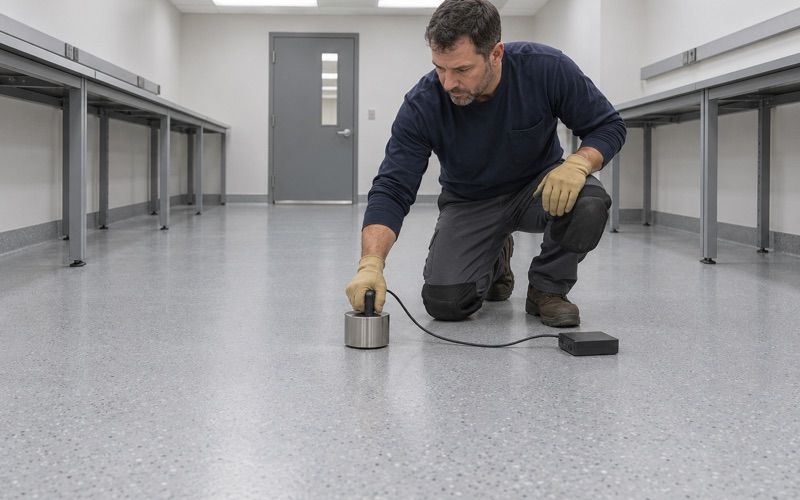
The housing stock runs wide, from 618 homes built in 1939 or earlier to 119 built since 2020, with the largest shares from the 1990s and 2000s. An older slab may have no vapor retarder beneath it, so ASTM F1869 calcium chloride testing or ASTM F2170 relative humidity probes are part of the quote rather than a later add-on. A walkout entry that takes on water is a water problem first, and a coating is not waterproofing.
The repellent rule carries over to a house unchanged. Keep the spray spot outside or on a mat, wipe drips before they sit, and confirm the topcoat against DEET before the floor goes into summer service. The village also counts 319 mobile homes, which have no slab to coat, so for those households the floor we can help with is usually a detached garage or shed on its own concrete.
Pricing, warranty and permits
We price per square foot for the system actually proposed, after seeing the slab rather than from a national garage average. Warranty exclusions are read aloud before the sale, with moisture named first, and grinding dust is captured at the grinder instead of being rinsed toward a drain or a storm inlet.
Salem Lakes sends permit applications through the Kenosha County online permitting portal, and Bluestone Inspections serves as the village’s contracted building inspector. Whether a floor coating needs any permit at all is a question we put to the village inspector rather than answer on our own.
- 20+ Years on Local Concrete
- Moisture Testing in Every Scope
- Written Per-Square-Foot Quotes