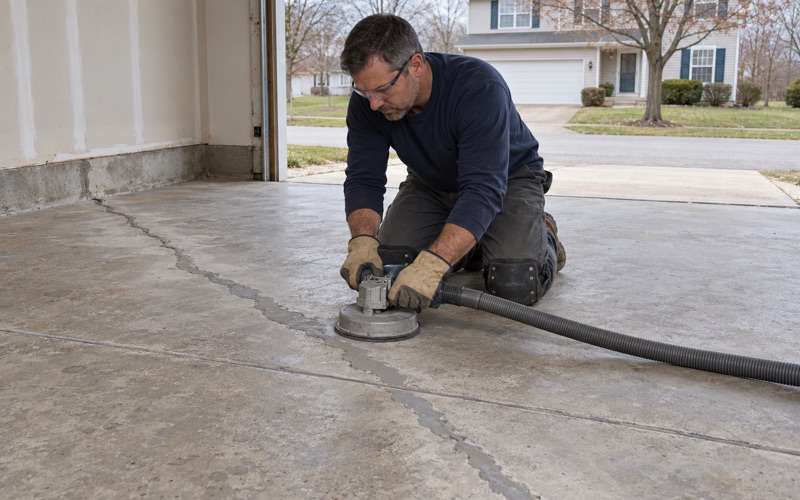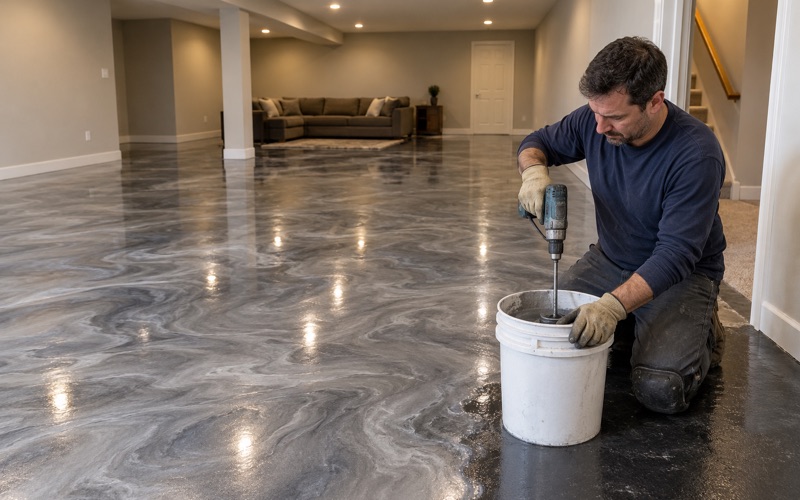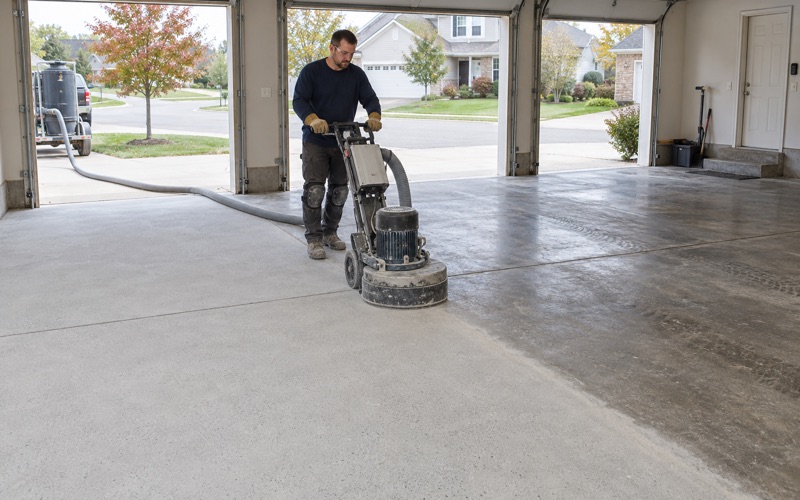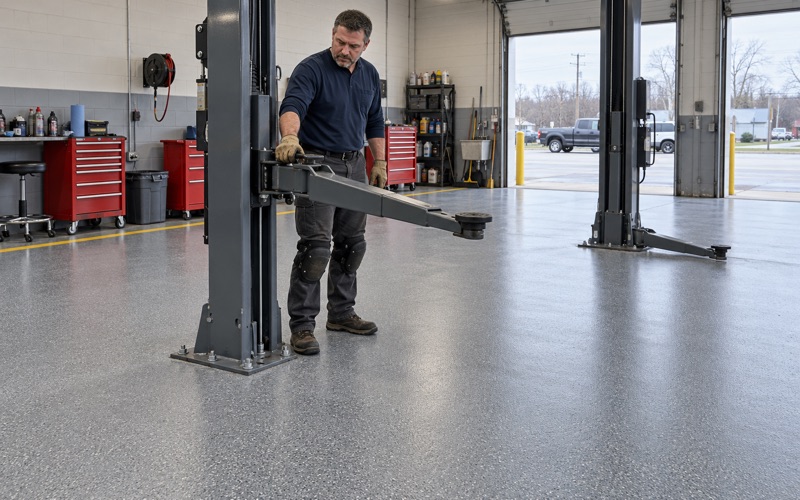
Crystal Lake Epoxy Flooring has put more than 20 years into epoxy flooring in Round Lake and across our service area, and every slab starts the same way: a diamond grinder or shot blaster opens the concrete before any resin goes down. We never acid etch, because an etched surface gives a coating far less to grip than a mechanically profiled one. Each proposal names the product, the system build and the finished thickness, so an owner can hold what was quoted up against what was installed.
Moisture testing sits in the scope as its own line, whether the floor belongs to a garage, a basement or a commercial room, and the warranty exclusions are read aloud before anything is signed, with moisture named first. We look over the cracks, joints and any old coating before we price a job, and we say so when a slab needs repair or replacement before a coating makes sense. Pricing is per square foot for the system we actually propose.
This page is about one kind of floor in particular: the rooms where people celebrate. A coated floor in a hall or party room takes a different kind of abuse than a garage does, and one of the newer sources of it is the spark machine rented for a first dance or a grand entrance. What follows covers what those machines drop, why a resin floor cares, and how we protect and repair a coated event floor around them.
A 400-Guest Hall on Railroad Avenue
Parkway Banquets Salon, downtown by the tracks
Downtown Round Lake has a banquet hall built for big nights. Parkway Banquets Salon, at 657 Railroad Avenue near the Metra line, describes capacity for 400 guests, 12-foot ceilings, crystal chandeliers and event up-lighting. The address geocodes inside Round Lake village, in Avon Township, rather than in one of the neighboring villages that share the name.
We have not worked on that hall, and we have not seen its floors or its rules on special effects. We name it because a room of that size, hosting events of that kind, shows what event floors in this village are asked to carry. A hall that seats several hundred people resets its room again and again across a season, and the floor absorbs every setup and every teardown.
Weddings, quinceaneras and the moments families plan around
The hall gives weddings and quinceaneras their own sections and also lists birthdays, anniversaries, showers, reunions, sporting banquets and holiday parties. Those are the events where families tend to want one moment that photographs well. Across the event business, cold spark machines have become a common way to produce it, set on the floor beside the couple or the honoree as the music starts.
That is a general observation about events, not a statement about any Round Lake venue. Whether a given hall permits spark effects is a question for the venue, its effects operator and the local fire authority, the Greater Round Lake Fire Protection District, and we give no advice on it. Our part is narrower: making sure a coated floor in an event room is built and kept for whatever might land on it.
Looking for epoxy-flooring closer to Fox Lake? See Fox Lake Epoxy-Flooring.
What a Cold Spark Machine Drops, and Why Resin Cares
Hot granules, whatever the name suggests
The word cold in the product name describes a marketing category, not a temperature. One maker’s manual, for the SparkOne machine, calls these units pyrotechnic simulators, tells anyone near the fallout area to wear safety glasses and says the sparks should never be touched. It puts the audience 12 to 15 feet back and asks for flammable materials to be kept 15 feet away.
A second maker’s manual, for the ML-CS01 machine, asks for no flammable material within 1 meter of the unit. The distances differ between brands, but both manuals treat what falls out of the machine as hot. Spark material that lands, rolls and comes to rest is the part a flooring contractor has to plan for.
Why a resin floor counts as a flammable surface
An epoxy, polyaspartic or polyurea floor is an organic polymer film bonded to concrete. That makes it the kind of material the manuals mean when they say to keep flammable materials away, even though the slab underneath will not burn. A hot granule resting on a coating can leave a dull spot, a brown scorch or a small pit in the topcoat.
No floor coating is fireproof, and we do not sell any system as fire-rated. Switching to a different resin does not change the basic fact that a hot particle sitting on a polymer film can mark it. The sound plan is to keep the fallout off the coating altogether rather than pick a product and hope.
Sand or a Class D extinguisher, never water
The SparkOne manual is specific about granules that ignite: put them out with a Class D extinguisher or sand, and do not use water-based or ABC extinguishers. We repeat that as what the manufacturer wrote, not as fire-safety guidance of our own. For the floor, it means the response to a burning granule puts sand or extinguishing agent on the surface, one more reason to keep the whole zone on something other than the finished coating.
Noncombustible Pads and a Fallout Zone Off the Coating
A plate under every machine
On a coated event floor, the machine should stand on a noncombustible pad or plate rather than directly on the resin. That keeps the base of the unit, where material collects first, from sitting on the polymer surface for the length of a reception. A pad also spreads the load of the stand, so its feet do not press into the finish.
The pad needs to reach well past the machine’s footprint to catch what drops closest. A steel sheet or a cement board panel fits the idea, while carpet scraps and vinyl runners do not, since they are flammable materials in their own right.
Laying out the fallout area before guests arrive
Beyond the plate, the fallout area itself can be covered with a sacrificial mat or temporary noncombustible panels so granules land there instead of on the coating. Setting this out before the room is dressed is far easier than squeezing it in after tables and linens are placed. A simple floor plan showing where machines and coverings go lets the next crew repeat it.
For a hall owner, this becomes part of the room’s setup routine rather than a special request. The cost is a few minutes and a stack of panels, and the alternative is a ring of marks around the head table that shows up in every later photograph.
Building a coated floor for a room that hosts events
When an event room is coated in the first place, we size the system to the traffic it will really see: rolling carts, table legs, chair glides and catering spills, plus whatever an effects operator brings in. That usually points to a 100% solids epoxy body under a polyaspartic or polyurea topcoat, with a quartz aggregate broadcast where slip resistance matters near a bar or a service door. The proposal states the finished thickness, which is exactly what a future spot repair has to match.
A commercial room that has to stay booked cannot lose a Saturday to its floor, so we schedule grinding and coating around the calendar, including overnight and weekend windows. Dust from the grinder is collected at the tool and never swept or washed toward a floor drain.
After the Event: Sweeping Granules and Spot-Repairing a Scorch
Let it cool, then sweep dry
Once the machines are off and cooled, any granules that escaped the covering should be swept or vacuumed up dry. Mopping first drags grit across the topcoat, and grit under a mop head is how a gloss floor collects fine scratches. A flashlight held low across the floor shows where anything landed outside the zone.
The panels and pads should be lifted away with their load rather than dragged across the finished floor. Any spot where a granule sat is worth noting for the next walk-through, since a scorch caught early is a smaller repair than one that has been walked on for months.
A spot recoat instead of a permanent mark
A scorch in a topcoat is a repair, not something to live with. We abrade the damaged area and a margin around it, clean it and apply a matching topcoat, and when the mark reaches into a broadcast layer we rebuild that layer first. Because the original proposal named the product and thickness, the patch is built to the same system rather than guessed at.
Where a room has gathered many small marks over a busy season, a full topcoat refresh across the floor can make more sense than a scatter of patches. We look at the whole floor and tell you plainly which of the two it needs.
Which Round Lake rules apply to the job
Round Lake, Round Lake Beach, Round Lake Park and Round Lake Heights are four separate villages, and a Round Lake mailing address does not settle which one a building sits in. Each village runs its own building department, so we check the address against the Census geocoder before assuming which rules apply.
Illinois licenses no flooring or coatings contractor, so we confirm the Village of Round Lake’s own registration, bond and insurance expectations with its Building Department at 442 North Cedar Lake Road before a job is scheduled. A home job also comes with a written contract and the state’s consumer-rights pamphlet before work begins, as the Illinois Home Repair and Remodeling Act requires.
- 20+ Years on Local Concrete
- Moisture Testing in Every Scope
- Written Per-Square-Foot Quotes