Crystal Lake Epoxy Flooring installs polyaspartic floor coating systems in Crystal Lake, IL, serving surrounding cities including Lakewood, Lake in the Hills, Cary, Algonquin and Fox River Grove. After more than 20 years of coating local concrete, we use polyaspartic where its strengths matter most: fast cures, resistance to abrasion, and color that holds up under sunlight.
Polyaspartic coatings are often marketed as a miracle product, and they are genuinely good at several things. They also cure so quickly that there is less time for the coating to soak into the concrete, which makes preparation even more important than it is with epoxy. A polyaspartic applied over a poorly prepared slab fails faster, not slower.
So our polyaspartic floors start the same way all of our floors do: diamond grinding, crack repair, moisture testing and a written proposal that names the products, the layers and the finished thickness. The price is per square foot for your floor, based on what the slab actually needs.
What a Polyaspartic Floor Coating Is
The Chemistry in Plain Terms
Polyaspartic coatings are a family of aliphatic polyureas. Two components react with each other when mixed and form a tough, flexible film. The reaction is slowed just enough that crews can roll and squeegee the material by hand instead of spraying it with heated equipment.
The result is a coating with high abrasion resistance, good chemical resistance and a surface that stays clear and glossy. Those properties make polyaspartic a natural topcoat, and with the right primer it can also serve as a base coat.
Short Pot Life and a Fast Cure
Once mixed, a polyaspartic has a short working time, often measured in minutes rather than the longer windows epoxy allows. Crews work in small batches and keep a steady pace across the floor so every section goes down while it is still workable.
The upside is speed. Layers can often be recoated within hours, and floors return to service much sooner than a multi-day epoxy system. That is why polyaspartic is popular for garages people need back quickly and for businesses that cannot close for long.
Holding Color Under Ultraviolet Light
Most epoxies yellow, or amber, when sunlight reaches them over time. Aliphatic polyaspartics resist that ambering, keeping light colors light and clear topcoats clear.
For a garage that faces south with the door open half the summer, or a showroom with a wall of windows, that difference shows within a season or two. It is the main reason a polyaspartic topcoat is part of nearly every garage system we install.
Residential Polyaspartic Floors
Garage Floors With a Quick Turnaround
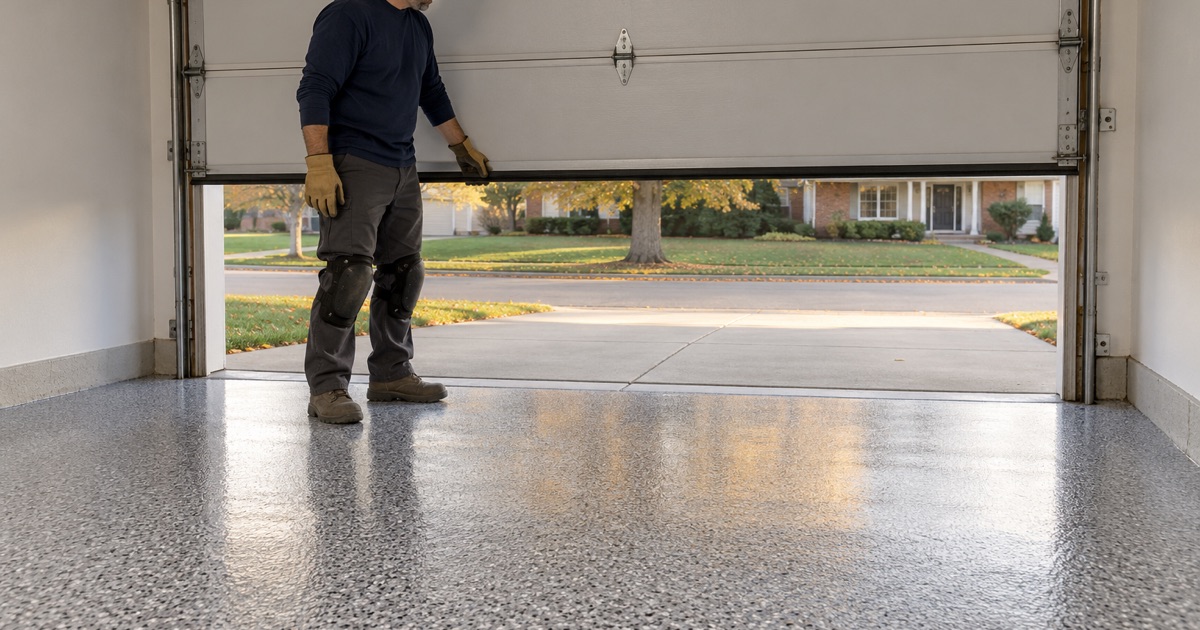
In a garage, polyaspartic is most often used as the topcoat over a flake broadcast, and sometimes as the base coat as well. The combination gives a floor that resists hot tire pickup, sheds brine from winter driving and is ready for vehicles sooner than an all-epoxy system.
A garage with a sound slab and minor repairs can sometimes be finished in a single day. When cracks, old coatings or moisture need more work, we add the time it takes rather than squeezing it into one day for the sake of a slogan.
Basements, Laundry Rooms and Workshops
Polyaspartic topcoats suit basements and utility rooms that need a durable, easy-clean surface. A workshop floor gets resistance to dropped tools, solvents and dragged equipment, and a laundry room gets a seamless surface that wipes up spills.
Basements come with one firm rule, though. Moisture is tested before anything is applied, and a basement with active water coming through the slab is fixed at the source first. No polyaspartic, however tough, holds against water pushing up from below.
Commercial Polyaspartic Coatings
Fast Return to Service
For businesses, every hour a floor is out of service costs money. Polyaspartic systems let us coat a shop, showroom or service area overnight or over a weekend and have it back in use far sooner than an epoxy system that needs a long cure. We phase larger floors so part of the building stays open, and we plan the work around the hours the business has to run, including nights and weekends.
Topcoats Over Epoxy for Heavy Wear
In commercial spaces we often build the body of the floor with a 100% solids epoxy, which adds thickness economically, then finish it with a polyaspartic or polyurea topcoat. The topcoat handles abrasion, ultraviolet light and chemicals, and it can be renewed later without removing the whole system.
That layered approach gives each chemistry the job it does best. It is also easier to repair, because a worn traffic lane can be scuffed and recoated rather than ground back to bare concrete.
Showrooms, Lobbies and Retail Floors
Showroom and retail floors are judged on looks as much as wear. Polyaspartic topcoats keep a high gloss, resist the black marks that rolling carts and shoes leave behind, and stay clear under bright lighting and large windows.
We can pair them with flake, quartz or metallic base coats to create the look a space needs, then finish with a satin or gloss topcoat depending on how much shine the owner wants.
Where Polyaspartic Needs Extra Care
Preparation Matters Even More
Because polyaspartic sets so quickly, it has less time to flow into the pores of the concrete than an epoxy does. That makes a clean, open surface profile from diamond grinding essential, and it is why many systems use a penetrating epoxy primer before the polyaspartic layers.
Acid etching and a quick roll-on application are where the bad reputation of fast coatings comes from. Our process grinds every slab mechanically to a measured profile before any coating touches it.
Moisture, Temperature and Dew Point
Polyaspartic can cure at lower temperatures than most epoxies, which helps with garage work in spring and fall. It is also sensitive to humidity and to a slab close to dew point, which can cause bubbling or a weak bond.
We measure slab temperature, relative humidity and the dew point spread before mixing. In a McHenry County winter, an unheated garage may still need to wait for warmer weather, and we say so in the quote.
What ‘Stronger Than Epoxy’ Leaves Out
You will see polyaspartic sold as many times stronger than epoxy. Strength in one test does not mean a floor will last longer, because nearly every coating failure starts with preparation, moisture or thickness, not with the chemistry of the topcoat.
We would rather show you the system build, the thickness and the warranty exclusions, with moisture named first, than lean on a slogan. Those details decide whether a floor lasts.
Our Step-by-Step Polyaspartic Coating Process
Step 1: Inspection and Moisture Test
We inspect the slab, map cracks and old coatings, and run moisture tests. The written proposal then lists every layer and its thickness.
Step 2: Grinding and Repair
The floor is diamond ground with dust collection. Cracks and spalls are then repaired with fast-setting fillers compatible with the system.
Step 3: Primer and Base Coat
A penetrating primer goes down first. The base coat and any flake or quartz broadcast follow while conditions are right.
Step 4: Polyaspartic Topcoat
The clear polyaspartic topcoat seals the system. We explain cure times and care before the floor goes back into use.
- 20+ Years on Local Concrete
- Moisture Testing in Every Scope
- Written Per-Square-Foot Quotes