Crystal Lake Epoxy Flooring brings more than 20 years of slab work to epoxy-flooring in Pingree Grove, and the floors we plan most carefully here are the ones that hold bags of lawn product. A garage that parks two cars all winter and stacks fertilizer every April is asking more of its concrete than it looks. We plan that floor around what the bags do to it, rather than around a color chart.
The chemistry is simple enough to explain on a driveway. Granular fertilizer sitting dry on a slab does very little, while the same product dissolved in a puddle carries salts that work on the cement binding the concrete together. So the jobs we quote here start by asking where the bags sit, how spills get cleaned up, and which joints a wet tire crosses on the way in.
What follows covers the supply side of lawn care in the village, what wet fertilizer does to bare concrete, the storage habits that matter more than any coating, and how we approach a garage in one of the newer subdivisions. Our quote names the product, the system build and the finished thickness, so the floor you receive can be checked against the floor you were sold.
A Turf and Fertilizer Supply Yard on Bell Road
A wholesale branch in the industrial area
SiteOne Landscape Supply lists a branch called Pingree Grove IL #22 at 900 Bell Rd, in the industrial area along Bell Road inside the village limits, in Rutland Township of Kane County. Its store listing describes a full line of professional-grade seed, fertilizer and control products. The branch is a wholesale supplier to landscape professionals.
We have no relationship with that yard and have never seen its floors or how its product is stored. It matters to this page for a simpler reason: a professional fertilizer supplier in town means a steady flow of turf product moving into contractors’ trucks, shop bays and, by way of those contractors and the big-box shelf, into home garages across the village.
A village that grew up on new lawns
Pingree Grove counted 124 residents in the 2000 census and 10,365 in 2020. Housing data puts about nine homes in ten in buildings from 2000 or later, which means most yards here were seeded or sodded within living memory and are still being fed on a schedule.
The Cambridge Lakes lawns and the newer neighborhoods around them run on spring and fall feeding programs, whether a crew applies the product or the owner walks a spreader. Either way, the bags spend weeks in a garage or shop before and after they go down, and that storage time is what our work has to account for.
Where the bags end up after the yard
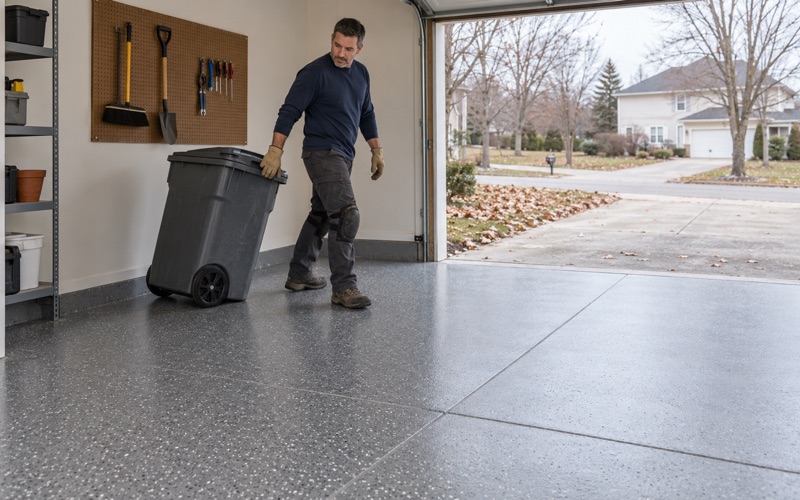
A landscape contractor’s shop often keeps pallets of turf product near the overhead door, with mowers and trailers rolling past them every morning. A homeowner usually keeps two or three bags along the garage wall beside the spreader, sometimes on the slab and sometimes on a shelf. Both are fertilizer storage floors, just at different scales, and both reward the same habits.
Looking for epoxy-flooring closer to Barrington? See Barrington Epoxy-Flooring.
Why Dry Fertilizer Is Not the Problem and Wet Fertilizer Is
A sealed bag on a dry slab
Bagged turf fertilizer is close to harmless to concrete while it stays dry. The granules sit on the surface, the paste underneath stays intact, and a broom takes care of anything that spills. If the product always stayed dry from purchase to spreader, there would be little to write about.
The trouble starts when water finds the product. A torn bag left on a damp floor, granules swept into a control joint, or a tire carrying snowmelt across a spill all turn a dry solid into a salt solution sitting on bare concrete.
What ammonium salts do to cement paste
Cement paste is the glue in concrete, and it is rich in calcium-bearing compounds. Ammonium ions have a strong affinity for that calcium, and when an ammonium salt is dissolved in water it pulls calcium out of the paste and carries it away. The RILEM state-of-the-art summary on aggressive aqueous environments describes ammonium nitrate solutions as producing rapid decalcification, because the calcium salts that form are highly soluble.
That same summary is honest about scale, and so are we. It says ammonium nitrate can cause severe degradation in fertilizer factories or storage silos yet remains a scarce risk for concrete structures generally, and that lower concentrations mean far less aggressive attack. A garage floor with an occasional spill is not a fertilizer silo, but the mechanism is the same one, working slowly wherever wet product is left to sit.
Where the damage collects
On the floors we inspect, surface wear from salts tends to concentrate in predictable places. Joints and cracks hold granules and water longer than the open slab, the low spot near a drain collects whatever runs off, and the patch under a stored bag stays damp if the bag sweats or leaks.
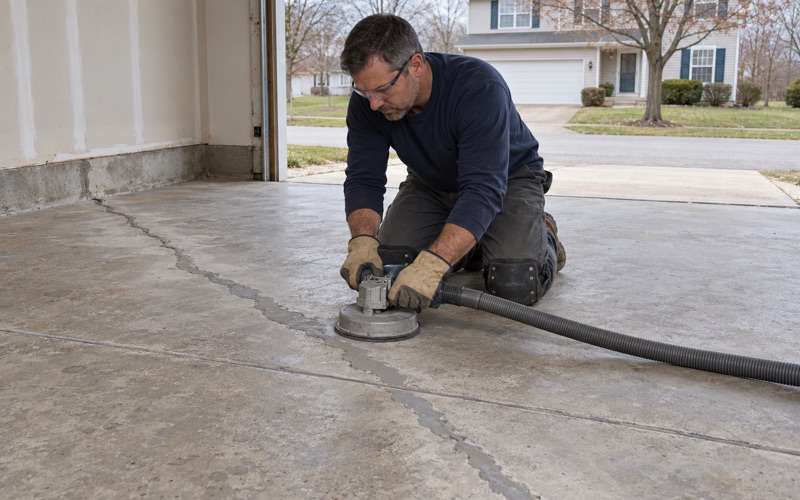
That is why we read the joints, cracks and any old coating before quoting, and why we say plainly when a section of slab needs repair before a coating will hold. Soft, sandy paste along a joint has to be ground back to sound concrete first, or the new floor inherits the weakness.
Pallets, Dry Sweeping and a Sealed, Joint-Tight Storage Floor
Bags belong on pallets
The University of Missouri Extension guide on fertilizer storage and handling gives advice we repeat to every customer who stores lawn product: provide pallets to keep bags off the floor. It also recommends storing dry products separately from liquids so that a leaking jug cannot wet the bags beside it.
A pallet does two jobs at once. It keeps the bottom bag out of any water that tracks in, and it lets air move under the stack so condensation does not build up between plastic and concrete. In a home garage, a short pallet or a sturdy plastic shelf along the wall does the same work at a smaller size.
Sweep spills up dry, and do it promptly
The same guide says dry spills should be cleaned up promptly and completely, swept up and reused as intended. That is the right instinct on any floor, coated or bare, because the moment someone reaches for a hose the granules become the solution described above.
We would add one point from the floor side: keep a dedicated broom and dustpan near the bags. Granules left in tire treads get carried across the slab, and a quick sweep before the car comes back in keeps them out of the joints where they do the most harm.
What a coated storage bay changes
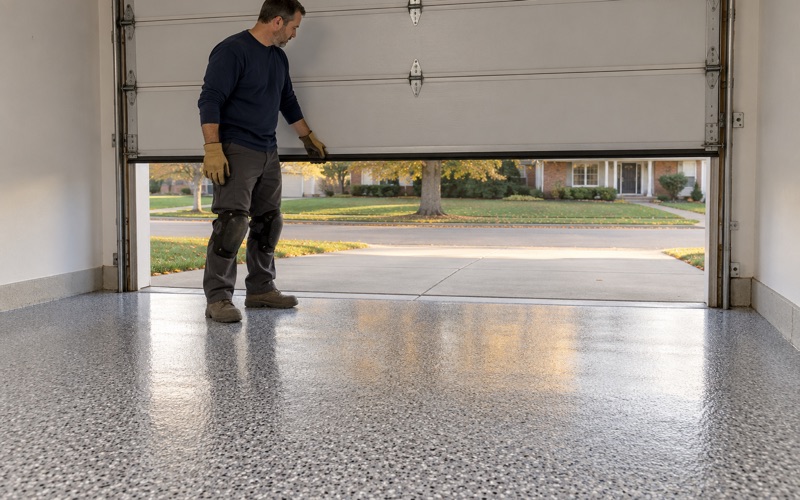
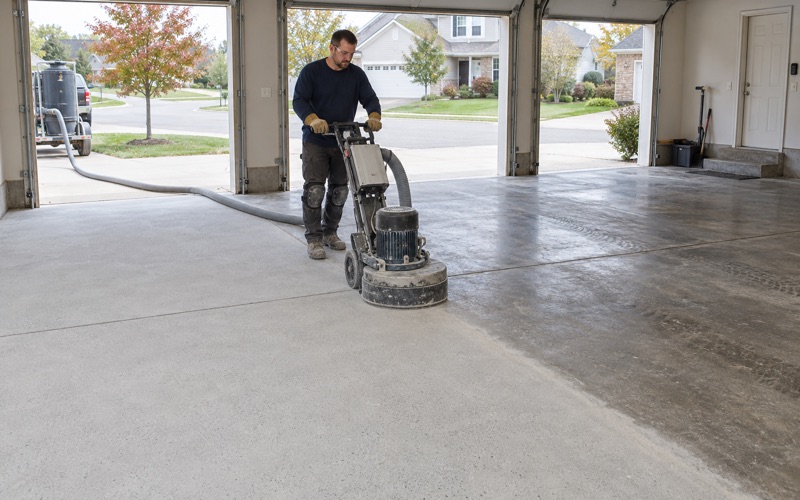
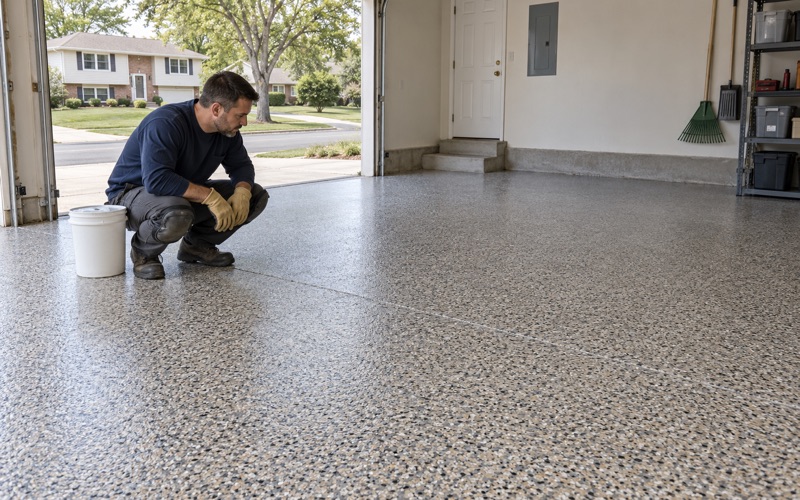
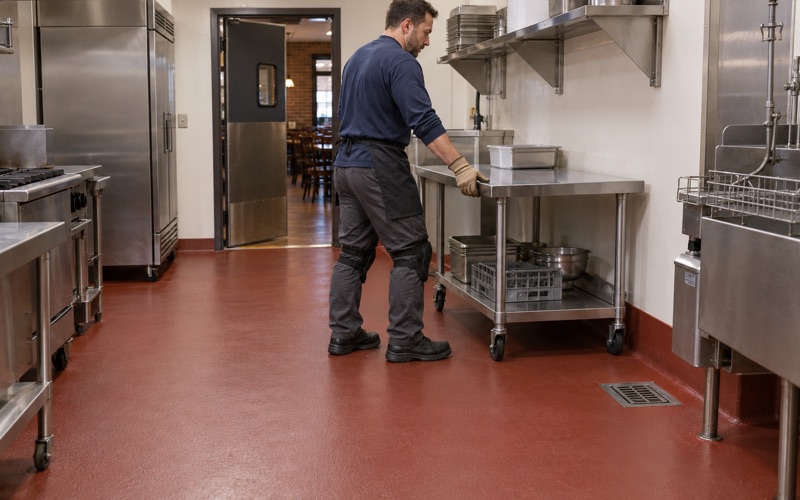
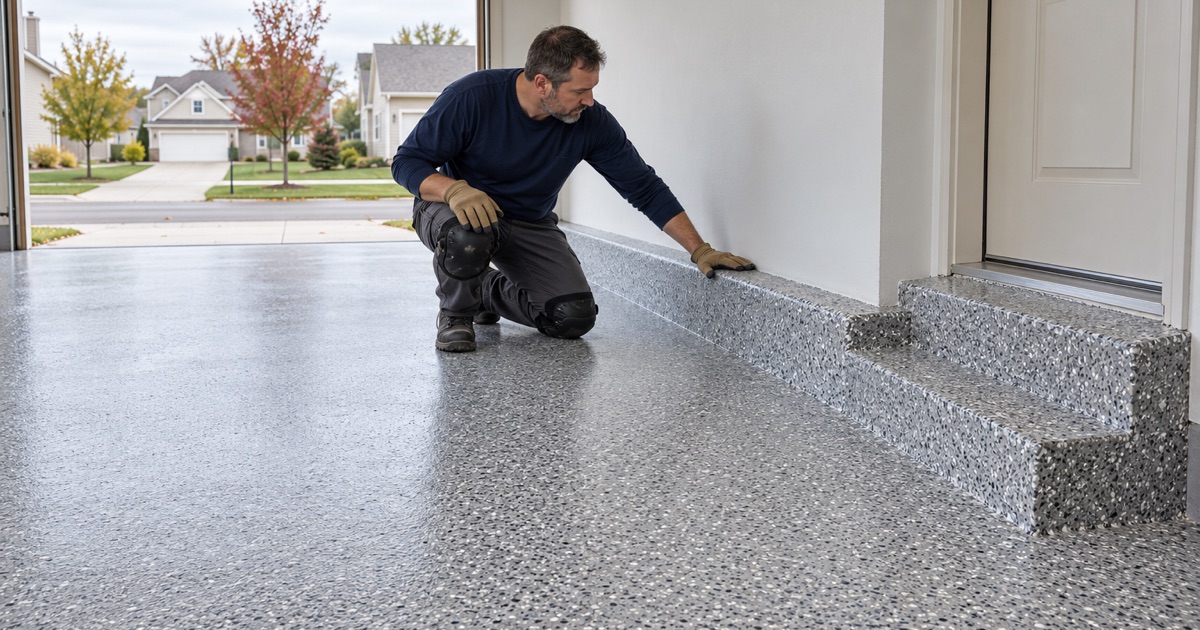
Under a storage area, the coating we build is meant to give a spill something other than bare paste to sit on. We open the slab with a diamond grinder or shot blaster rather than acid, fill control joints and cracks with a semi-rigid polyurea joint filler so granules cannot pack into them, then build a 100% solids epoxy base with a broadcast and a polyaspartic topcoat that wipes clean.
A resin floor is not secondary containment, and it does not make a fertilizer or pesticide storage area compliant with any storage rule. What it does is keep an occasional wet spill on a surface that can be swept and wiped, instead of soaking into porous concrete and open joints. The pallets and the broom remain the first line, and the floor backs them up.
Lawn Fertilizer in a New-Subdivision Garage
Young slabs still get a moisture test
Most garage slabs in Pingree Grove are young, so the typical job here is a first coating on a builder-finished slab rather than stripping an old one. Young does not mean dry. The model residential code has long exempted garage slabs from the vapor retarder required under living-space floors, under the IRC R506.2.3 exception, so a garage poured in 2015 may sit directly on soil with nothing between them.
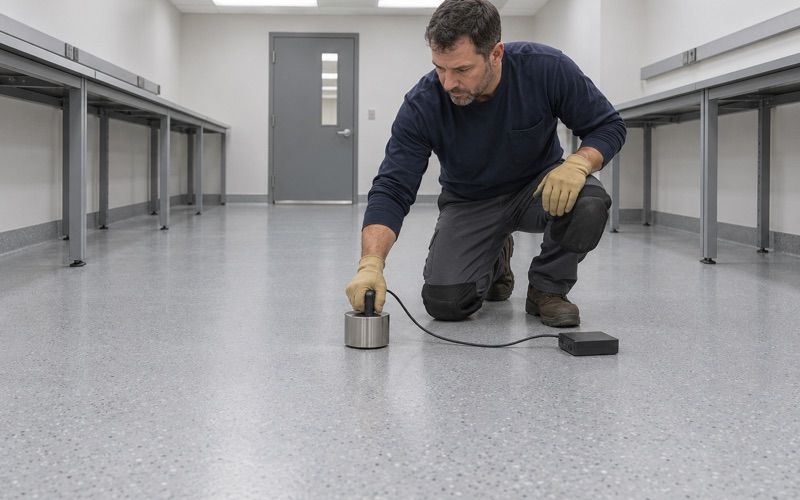
That is why moisture testing appears as its own line item in our scope rather than as an afterthought. A slab pushing vapor up from below will lift a coating no matter how carefully the fertilizer is stored above it, and our warranty exclusions, which we read out before the job is sold, name moisture first.
Planning around the spreader and the season
The garage that holds fertilizer is often the one an owner wants coated in spring, which is also when the bags come home. We schedule curing against slab temperature and the dew point at the surface rather than the calendar, and an unheated garage sometimes has to wait until the slab warms enough to cure properly.
When the date is set, we ask that bags, spreaders and any open product come out of the garage before grinding starts, and stay out until the topcoat has cured. Grinding dust is collected at the machine, so nothing is washed toward the driveway or a storm inlet, and the floor goes back into service with a clear spot planned for a pallet along one wall.
Townhomes and shared driveways
A large share of owner-occupied homes in the village are single-family attached, where a garage can share a wall, an apron or a driveway with the neighbor. The interior garage floor is often the owner’s own business, but association documents differ, and we suggest reading them before a date is booked rather than assuming.
We also confirm the Village of Pingree Grove’s own registration, bond and insurance expectations for contractors before a job is scheduled, since Illinois issues no state license for flooring work. The written home-repair contract and the state’s consumer-rights pamphlet come to the homeowner before any grinding begins.
- 20+ Years on Local Concrete
- Moisture Testing in Every Scope
- Written Per-Square-Foot Quotes