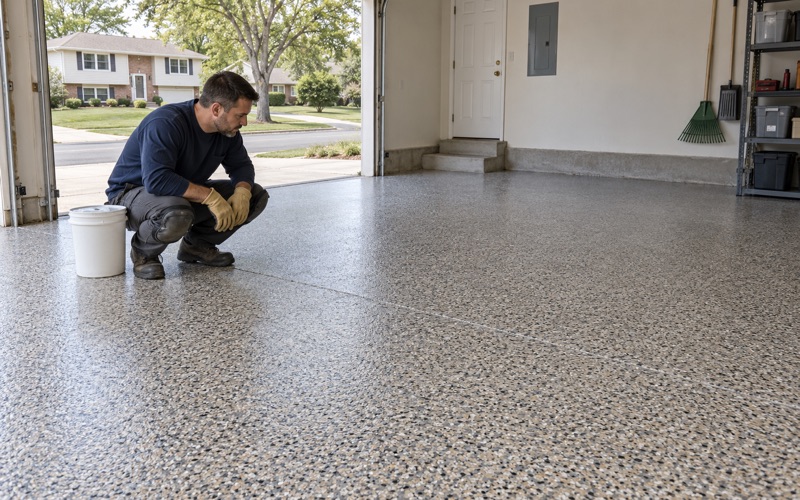
Crystal Lake Epoxy Flooring has spent more than 20 years on epoxy flooring in North Aurora and across the Fox Valley, and the part of the job we take slowest is the part nobody photographs: the cracks. A resin floor is only as quiet as the slab under it. Roll a coating across a crack that was never sorted and repaired, and the line comes back through the finish within months.
So our quotes here start on hands and knees with a marker. Each crack gets traced, measured and classed by how it behaves, and the proposal says which ones get a rigid fill, which get a flexible sealant, and which ones raise a question we cannot answer for the owner. Only after that does it name the product, the system build and the finished thickness.
That order matters in a garage, but it matters most in buildings where the state writes floor condition into the rules. North Aurora has one of those on its north side, and it is the clearest way to explain why we work the way we do.
A 129-bed care building and the state’s floor clause
The nursing facility on Banbury Road
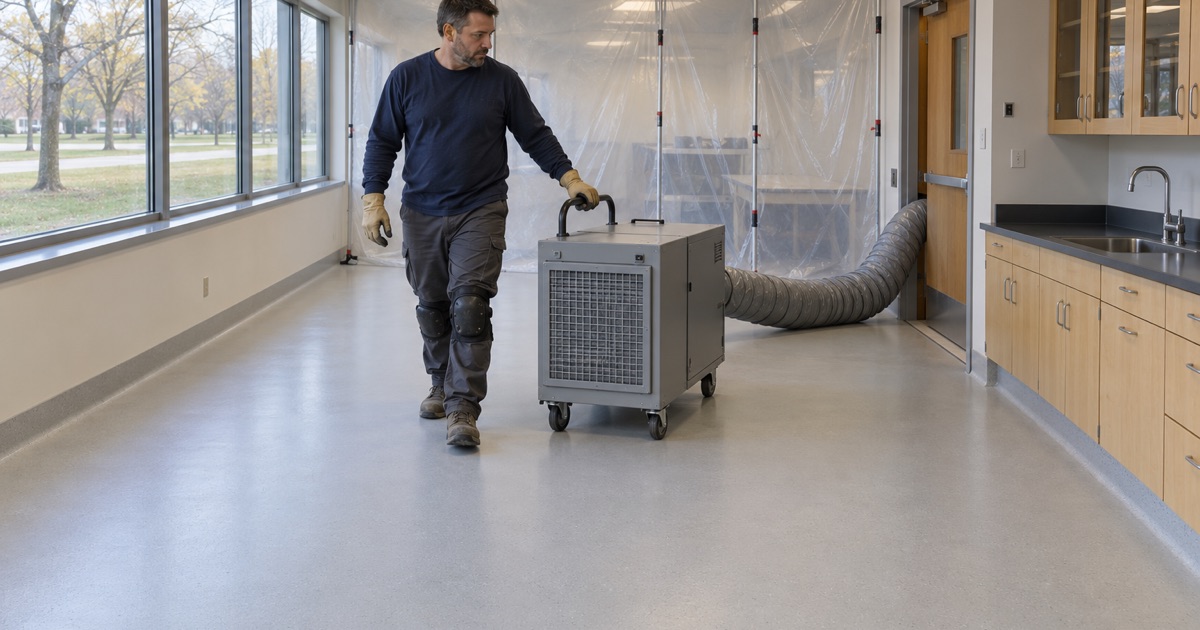
North Aurora Living & Rehab Center sits at 310 Banbury Road, inside the village in the Batavia Township part of town, on the same road as Schneider Elementary. Federal provider data lists it as a Medicaid facility with 129 certified beds. That makes it a licensed long-term care building, and those buildings answer to Illinois’ nursing-home code rather than to a homeowner’s sense of whether a crack is worth fixing.
We have not read the facility’s floors, its maintenance plan or its survey history, and it is not a customer. We use it here because it is the place in North Aurora where a written rule about floor cracks applies, and that rule describes the right order for any resin job.
What the Illinois code actually says
The Skilled Nursing and Intermediate Care Facilities Code, at Title 77 of the Illinois Administrative Code, Section 300.2210, requires every facility to keep an effective written plan for maintenance. It then says the building must be kept in good repair, safe and free of cracks in floors, walls or ceilings. The same list names warped, broken, loose or cracked floor covering, such as tile or linoleum.
Read plainly, cracks in floors are a maintenance defect the facility has to keep out of the building. A new finish over a crack that later reappears is not an improvement under that wording. It is the same defect with fresh color on top.
Why that turns a floor job into crack work
In a licensed care building, the floor project therefore begins before any resin is opened. The cracks are located, sorted and repaired, the repairs are checked, and the coating comes last. The facility’s own engineer decides what to do about any crack that is moving, and we do not certify licensing compliance for anyone.
What we can do is make sure the coating is not the reason a crack returns. That is a narrower promise than some installers make, and it is the honest one.
The same rule also asks for sufficient staff, appropriate equipment and adequate supplies behind that maintenance plan. For a floor contractor, that translates into a scope a maintenance director can file: a crack map, the repair chosen for each line, and the dates the repairs were checked before primer.
Looking for epoxy-flooring closer to Warrenville? See Epoxy-Flooring Services in Warrenville.
Static cracks and moving cracks are repaired differently
Mapping comes first
Before we price a North Aurora floor, we draw the cracks on a plan of the room. Hairline shrinkage cracks that wander across a slab look different from a crack that runs straight, has offset edges or has opened since the last coating went down. The map tells us how many lineal feet of each repair the job needs and where the true expansion joints are.
An old coating can hide a lot. Where a previous finish has split along a line, we treat that line as a crack until grinding shows otherwise, because the split usually started below.
Static cracks: route and fill
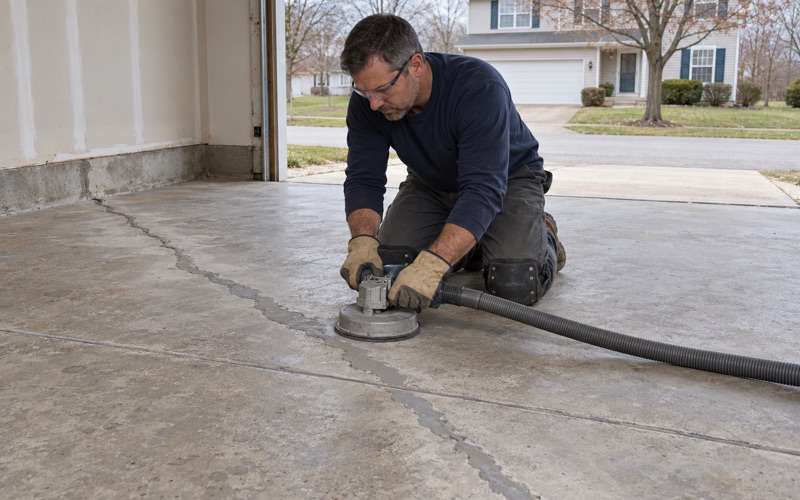
A static crack comes from shrinkage or minor settlement that has finished. For those we route or grind the edges open so the repair has something to grip, vacuum the dust out, and fill flush with a rigid epoxy filler or an epoxy and sand blend. After it cures, the fill is ground level with the surrounding slab.
The point of routing is width and depth. A hairline crack filled straight from the surface takes a skin of material that can let go, while an opened crack takes a plug that bonds on both faces. Map cracking, the fine web some slabs show across a whole bay, is usually ground and filled as an area rather than chased line by line.
Moving cracks: flexible and carried through
A moving crack is a different animal, because the slab is still working at that line. A rigid fill there simply cracks again beside or through itself, and that is why trade guidance warns against brittle repairs on moving cracks. These lines get a flexible sealant instead, and the coating is detailed to honor them rather than run over them solid.
True expansion joints are handled the same way: never coated solid. If a crack is moving because of something structural, no coating changes that, and the decision about it belongs to an engineer before we schedule anything.
Route, fill, re-check, then prime
Why a coating never hides a crack
One coatings maker’s technical sheet on crack repair puts it bluntly: cracks and surface defects must be addressed before a resinous floor goes in, and skipping that leads to reflective cracking, telegraphing, delamination and coating failure. Reflective cracking is the crack reappearing as a line in the new finish. Telegraphing is its shadow, a visible ridge or dip that shows where the defect sits even when the film has not split yet.
A thick broadcast system can hide a crack on installation day. It cannot stop the slab from moving under it, so the line usually returns along the same path.
That is why our proposals price crack work as its own line, in lineal feet, instead of folding it into a per-square-foot coating number. If a slab turns out to need more repair than the map showed once grinding begins, the owner sees the change before we fill anything.
Opening the slab without acid
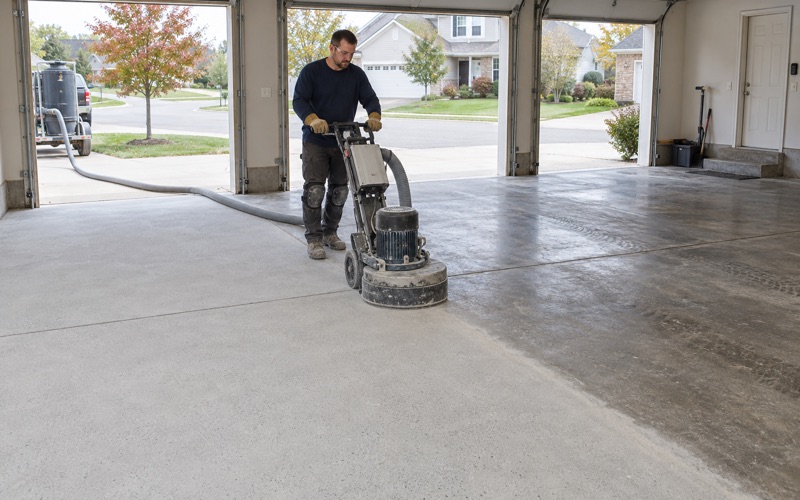
Our surface preparation on these jobs is mechanical every time, with a diamond grinder or a shot blaster and no acid etching. Grinding does two jobs at once here: it opens the concrete for the primer and it shows us cracks the old finish was covering. Dust is pulled into a vacuum at the grinder head rather than swept or rinsed toward a drain.
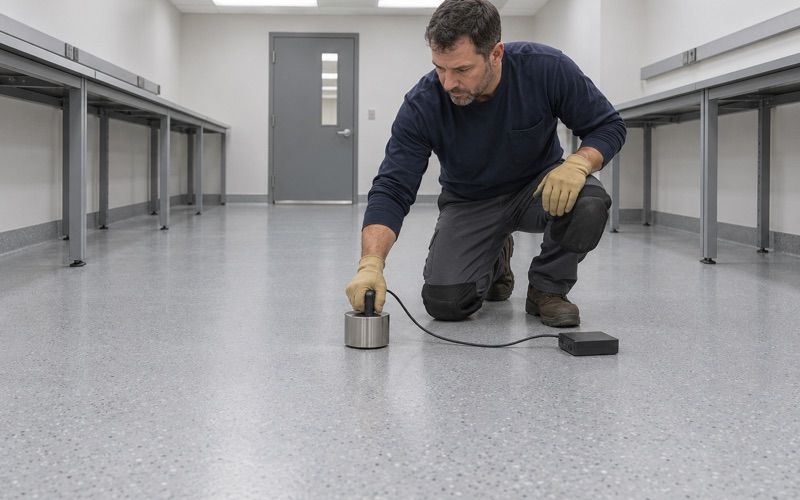
Moisture testing is a separate line in the scope, not an upsell after a blister. A crack can be a path for vapor, and a damp slab is the first exclusion we read out in the warranty discussion.
Re-checking every repair before primer
After the fills cure and are ground flush, we walk the repaired lines again before priming. A fill that has shrunk, a sealant that pulled from one edge, or a hairline that showed up beside a repair all get handled now, while it is still easy. Trade best practice says to re-assess repaired areas prior to priming, and we treat that as a step with its own time on the schedule.
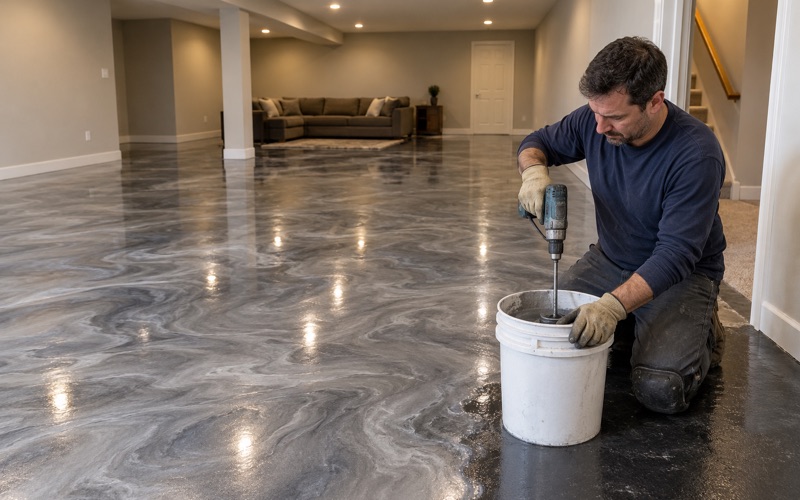
Only then does primer go down, followed by the body coat and topcoat the proposal named. Curing is timed against slab temperature and dew point, not the calendar.
The cracked home garage slab, done in the same order
North Aurora’s 2000s-era slabs
The village grew fast, and its housing shows it. Census counts put 2,642 homes in the 2000 to 2009 building years alone, about half the housing stock is from 2000 or later, and that makes many garage and basement slabs roughly 15 to 25 years old. Slabs of that age have usually finished their early shrinkage cracking, and some have picked up settlement lines near the apron or the door to the house.
Those garages also take calcium chloride brine and rock salt every winter, which works into any open crack. A crack that is sealed and filled before coating keeps that brine out of the concrete below the finish.
A homeowner can do a quick version of our first step before calling. Sweep the floor, look across it with a flashlight held low, and note any crack with one edge higher than the other or one that has grown since you moved in. Those are the lines we will ask about first, and they are the ones most likely to change the quote.
Townhome and detached garages alike
North Aurora has a real share of attached single-family homes, with 1,017 of them alongside its detached houses. A townhome garage is often smaller and tighter, but the crack question is the same, and a shared wall between garages means a moving crack near it deserves a closer look before anyone coats over it.
The order does not change for a detached two-car garage either. We map, sort static from moving, route and fill or seal, re-check, then prime, and the quote shows each step and its cost per square foot.
Permits, paperwork and when we stop
The village’s building and zoning guidance lists flooring among projects that do not need a permit, so a coating by itself is permit-free in North Aurora. Slab replacement, driveways, patios and structural work are on the permit list, and that is exactly where we stop if the map shows a slab past repair. We say so in writing rather than coating over it.
Every home job still starts with a written contract and the Illinois consumer-rights pamphlet in the owner’s hands. The village does not require contractor registration for this trade, so the paperwork we bring is the paperwork that protects you.
- 20+ Years on Local Concrete
- Moisture Testing in Every Scope
- Written Per-Square-Foot Quotes