Crystal Lake Epoxy Flooring has spent more than 20 years installing epoxy flooring in Lindenhurst garages and commercial spaces, and the floors we think hardest about are the ones a machine cleans every night. A coated sales floor rarely wears out from foot traffic alone. It wears at the pace of whatever pad or brush spins under the cleaning machine, which is why we treat floor care as part of the specification rather than an afterthought.
Our proposals name the resin, the system build and the finished thickness, and on a commercial job they also name the cleaning method the topcoat was chosen to survive. That puts the owner, the installer and the cleaning contractor on one document. When a cleaning routine and a coating work against each other, the coating is the one that loses.
We also schedule around the hours a business has to stay open. For a store that trades every day, that means overnight sections, phased aisles and cure times read from the product data sheet at the slab temperature we actually measure.
A Grocery Changing Hands on East Grand Avenue
Shop & Save in the Former Butera Market Space
Lindenhurst’s grocery picture shifted in 2026. Des Plaines-based Shop & Save is opening in the former Butera Market space on the north side of East Grand Avenue, in the same plaza as Ocean Seafood, with Play Tyme gym in the same building. The Daily Herald reported in June that the company was adding six suburban locations, Lindenhurst among them, most of them Butera-brand stores it had acquired or leased.
Co-owner Eva Jakubowski told the paper the changes would come gradually, and that moving a store from the old operator’s format to Shop & Save’s takes about six months. We have not worked in that building and do not know what its floors are made of or who cleans them. What interests us is the pattern, because a conversion like that is when an owner decides what the floor will be for years to come.
Why a Store Conversion Is a Floor Decision
When a grocery changes operators, fixtures move, departments get reset and aisles shift, and concrete that sat under old gondolas is exposed for the first time in a long while. Some owners patch and carry on, some polish the slab, and some put a resinous system into the back room, the prep areas or the whole sales floor. Each choice comes with its own cleaning routine, and that routine decides whether the money holds up.
Lindenhurst is a Lake County village of 14,406 people at the 2020 census, and its commercial floor stock is mostly neighborhood retail strung along Grand Avenue. Tenant turnover is the usual way a commercial floor here gets redone, and the decisions made in that window tend to stick. We would rather be in the room while the coating is still being chosen than after the first night of scrubbing.
Looking for epoxy-flooring closer to Antioch? See Antioch Epoxy-Flooring.
Floors That Get Machine-Scrubbed Every Night
What the Night Crew Actually Does
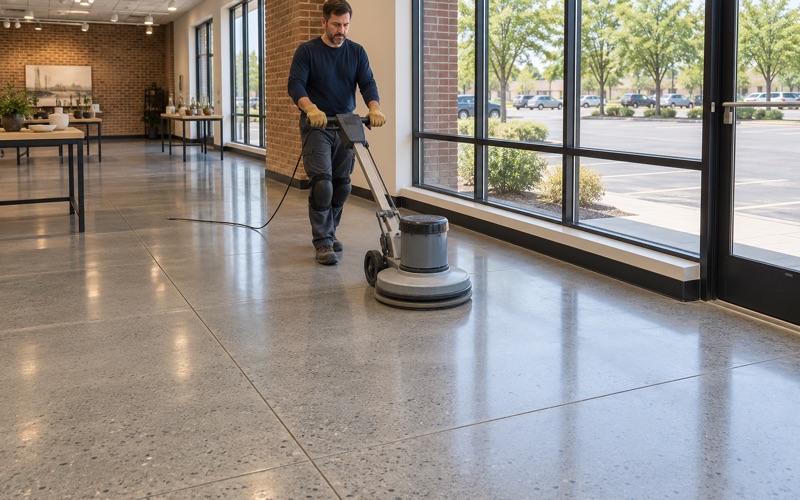
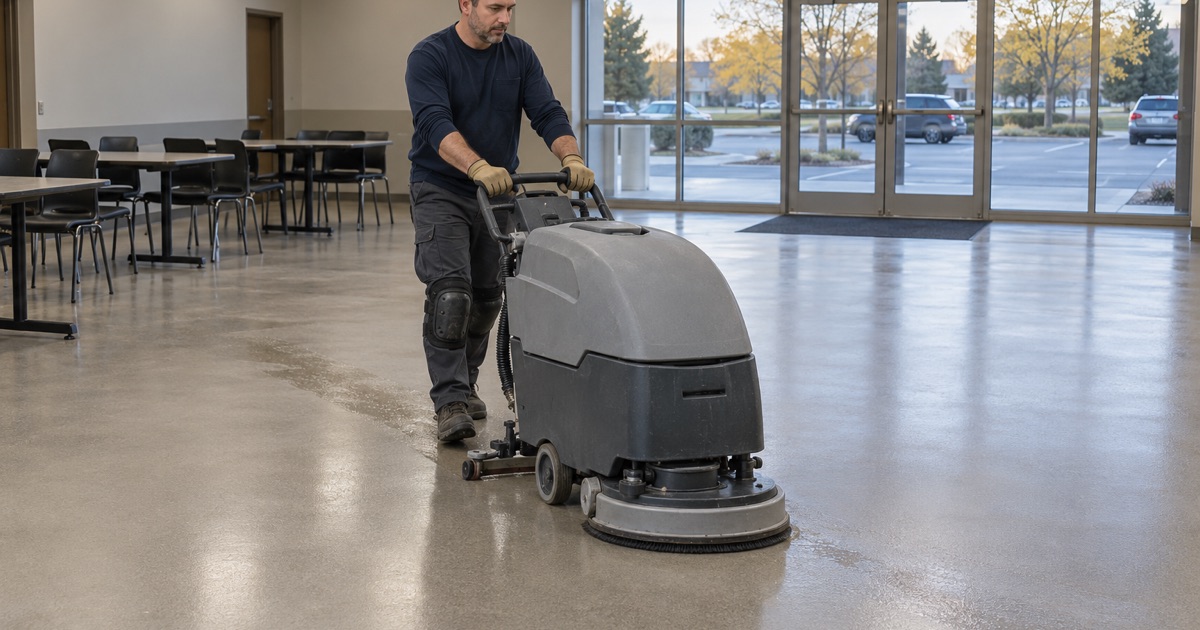
Grocery floors take a steady beating from spilled produce water, tracked-in slush, dropped dairy and cart wheels. Most stores answer with an auto-scrubber run after closing, nightly or close to it, plus a rotary machine on spots that need agitation. That adds up to hundreds of passes a year, and every one puts a spinning abrasive against the top few mils of the floor.
On vinyl tile, that routine is built around a floor finish that is expected to wear and be renewed. On a resin floor there is nothing sacrificial on top unless we design it in, so the machine works directly on the topcoat that carries the gloss, the color and the slip resistance. Clean it like a waxed tile floor and it wears like one, without the option of a quick fresh coat.
How Texture and Traffic Change the Wear
A smooth topcoat and a textured one wear differently under the same machine. A fine quartz aggregate broadcast gives footing in a wet produce aisle, but its peaks are the first thing an aggressive pad knocks down, so the texture fades in the main lanes long before it fades along the shelving. We set the grit size and the topcoat thickness over it knowing which aisles the scrubber crosses most.
The heaviest wear tends to show at the front-end lanes, the entry and the path from the back room doors, where carts, pallet jacks and the scrubber all converge. Polyaspartic and polyurea topcoats generally hold their gloss under abrasion better than a plain epoxy top layer, and a thicker build leaves more to lose before the primer shows. Those choices get made on paper, before anything is mixed, with the cleaning routine on the table.
Winter Grit at the Doors
Every winter, rock salt and calcium chloride brine come through the doors on boots and cart wheels. Between scrubber passes, that brine dries into a gritty film near the entrance. Run a pad over the grit and it acts as added abrasive, which is why pad choice matters more at the vestibule than in the middle of the store.
Pads and Brushes: What Resin Makers Allow on a Topcoat
White, Tan or Red, and Nothing Harsher
Coating manufacturers publish maintenance guides, and on the basic point they agree. The Sherwin-Williams resinous flooring guide says that on a rotary floor machine the pad should be a white, tan or red 3M pad or a similar one. Imperial Dade’s epoxy floor guide points the same way for an auto-scrubber, listing a red or white pad run at slower speed with moderate water and higher vacuum.
Those colors sit at the gentle end of the pad range. The darker pads made for stripping and heavy scrubbing are built to cut through a finish, and on a resin floor the finish they cut is the topcoat itself. A crew that grabs whatever pad is on the shelf can dull a new floor long before anyone expected it to look tired.
Brushes, Bristles and Abrasives
Brushes call for the same restraint. Floorguard’s resinous floor care guide is blunt: never use harsh abrasives or stiff bristle attachments. Stiff bristles leave fine swirl scratches that hold soil, and a scratched topcoat looks dirty sooner, gets scrubbed harder in response and wears faster still.
There is a nuance worth knowing. The Sherwin-Williams guide does call for a medium or stiff deck brush for hand work, and it pairs the auto-scrubber with a foamer or a rotary machine on large textured surfaces. A heavily textured prep area may need more agitation than a smooth sales floor, so the plan has to say which areas get which tool.
Whose Guide Governs
We follow the guide published by the maker of whatever system we install, not a generic one, because warranty language usually points back to that document. These recommendations come from coating manufacturers, not from a pad maker and not from any store’s house rules. If a cleaning contractor wants to run something outside the guide, the time to raise it is before the floor goes down, while a different topcoat could still be chosen.
Refinishing While the Store Stays Open
Working in Sections Around Trading Hours
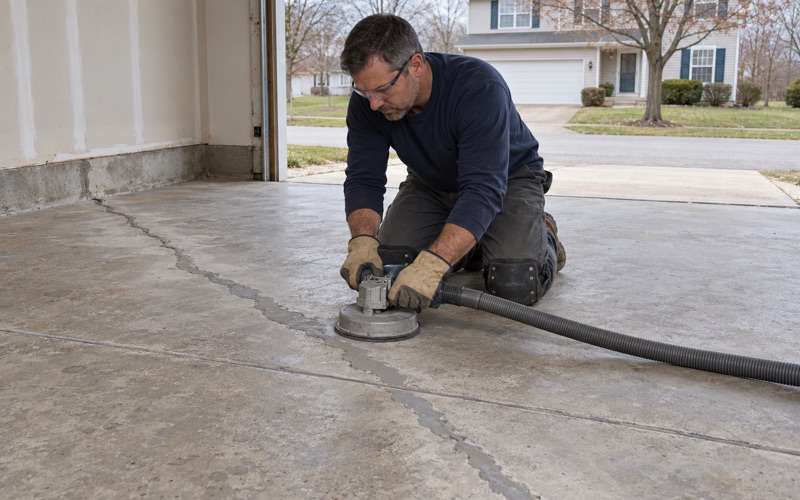
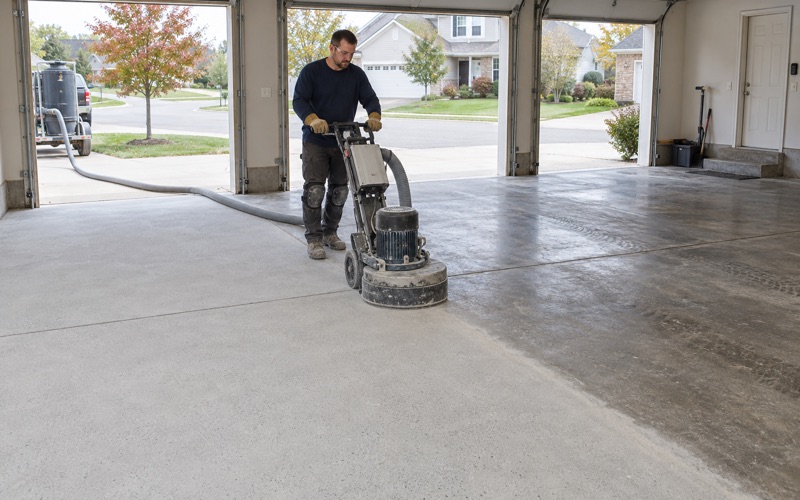
A store in the middle of a conversion cannot close for a week while a floor cures. The work goes in sections, an aisle or a department at a time, closed off after hours, ground with the dust captured at the grinder, primed and coated, then reopened once the topcoat reaches the foot-traffic time on the data sheet at the measured slab temperature. Fast-cure polyaspartic topcoats suit tight overnight windows, while slower epoxies may need a section held closed longer.
Every section also needs a cleaning gap. A freshly coated aisle should not meet a scrubber the night it reopens, so the plan marks which zones the night crew skips and for how long the maker says to wait. Getting that wrong on the first night is one of the easiest ways to scar a new floor.
What Goes in the Written Floor-Care Plan
At handover we give the owner a floor-care plan written for the people who run the machines. It names the pad colors allowed in each area, the brushes allowed and banned, the auto-scrubber speed, water and vacuum settings the maker suggests, and a neutral cleaner for routine work. It also states the dwell time, which the Sherwin-Williams guide puts at five to ten minutes before the solution is picked up.
The plan is short on purpose, a page or two that can be laminated and hung in the janitor’s closet. Night crews turn over, and a cleaning contractor may change along with a store’s operator, so the instructions have to live with the floor rather than in someone’s memory. We walk through it in person with whoever will push the scrubber, because a plan nobody read protects nothing.
Bringing the Cleaning Contractor In Early
The best time to involve the cleaning contractor is at the proposal stage. We show them the system, the finished thickness and the texture, and they tell us which machines and pads their fleet already carries. If nothing in it is gentler than a black stripping pad, either the fleet changes or the topcoat does, and both are cheaper to settle before the first section is ground.
For a Lindenhurst owner planning a reset on Grand Avenue, that conversation costs little and protects a lot. We price the job per square foot for the system actually proposed, read the warranty exclusions aloud before anything is signed, and leave a care plan that matches what went down. The coating and the cleaning routine get decided together, which is how both of them last.
- 20+ Years on Local Concrete
- Moisture Testing in Every Scope
- Written Per-Square-Foot Quotes