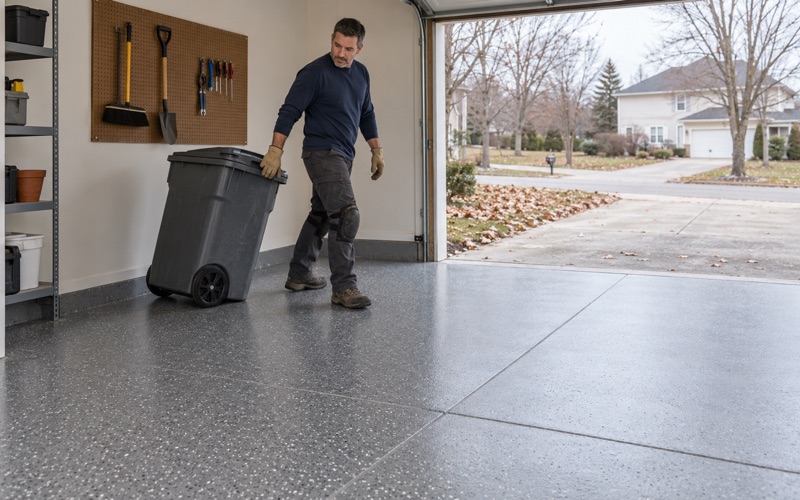
Crystal Lake Epoxy Flooring brings more than 20 years of epoxy flooring work to Lake in the Hills, and most of what we are asked to coat here is a garage slab that has been carrying cars for about three decades. That age matters more than the color chart. A coating bonds to whatever surface is under it, so every visit starts with reading the slab: its joints, its old patches, any earlier paint or sealer, and how much of the original troweled surface is left.
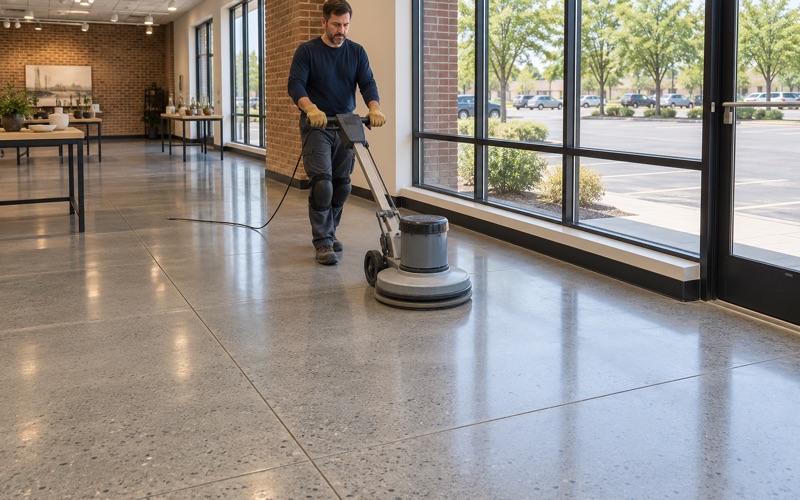
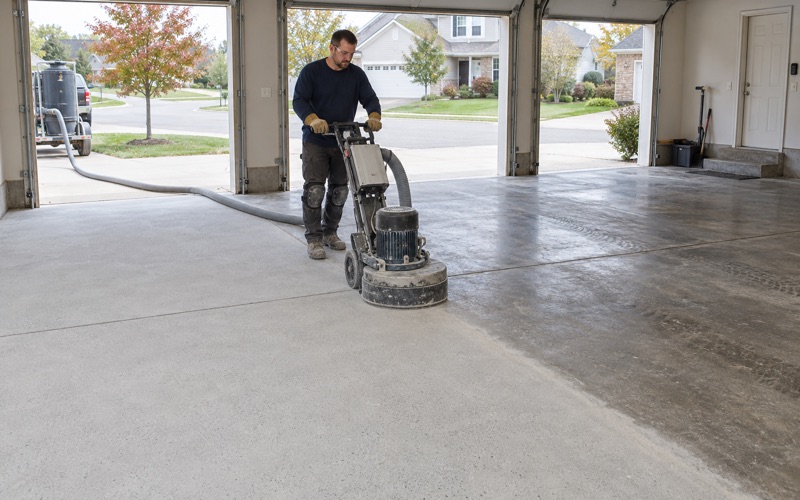
We open every floor mechanically, with a diamond grinder or a shot blaster, and we never acid etch. The goal is a measured surface profile the primer can grip, not a slab that merely looks clean. When the reading shows a floor needs repair first, or needs replacing rather than coating, we say so before a price is written.
The proposal that follows names the product, the system build and the finished thickness, priced per square foot for that system rather than lifted from a national per-garage average. Moisture testing sits on it as its own line, and the warranty exclusions are read aloud before anything is signed, with moisture named first.
A Village That Built Half Its Homes in the 1990s
One decade, one generation of garages
Lake in the Hills grew faster in the 1990s than in any period before it. Annexations in the late 1980s and early 1990s carried the village west of Randall Road toward Route 47, and the population went from about 5,866 in 1990 to 15,770 by 1996. In 1995 alone the village issued over 1,000 residential building permits.
The housing count shows the result. Census estimates put 5,103 of the village’s 9,952 homes in the 1990-99 build era, a little over half, against 594 from the 1980s and 2,232 from the 2000s. Before that decade, the village was described as a sleepy lakeside place of cottages and small ranches, and the Old Section around the lake is still its oldest neighborhood.
Big Sky, Harvest Gate and Spring Lake Farm
Town and Country Homes built Big Sky and Harvest Gate, described as some of the village’s first subdivisions, with Woods Creek running between them. Sundance Homes and Americana Homes built Spring Lake Farm in the early 1990s. Village Hall itself now sits at 600 Harvest Gate.
These were production builds: many houses, a handful of plans, crews moving street to street. We have not inspected the slabs in any of these neighborhoods, and we do not assume how they were poured. What the dates do tell us is that thousands of garage floors across the village reached their thirties at roughly the same time.
Why the cohort matters for a coating
Of the village’s housing units, 72.4 percent are detached houses and 84.4 percent are owner-occupied, so most of these garages belong to the people who park in them. An owner weighing a coating is usually looking at a floor that has outlived its first finish, its first patch and sometimes a previous owner’s paint. That is the floor we plan around: one with a history, not a blank slab.
Looking for epoxy-flooring closer to Cary? See Cary Epoxy-Flooring.
What 30 Years Does to a Garage Slab, and What Gets Repaired First
Reading the surface before quoting
A garage floor of this age has usually lost some of the dense cement paste the finisher troweled onto it. Tire traffic, dropped tools and the occasional spill wear that top layer unevenly, leaving smooth lanes where the cars park and rougher ground near the door. Many floors also carry a coat of garage paint or a clear sealer from years back, often peeling where the tires turn.
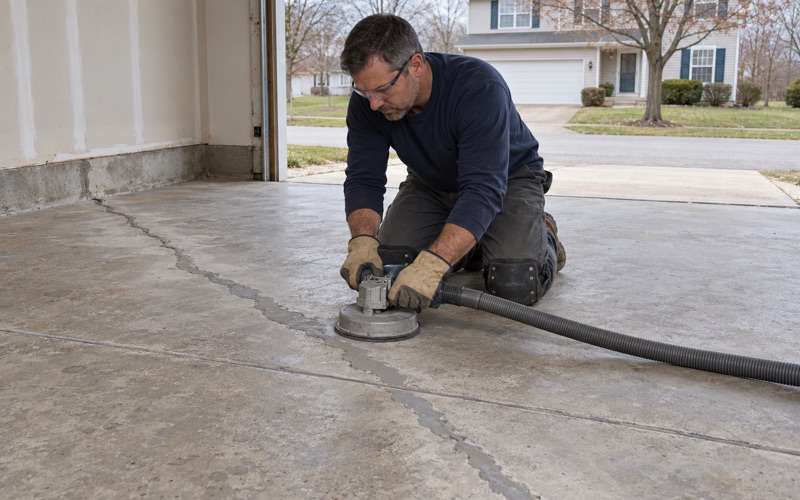
We walk the floor before quoting and note each of these. Old paint and sealer come off completely under the grinder, because a coating laid over a failing film can only hold as well as that film does. Where the worn paste has exposed sand and small aggregate, grinding takes the surface down to sound concrete so the primer bonds to the slab itself.
Joints and cracks
Control joints and cracks move as the slab warms and cools, so they cannot simply be buried under a rigid coating. We clean each joint out, fill it with a semi-rigid polyurea joint filler, and grind the fill flush. Cracks are read for their pattern: a hairline that has not shifted is treated differently from one with a step across it, which can signal movement no coating will stop.
When a crack shows ongoing displacement or a section of slab has settled, we tell the owner that a coating will not fix it and that the slab, or that section, may need repair or replacement first. That conversation happens before the proposal, not after the floor is down.
Old patches and spalled spots
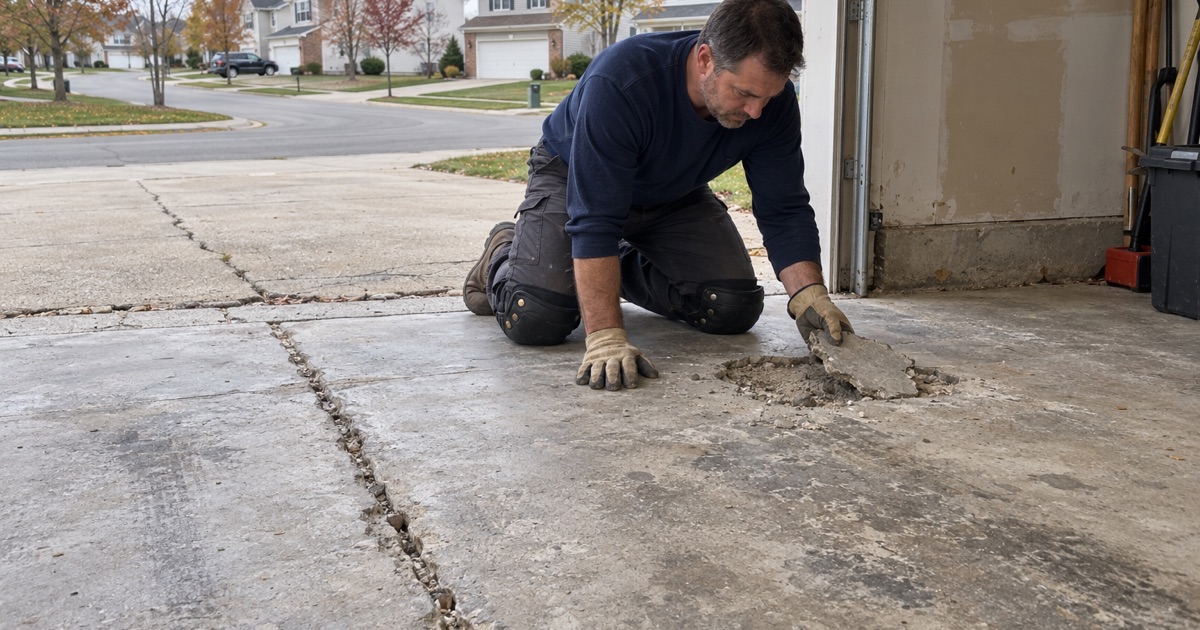
Three decades of ownership often leave patches behind: a corner filled after a drain was moved, a spot repaired after a water heater leaked, a chip where something heavy landed. Some are well bonded; others sound hollow when tapped. We sound every one, remove what has let go, and rebuild with a repair mortar suited to the system going on top.
Pitted and spalled areas get the same treatment. The finished coating is only as flat as the surface it covers, so repair is the step that decides whether a flake or quartz broadcast floor reads as smooth or shows every old scar.
Testing a Slab Before Coating It, Not After
Moisture comes first
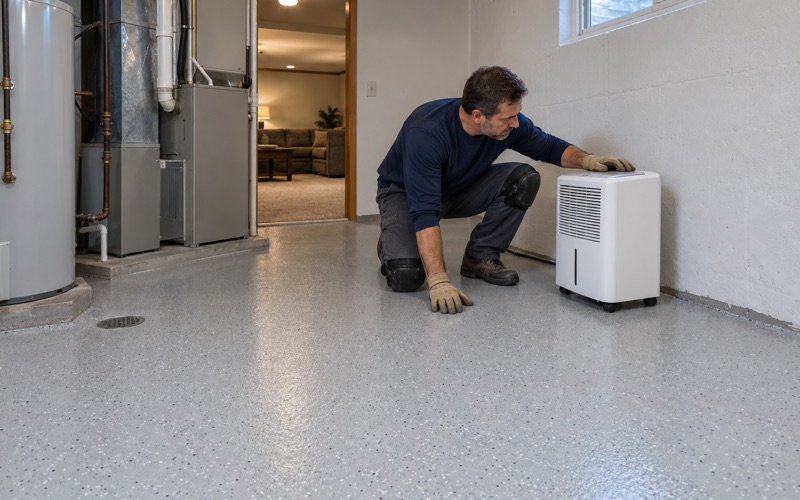
An older garage slab may or may not sit on an under-slab vapor retarder, and we have no record of how any particular Lake in the Hills floor was built. That is exactly why we test rather than guess. Moisture is a line item in every scope we write, on a garage just as on a basement or a shop.
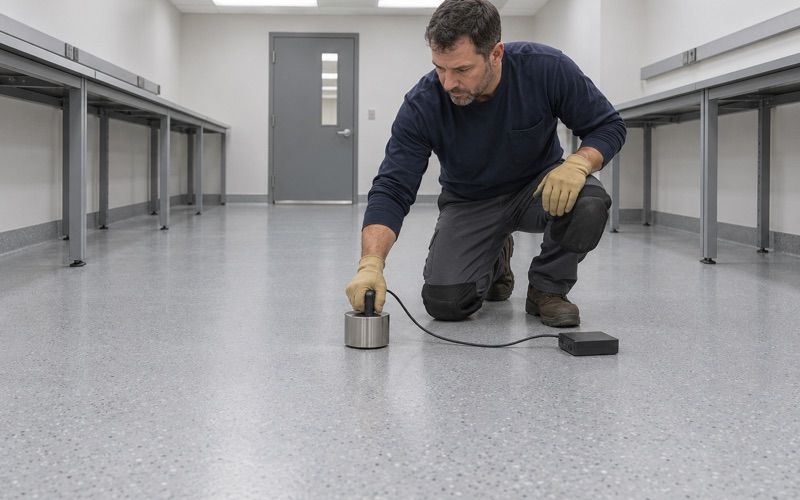
Depending on the floor, that means an ASTM D4263 plastic sheet test as a first screen, ASTM F1869 calcium chloride kits for the vapor emission rate, or ASTM F2170 in-situ relative humidity probes set into the slab. When readings come back high, the system changes to include a moisture-mitigation primer, or we hold off and explain why. A floor coating is not a moisture barrier for the house, and we never sell it as one.
Bond and profile checks
After grinding, we check that the surface reaches the ICRI CSP profile the primer’s product sheet calls for. On a slab with old sealer or oil soaked into it, a small test area tells us whether the contamination is gone or still lifting through.
Testing before the job is the cheaper way to learn. A floor that blisters or peels a year in has to be ground back off, and nothing about a 30-year-old slab makes that easier the second time.
Temperature and curing
Curing is scheduled against the slab’s temperature and the dew point spread at its surface, not against the calendar. An unheated garage in late fall can hold a slab too cold for the resin to cure properly, and amine blush on a cold, damp epoxy surface interferes with the next coat. When conditions are not there, we say plainly that the job waits for spring.
Registering With the Village and Choosing the System
The village’s own rules
Illinois issues no state license for flooring or coatings work, so the rules that matter here are local. The Village of Lake in the Hills asks contractors to register each calendar year, January 1 through December 31, with a 75-dollar fee, a certificate of 1,000,000-dollar general liability naming the village as certificate holder, and a 10,000-dollar surety bond. We confirm those requirements with the village before a job goes on the schedule.
The village adopted the 2021 International codes, the IRC among them, with amendments effective May 1, 2022, set out in Chapter 24 of its municipal code. Whether a given floor project needs a permit is a question for Community Development at Village Hall, 847-960-7400, and we ask it rather than assume an answer.
Contracts and coatings rules
Every home job gets a written contract and the Home Repair: Know Your Consumer Rights pamphlet before work starts, as the Illinois Home Repair and Remodeling Act requires. McHenry County is a whole county inside the Chicago 2015 ozone nonattainment area, and Illinois caps floor coatings at 250 grams of VOC per liter under Part 223 Subpart C of the Illinois Administrative Code, a limit that binds the installer as well as the manufacturer. The products we propose are chosen within it.
Grinding dust is captured by vacuum at the grinder. None of it is rinsed out the garage door toward a storm inlet.
Picking a system for a 30-year-old floor
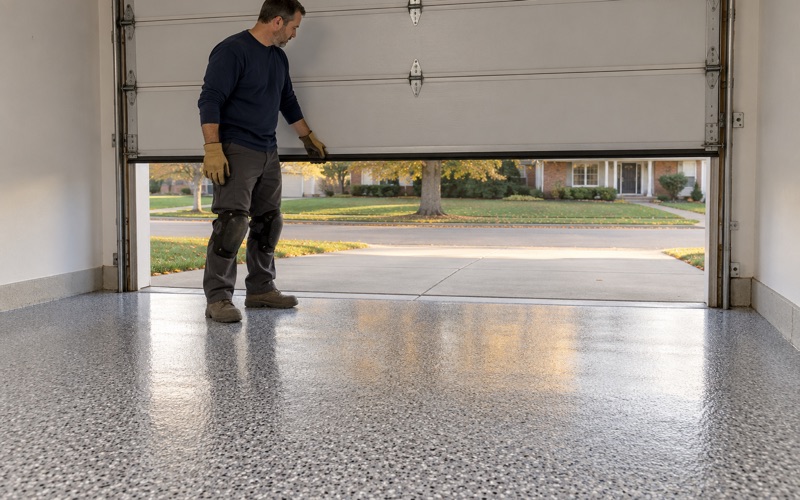
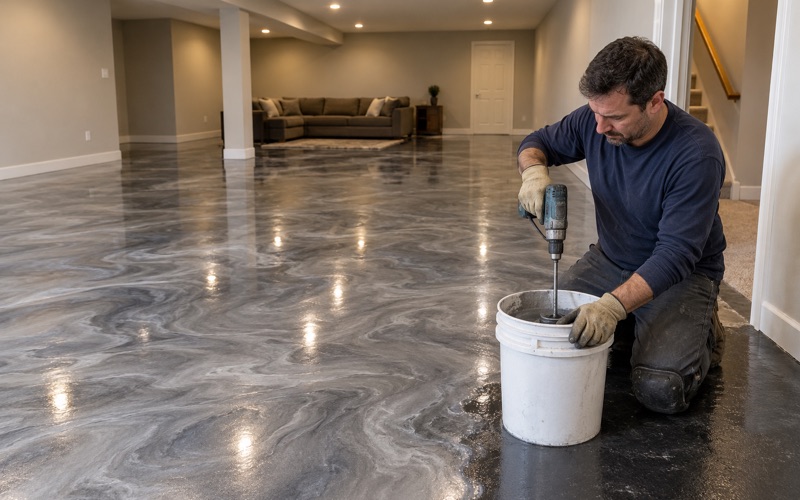
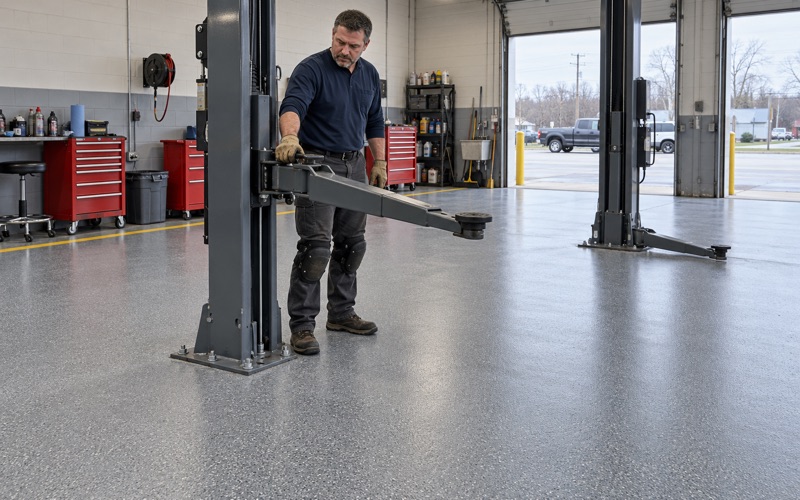
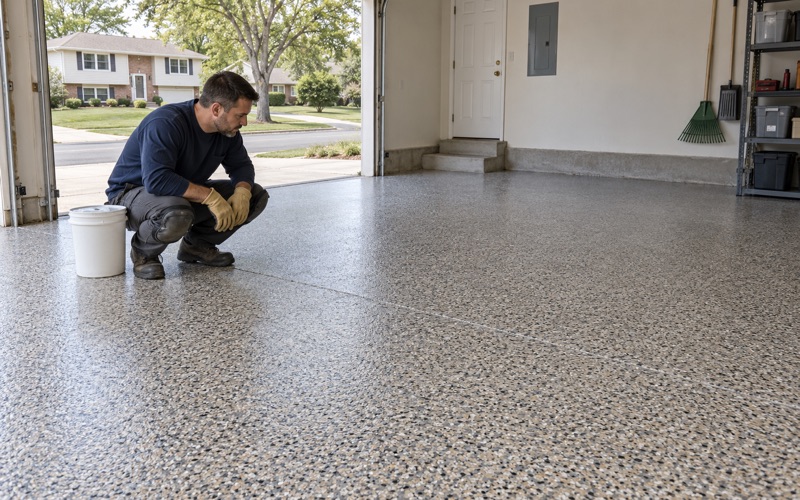
For most garages we build on a 100% solids epoxy base coat, broadcast vinyl flake or quartz aggregate into it, and finish with a polyaspartic or polyurea topcoat that resists hot tire pickup. Owners who want a plainer finish can skip the broadcast, while a garage that doubles as a workshop may call for more texture underfoot.
The proposal lists the base, the broadcast, the topcoat and the finished thickness, so what goes down can be checked against what was quoted. On a floor this age it also lists the repair work, line by line, because that is where most of the difference between one garage and the next actually lies.
- 20+ Years on Local Concrete
- Moisture Testing in Every Scope
- Written Per-Square-Foot Quotes