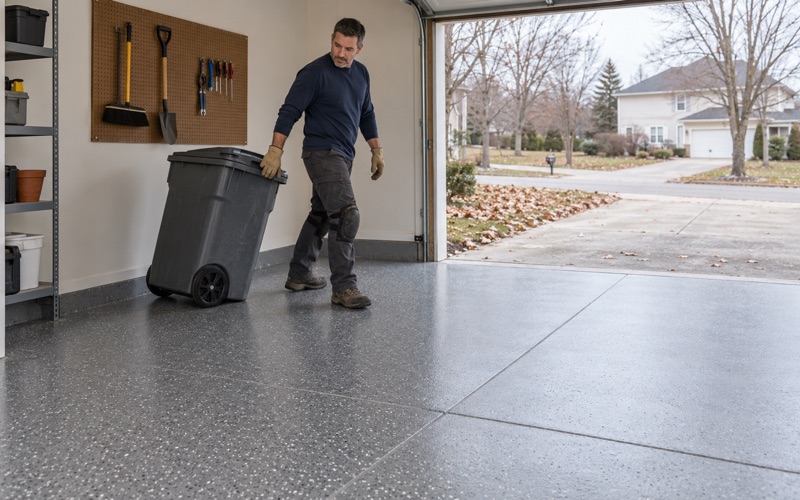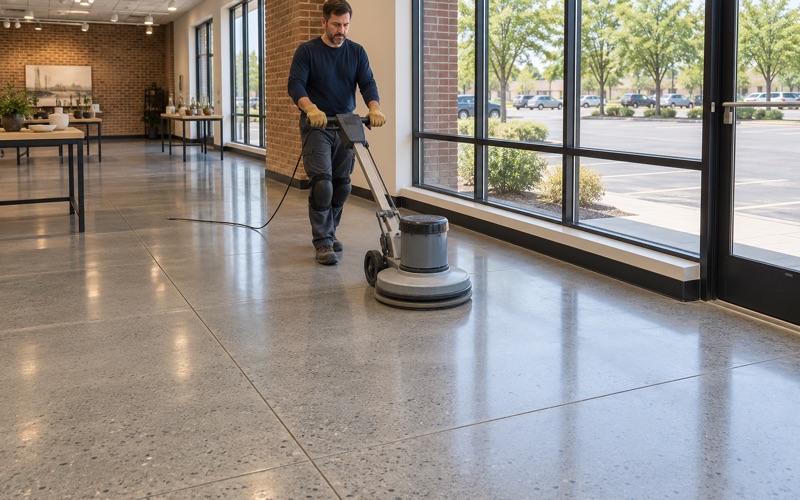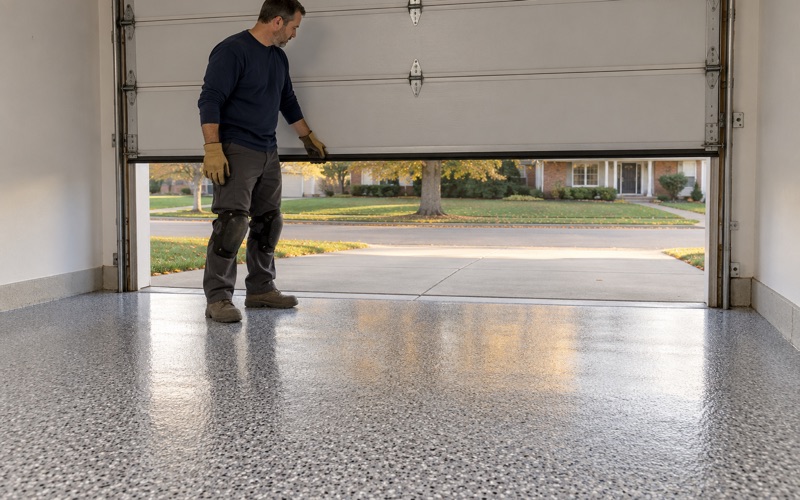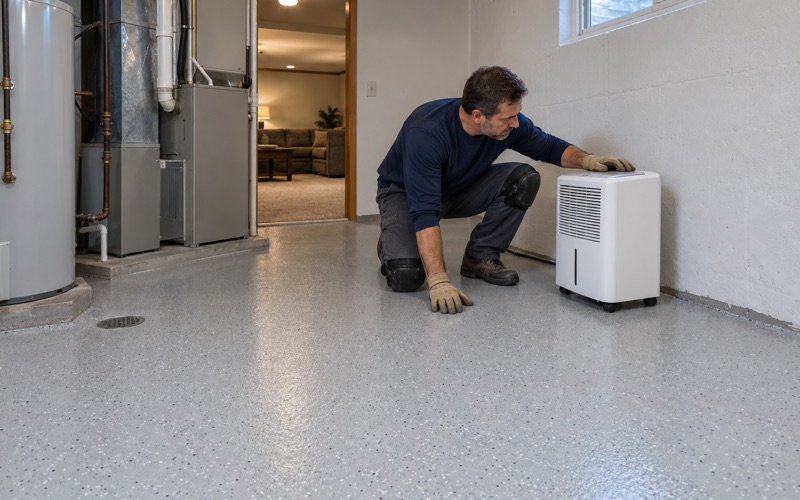
Crystal Lake Epoxy Flooring has spent more than 20 years installing epoxy flooring in Lake Forest and across the northern suburbs, and the floors we think hardest about here are the ones cars park on. A garage coating tends to fail in one predictable way when it is built thin and driven on too soon. We would rather explain that failure before the job than repair it afterward.
Our proposals name the product, the system build and the finished thickness, so an owner can hold the finished floor up against the quote. Before we price anything we read the slab’s cracks, joints and any old coating, and if the concrete needs repair or replacement first, we say so in writing. Moisture testing appears in the scope as its own line, priced before work begins.
This page follows one building through that reasoning: a city-owned office building being rebuilt for a police department whose cars come and go at every hour. We have no part in that project. It simply shows, at full scale, the conditions that decide whether a vehicle floor holds or peels.
An Office Building on Field Court Becomes a Police Headquarters
What the city approved
Lake Forest bought the office property at 1925 Field Court, in Conway Park, in September 2024 for $3.5 million, according to Lake Forest High School’s student newspaper. At its July 10, 2025 meeting, the Building Review Board reviewed an addition to adapt the building as the police headquarters, describing a three-story precast structure of about 100,000 square feet in two wings. The address geocodes inside the city, in the Libertyville Township portion of Lake County.
The addition brings roughly 9,000 square feet of cast-in-place concrete at the rear, because the department needed a secure sally port the existing footprint could not hold. Ramps carry police vehicles up to the sally port and back down, and they were widened from 11 to 12 feet so modern ambulances fit. Construction began in October 2025, and the newspaper reports an opening set for fall 2026.
Why the lower-level garage is the floor that matters
On October 6, 2025, the City Council approved a base project that includes renovating the lower-level parking garage along with the first and second floors. A garage beneath an office building typically serves commuters who arrive in the morning and leave in the evening. A police department asks the same concrete to do something very different.
We have not seen the city’s floor specifications, and nothing on this page describes what the city chose. What follows is how we would reason about a garage with this kind of duty cycle, and why that reasoning carries over to the smaller garages around Lake Forest.
Looking for epoxy-flooring closer to Deerfield? See Epoxy-Flooring Services in Deerfield.
A Garage and a Sally Port That Never Close
Warm cars, the same stalls, every shift
An office garage fills once in the morning with cars that cooled on the drive in. A police garage turns over at every shift change, around the clock, and patrol cars return after hours on the road with their tires still warm. Each one tends to pull back into the stall it left, so the same few square feet of floor take that heat again and again.
That repetition matters more than the total traffic count. A coating can shrug off thousands of cool tires rolling across it and still fail in a stripe where warm tires park and cool day after day. On a fleet floor, those stripes line up neatly with the stall markings.
A sally port built for every size of vehicle
The student newspaper reports that the sally port will accommodate all sized vehicles, and the board’s record describes ramps sized for ambulances. Larger vehicles bring heavier tires, longer stops and tighter turns on a confined floor, and turning in place scrubs tread against the surface. A floor in a space like that is judged by how it handles torque and point loads, not only by how it looks under the lights.
The board’s record also notes that the ramp drainage was extended and lowered, with an ejector pit pumping stormwater to the adjacent detention pond. Rain and snowmelt run toward that level, and through a Lake County winter every tire carries brine and rock salt in with it. A vehicle coating here has to sit under standing slush without softening or staining.
Reading a fleet floor after the first winter
On any garage that parks the same vehicles in the same places, the first sign of trouble is rarely a crack. It is a dull, scuffed rectangle where the tires rest, or a few pinhead lifts at the edge of a tire track. Those marks say the topcoat is wearing faster than the base, and they are far cheaper to address as a cleaned, abraded recoat than after the base itself starts lifting.
We suggest owners of busy garages walk the stalls each spring, after the salt season, and look closely at the tire paths rather than the open aisles. Rinsing brine off regularly through the winter slows the wear considerably. A floor built to full thickness leaves room for that kind of maintenance, while a thin coating has nothing left to give once its surface is gone.
Hot-Tire Pickup: How Warm Tires Lift a Coating
The mechanism
Driving produces friction, and friction heats a tire. A garage-coating company puts tire temperature on a hot day at roughly 140 degrees F, which it describes as just hot enough to weaken an epoxy’s bond to the concrete. That is a vendor’s approximate figure, not a measurement from any Lake Forest garage, but the mechanism behind it is widely described.
Other trade sources describe heat moving from the tread into the coating, then the tire gripping the softened surface as it cools. When the car pulls away, a patch of coating leaves with it. The causes most often named are a thin single coat, poor surface preparation and driving on the floor before it has fully cured.
Preparation decides the bond
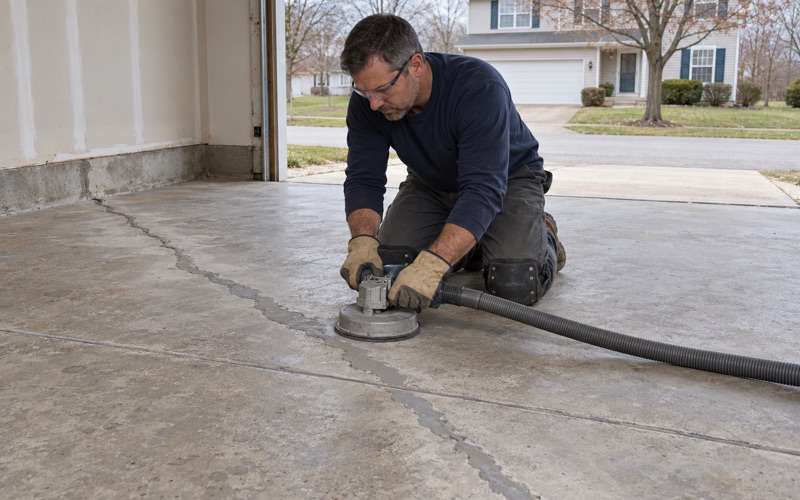
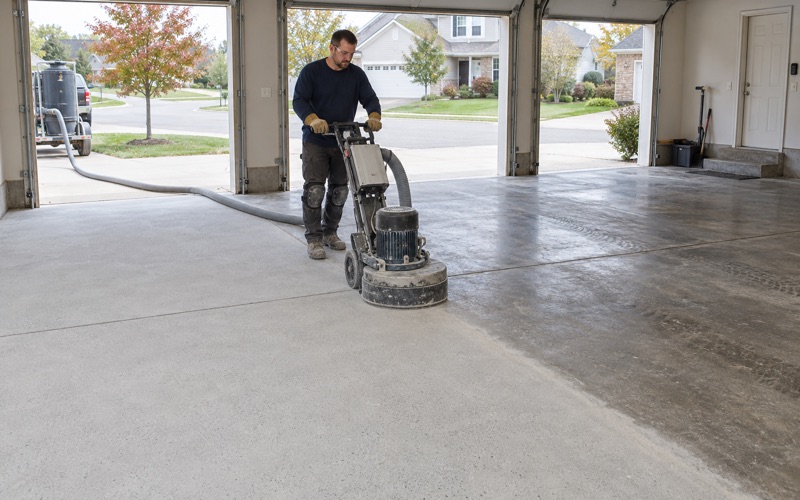
Hot-tire pickup is a bond failure, so the fix starts at the surface the coating grips. We open every slab with a diamond grinder or a shot blaster to a measured profile on the ICRI CSP scale, and we never acid etch. Etching leaves a weak, contaminated skin, and warm tires find that skin first.
On an older slab we also fill cracks and joints before coating, often with a semi-rigid polyurea joint filler where a joint still moves. Grinding dust is captured at the machine by a vacuum rather than rinsed toward a floor drain. In a garage whose water already runs to a pump and a pond, that habit matters.
Thickness and the topcoat
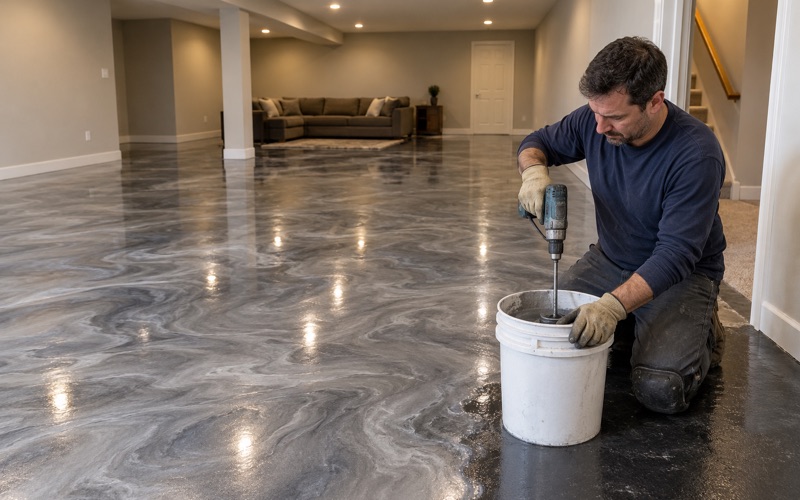
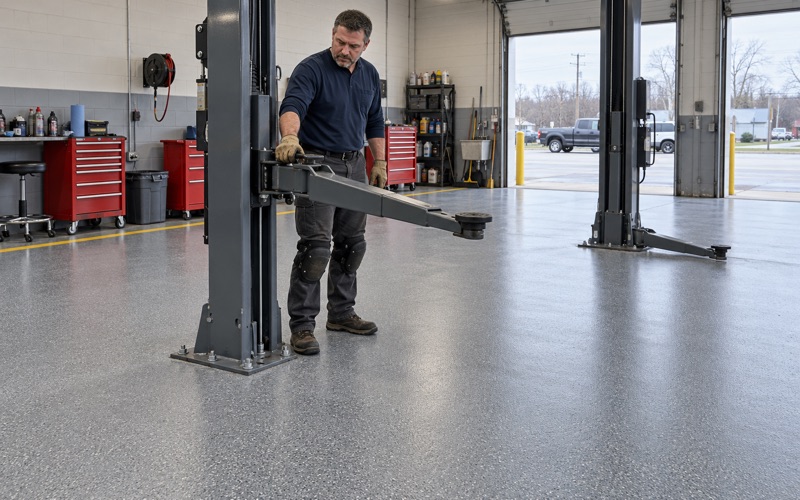
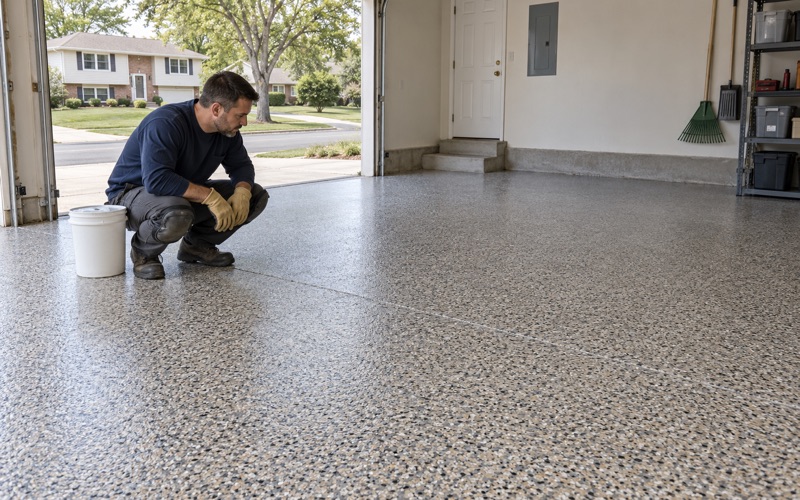
A thin roll-on product has very little material to absorb heat before the bond line feels it. For a vehicle floor we build a 100% solids epoxy base to full film thickness, often with a quartz or vinyl flake broadcast that adds body and texture, then seal it in. The proposal states that build and its finished thickness so the floor can be checked against it.
The topcoat is where a hot-tire rating actually lives. A polyaspartic or polyurethane topcoat rated for vehicle traffic resists the softening and chemical attack that an epoxy surface handles less well, and it stands up to winter brine. We treat it as part of the system design, not an upgrade bolted on at the end.
Finish and Cure Before the Fleet Moves In
Sequencing inside a renovation
A building under renovation offers the best window a garage floor will ever get: no cars, no shift schedule, and other trades that can be routed elsewhere for a few days. In a garage like the one on Field Court, the sensible order is to finish and cure the garage and sally-port floors before move-in. A recoat later would have to work around a fleet that cannot leave.
Coating a working garage means closing stalls in sections, rerouting vehicles and living with odor and cure periods. It can be done, and we schedule fleet and shop floors into overnight and weekend windows when a building has to keep running. Even so, a resin floor performs best when its first cure goes undisturbed.
Curing to slab conditions, not a date
Full cure is a chemical state, not a day on the calendar. We time application and the return to traffic against slab temperature and the dew point spread at the surface, because condensation on a cold slab causes amine blush and a weak topcoat bond. A lower-level garage tucked under a building often runs cooler than the air above it, so we read the slab itself.
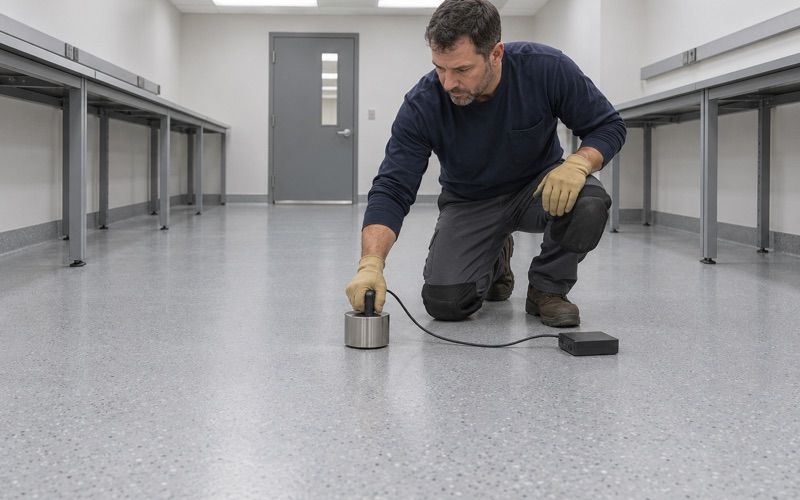
Moisture rising through concrete is the other common reason a vehicle coating lets go. We test before quoting, with ASTM F2170 relative humidity probes or calcium chloride emission tests as the slab calls for, and we read the warranty exclusions aloud before anything is signed, moisture first. When readings run high, a moisture-mitigation primer goes into the build instead of becoming a surprise later.
What this means for a Lake Forest home garage
Lake Forest’s housing runs from homes built before 1940 to houses finished since 2000, and the city’s building scale rules make an allowance for garage area. A home garage sees the same mechanism on a gentler schedule: a car comes home warm from the highway and sits on the same patch all night. The answer is the same as well, with a ground surface, a full-thickness build, a hot-tire-rated topcoat and patience before the first parking.
For home jobs we hand over a written contract and the state’s consumer-rights pamphlet before work starts, as Illinois law requires, and our coatings stay within the state VOC limit for architectural coatings. Illinois issues no license for this trade, so we confirm Lake Forest’s own requirements with the Community Development Department before a job is scheduled.
- 20+ Years on Local Concrete
- Moisture Testing in Every Scope
- Written Per-Square-Foot Quotes