Crystal Lake Epoxy Flooring has spent more than 20 years installing epoxy flooring in Fox River Grove and the surrounding part of McHenry County, and much of that work is garage floors with a specific job to do every winter. In this village, that job is often holding a boat. We plan each floor around the date it has to be ready, not only the day we can start it.
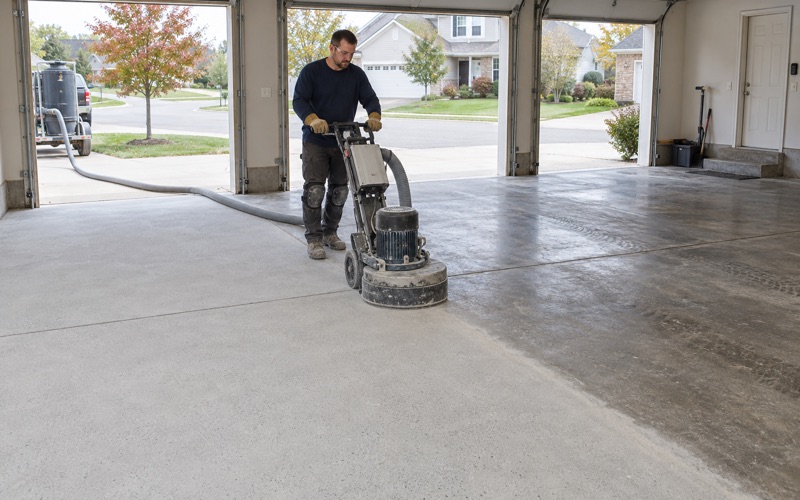
Every slab we coat is opened mechanically with a diamond grinder or a shot blaster to a measured ICRI surface profile, and we never acid etch. Moisture testing sits in the scope as its own line item instead of being sold after a floor has blistered. The written proposal names the product, the system build and the finished thickness, so you can hold the paperwork up against the floor once it is down.
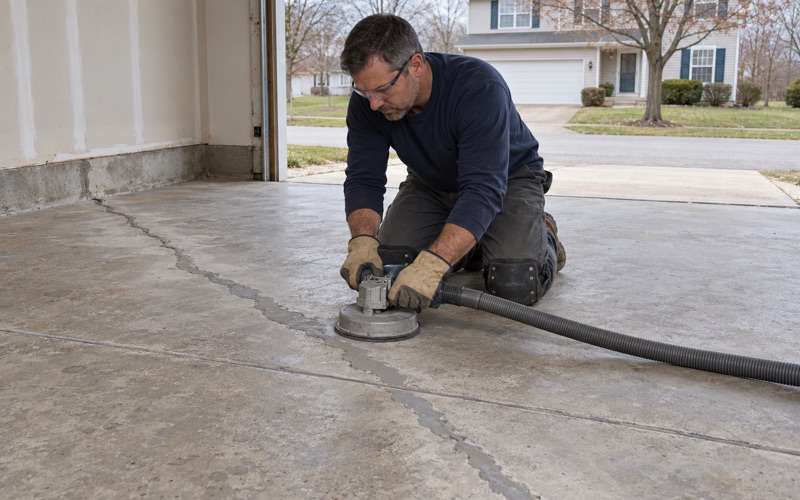
Before we quote, we read the cracks, the control joints and any old coating, and we tell you plainly when a slab needs repair before it can take a coating. Warranty exclusions are read out before the job is sold, with moisture named first. The price comes per square foot for the system we are actually proposing, not from a national per-garage average.
Fox River Grove’s Winter Boat Calendar and the Riverfront Rule

December 1 Through March 31 on Lots Away From the River
The village property maintenance code sets a seasonal rule for boats and personal watercraft on residential lots that do not border the Fox River. Under Section 6-310(2)(a), from December 1 through the following March 31, a boat may not be stored in the required front yard unless it is parked or stored within a totally enclosed structure or garage. From April 1 through November 30, front-yard storage is allowed only on a driveway, at least 3 feet from a sidewalk or 10 feet from street pavement, unless the boat is garaged.
The code does not tell anyone to keep a boat in a garage. It limits where a boat may sit outdoors in winter, and Section 6-307 also allows storage at a marina or a commercial storage business. For many owners, though, the realistic choices come down to the side yard, the back yard or the garage, and the garage is the one that keeps the cover out of the snow.
Riverfront Lots and the 10-Foot Street Setback
Lots that border the river follow a different subsection, 6-310(1)(a), and it carries no season at all. A boat or personal watercraft on a riverfront lot may not be stored less than 3 feet from a sidewalk or within 10 feet of the pavement of a public street unless it is inside a totally enclosed structure or garage. Where a house sits close to the road, that setback can leave very little legal room outside.
For some riverfront owners the garage becomes boat space for the whole year rather than a winter arrangement. A floor that holds a trailer through the summer has no seasonal gap, so the coating has to fit around launch dates instead of a storage calendar. We ask about that at the first visit, because the right window depends on when the boat is actually on the water.
What the Ordinance Means for the Floor
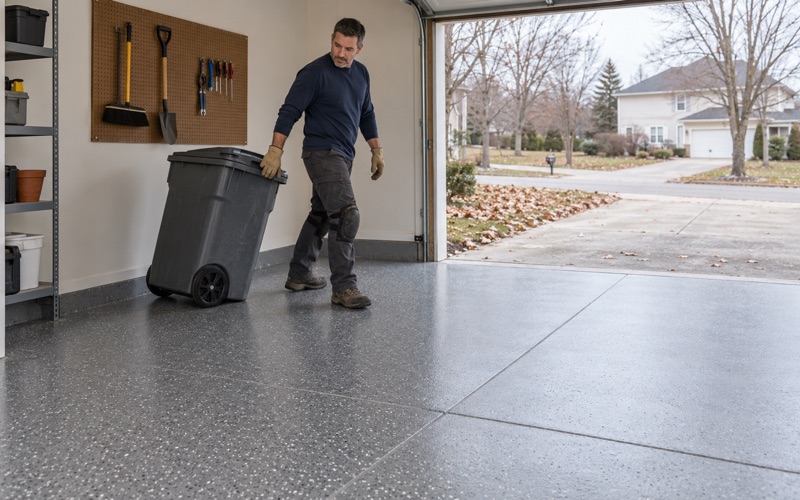
None of this requires a coated floor, and we never suggest otherwise. What the rule does is predict how a garage gets used: from December into spring, many Fox River Grove garages hold a trailer, a hull and the gear that rides along with them for about four months. A floor coated in late November and loaded the same week spends that whole stretch covered before it has finished curing.
The planning question is therefore less about which flake color to broadcast and more about when the last coat can go down. Working backward from December 1 is how we set the date.
Looking for epoxy-flooring closer to Huntley? See Huntley Epoxy-Flooring.
Booking the Garage Floor Between April and November
Why Spring and Summer Are the Easy Months
A boat that leaves the garage in April opens the cleanest window of the year. The floor is empty, the slab is warming, and there are months of margin before the trailer has to come back inside. An owner who launches early can have grinding, coating and full cure finished long before the first cold night.
Spring also leaves time to deal with whatever the grinder exposes. If a crack needs a semi-rigid polyurea joint filler, or a damaged section needs repair or replacement before it can be coated, the schedule absorbs it without pushing the coating into the cold.
Fall Jobs and the Shrinking Margin
Climate records bracket Fox River Grove rather than measure it, since no normals station sits inside the village. The Crystal Lake 4NW station averages 135.6 nights a year at or below 32 degrees, with spring and fall freeze dates of April 25 and October 22, and Barrington 3SW records 137.2 such nights. An unheated garage slab cools with the season, and by late October the margin is thin.
We schedule curing against slab temperature and the dew point spread at the slab surface rather than the calendar date. When a fall booking cannot reach full cure before December 1, we say so plainly and recommend waiting for spring, or keeping the boat at a storage business for one season, rather than loading an uncured floor.
Permits and Paperwork in the Village
Fox River Grove’s Office of Building and Zoning works from the 2021 International Residential Code, and its permit summary lists jobs such as driveways, patios and finishing a basement, but not floor coatings. That page calls itself a general summary, so whether a particular job needs a permit is a question for Building and Zoning at Village Hall, 305 Illinois Street, 847-639-3170. Since March 1, 2026, basic permits that need two or fewer inspections carry no fee.
We found no village contractor registration rule, and Illinois issues no license for flooring or coatings work, but we still confirm local registration, bond and insurance requirements before a job goes on the calendar. Every home job also gets a written contract and the Home Repair: Know Your Consumer Rights pamphlet before work starts, as the Illinois Home Repair and Remodeling Act requires.
Full Cure Before the Trailer Rolls In
Walkable Is Not the Same as Cured
Epoxy hardens in stages, and the stage that matters for winter storage is the last one. One maker’s system, Sikafloor MultiDur ES-15, lists foot traffic after about 24 hours at 68 degrees, light traffic after about 4 days and full cure after about 7 days. Those are that product’s published figures, cited as an example, and other systems carry their own.
A floor that feels hard underfoot on day two is still gaining hardness and chemical resistance for days afterward. Trailer tires, a damp boat cover and four closed-up months with little air movement are a poor test for a coating that has not reached that last stage.
How Temperature Stretches the Schedule
The same data sheet shows how far the calendar moves with the thermometer. Full cure takes about 5 days at 86 degrees, about 7 at 68 degrees and about 10 at 50 degrees, and the product is not applied at all on a substrate or in air below 50 degrees. It also calls for the slab to stay at least 3 degrees Celsius above the dew point and for the fresh floor to be protected from damp and condensation for at least 24 hours.
That is why a coating finished in a cool November garage may need about ten days before it is ready for a boat, and a colder slab cannot be coated at all. It also rules out the familiar shortcut of running a propane heater to hurry things along, because the maker excludes fossil-fuel heaters during application.
Building the System for a Long Winter Under Cover
A typical boat-garage build pairs a 100% solids epoxy base with a vinyl flake or quartz aggregate broadcast and a polyaspartic or polyurea topcoat. Every product is chosen within the Illinois VOC limit of 250 grams per liter for floor coatings, set in Part 223 Subpart C of the state’s air rules, which binds the installer as well as the manufacturer. McHenry and Lake counties both sit whole in the Chicago 2015 ozone nonattainment area, classified Serious.
Before any of it goes down, the slab gets an ASTM F1869 calcium chloride test or ASTM F2170 in-situ relative humidity probes. Trapped moisture shows up as blistering, and a blister forming under a stored boat may not be noticed until the boat leaves in April.
RVs, Vehicle Work and Fox River Grove Garages
Tall RVs and RV Repairs Belong Inside
Boats are not the only thing the village code sends indoors. Under Section 6-308, no recreational vehicle in a residential district may stand taller than 10 feet unless it is inside a totally enclosed structure or garage, and repairs beyond routine maintenance that involve dismantling any part of the vehicle must be done inside one as well. An RV stored outdoors must sit on concrete, asphalt, crushed stone or an equivalent hard surface.
An owner rebuilding RV brakes or pulling a slide-out motor is therefore working on the garage floor by rule rather than in the driveway. That floor needs a finish that cleans up quickly after a weekend of repair work and does not hold grime in the texture.
Vehicle Bodywork and Painting Rules
Section 6-302(g) carries a parallel rule for cars and trucks. A vehicle may undergo major overhaul, including body work, only inside a structure or similarly enclosed area designed and approved for that purpose, and painting a vehicle is prohibited unless it is done in an approved spray booth. A coated floor does not turn a garage into an approved spray booth, and we never describe it that way.
What the floor can do is make the indoor work the code expects easier to live with. A light flake floor bounces more light up onto the underside of a vehicle than bare gray concrete, and a sealed surface sweeps clean instead of shedding dust into the next job.
Older Houses, Newer Garages and Two Counties
Fox River Grove was incorporated in 1919 as the ninth village in McHenry County, and about 20.4 percent of its homes were built before 1940, with much of the rest dating from the 1980s and 1990s. Section 6-12 now requires every new single-family house to have an attached two-car garage, so the slabs we see run from old detached garages to recent attached ones. The age and condition of a slab shape how we grind it and which repairs come first.
The village lies about 89 percent in McHenry County and 11 percent in Cuba Township in Lake County, and much of it sits in the Fox River floodplain. A coating does nothing to keep floodwater out of a garage, and we say so before anyone books one near the river. Grinding dust is collected at the grinder and never washed toward a floor drain or storm inlet, which matters in a village that runs its own NPDES stormwater program.
- 20+ Years on Local Concrete
- Moisture Testing in Every Scope
- Written Per-Square-Foot Quotes