
Crystal Lake Epoxy Flooring installs ESD flooring in Crystal Lake, IL, serving surrounding cities including Lakewood, Lake in the Hills, Cary, Algonquin and Fox River Grove. With more than 20 years of commercial and industrial floor work, we install static-dissipative and conductive epoxy systems for spaces where a single static spark can ruin a component or disrupt sensitive equipment.
Static electricity builds up as people walk, carts roll and materials move. Most of the time it is harmless, but in electronics assembly, labs, server rooms and some manufacturing areas, an uncontrolled discharge can damage parts, corrupt data or create a safety hazard. An ESD floor gives that charge a controlled path to ground.
These floors are specified, not guessed. Our proposal states the system, the resistance range it is designed to meet, the grounding layout and how the finished floor will be tested, along with the per-square-foot price and the schedule.
How ESD Flooring Works
A Controlled Path to Ground
An ESD floor contains conductive materials, such as carbon fibers or conductive fillers, that let electric charge move through the coating. Copper grounding strips or tape under the system connect the floor to the building ground.
When a person wearing ESD footwear walks across the floor, charge flows from their body, through the floor and into the ground system instead of building up and discharging into a component.
Conductive Versus Static-Dissipative
Conductive floors have lower resistance and drain charge very quickly. They are used in the most sensitive environments where even small charges matter.
Static-dissipative floors have higher resistance and drain charge more gradually, which suits many electronics and lab applications. We match the system to the resistance range your process or your customers’ standards call for.
Part of a Larger Static Control Program
The floor is one element of an ESD program that also includes footwear or heel straps, grounded workstations, carts and chairs, and procedures for handling sensitive parts. A floor alone cannot protect a component if the person handling it is not grounded through the floor. We coordinate with your quality or facilities team so the floor fits the rest of the program.
Where ESD Floors Are Used
Electronics Assembly and Repair
Circuit boards, sensors and other electronic components can be damaged by discharges too small to feel. Assembly, rework and repair areas use ESD floors to protect parts and reduce hidden failures that show up later in the field.
Many contract manufacturers also have to meet the static control requirements their customers write into purchase orders. A documented ESD floor, with test results on file, helps show an auditor that the work area was built to the stated range.
Server Rooms and Data Spaces
Server rooms, control rooms and network closets benefit from ESD floors that reduce static buildup around sensitive equipment, especially where technicians open cabinets and handle components. These rooms are rarely empty for long, so we plan the installation around equipment moves and keep dust out of nearby racks with containment and vacuum-equipped grinders.
Labs and Specialized Manufacturing
Testing labs, clean manufacturing areas and spaces that handle sensitive materials often specify ESD floors as part of their process controls. Each application has its own requirements, which we confirm before choosing a system.
Installing an ESD Floor
Slab Preparation and Moisture Testing
An ESD system starts the same way as any good coating: diamond grinding to an open profile, repair of cracks and joints, and moisture testing. Moisture problems are especially important here, because a coating that blisters or debonds can break the conductive path. Where readings are high, we add a moisture-mitigation primer before the conductive layers.
Grounding Layout and Conductive Primer
Copper grounding strips are laid out on the prepared slab and connected to the building ground at specified points. A conductive primer then ties the strips together and creates a continuous conductive layer under the finish coat. The grounding layout depends on the size and shape of the room, and it is drawn into the proposal.
The ESD Finish Coat
The final layer is an epoxy formulated with conductive materials so charge can pass through it. It is installed at a controlled thickness, because thickness affects resistance. The finished surface is smooth, seamless and chemical resistant, and it can be produced in light colors that brighten work areas.
Testing and Handover
Resistance Testing
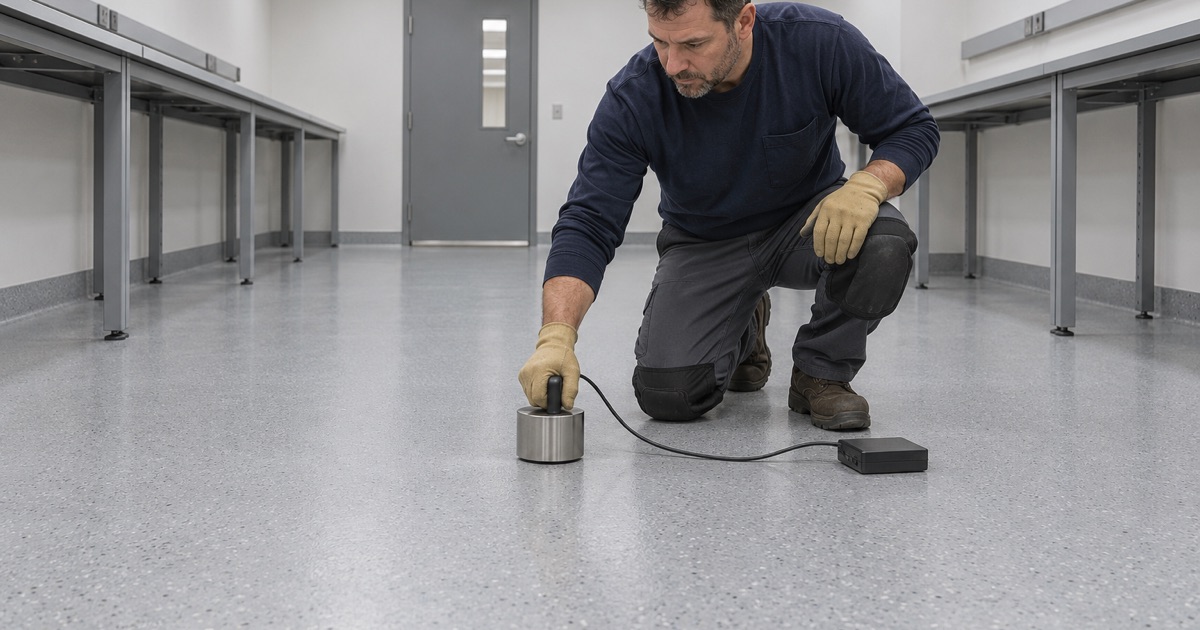
After the floor cures, we test it with a resistance meter at points across the space, measuring point-to-ground and point-to-point resistance. The readings are compared with the range the system was designed to meet. You receive the test results at handover so the floor’s performance is documented from day one.
Ongoing Checks
ESD floors should be retested periodically as part of your static control program. We can show your team how to run those checks and what readings to expect.
A reading that drifts out of range usually points to a cleaning residue, a worn area or a damaged ground connection, and each has a different fix. Catching the drift early keeps a small maintenance task from turning into a failed audit.
Dry Winter Air and Static
Static problems get worse when indoor air is dry, and heated buildings through a McHenry County winter often run at low humidity. An ESD floor keeps doing its job in those months, but it is also the season when footwear, grounding and cleaning habits matter most, so we suggest checking the floor before winter sets in.
Living With an ESD Floor
Cleaning Without Insulating the Surface
Waxes, polishes and cleaners that leave a residue can insulate an ESD floor and push its resistance out of range. Use cleaners made for ESD floors and keep the surface free of buildup.
Repairs and Changes
Damaged areas can be repaired with matching conductive materials, but repairs must be tied into the grounding system. If you move equipment or add workstations, we can extend grounding to new areas and retest the floor.
Scheduling Around Production
Many ESD floors go into active facilities. We phase work and schedule overnight or weekend shifts so production can continue, and we plan curing time before sensitive equipment moves back in.
- 20+ Years on Local Concrete
- Moisture Testing in Every Scope
- Written Per-Square-Foot Quotes