Crystal Lake Epoxy Flooring has spent more than 20 years on concrete floors, and our epoxy-flooring in Deerfield work starts with a question most quotes skip: where will the machines run? On a shop or light industrial floor, the grinder, the vacuum and the dust collector are as much a part of the job as the resin. We settle how they will be powered and where they will sit before anyone signs a proposal.
That plan matters because some commercial floors here sit close to houses, and the village has rules about what a parked truck may do near them. A crew used to running a generator or compressor off the trailer has to work differently. We write that difference into the scope up front, so a building owner is not surprised on the first morning.
The rest of the job is what you would expect from us anywhere. The slab is opened mechanically rather than etched, moisture is tested and priced as its own line, and the proposal names the product, the system build and the finished thickness. What follows is how the local part of the plan works.
A small industrial district with homes nearby
Working bays, close neighbors
Deerfield is a village in Lake and Cook counties on the North Shore, about 28 miles north of downtown Chicago. Its I-2 Limited Industrial District is a district of modest buildings rather than a warehouse corridor, and its own rules are written with nearby residential areas in mind. That is why a floor job there gets planned around the neighbors as much as around the slab.
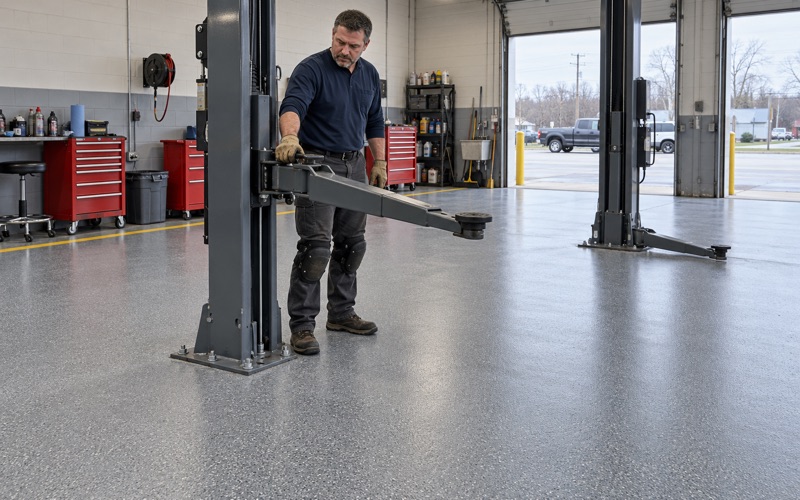
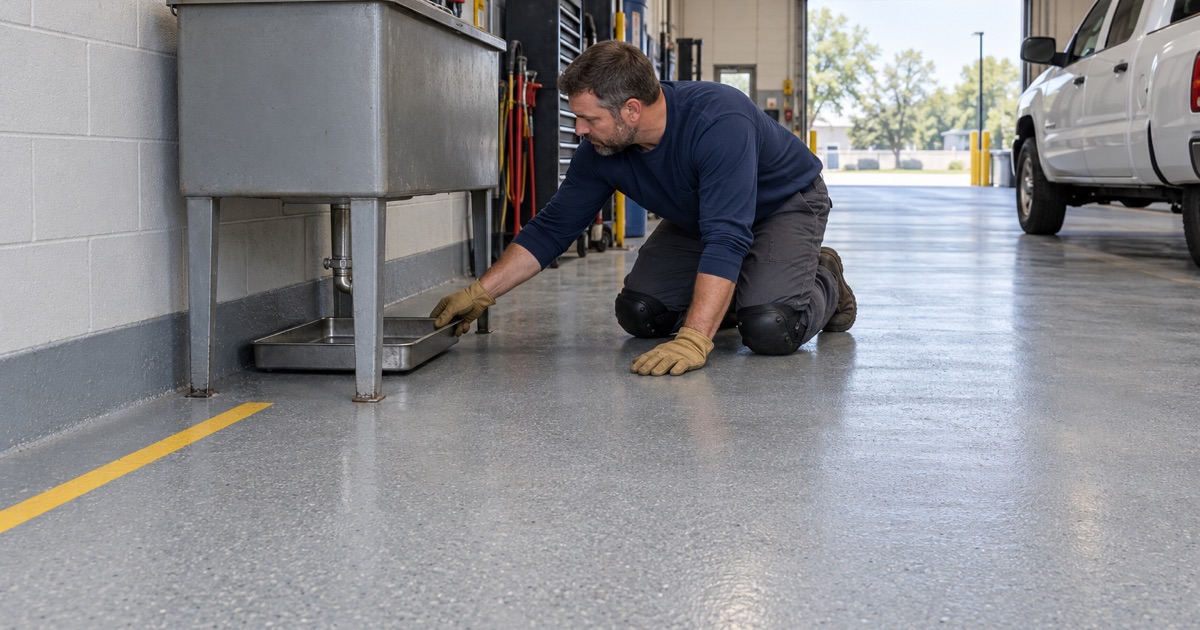
The floors in a district like this tend to be working bays: a contractor’s shop, a service area, a back room where equipment is cleaned and repaired. They carry rolling equipment, dropped tools, spilled fluids and regular wash-downs, and the business usually cannot close for a week while the floor is redone. We schedule around the hours the building has to keep running, including weekend windows, and stage the work so part of the bay stays usable.
What the village proposed in 2023 and voted on in 2024
In December 2023 the village circulated a draft amendment to the I-2 rules in its 1978 zoning ordinance. As drafted, it would cap buildings for permitted uses at 25,000 square feet and list contractors’ offices and shops, such as pest control, carpet cleaning, lawn care and pool maintenance, with their equipment and materials stored inside. It also proposed performance standards for noise, glare, vibration, odor and particulate detectable at the zoning lot line.
Trade press reported that in early February 2024 the Board of Trustees voted unanimously to amend the zoning code and effectively bar motor freight terminals, logistics centers and fulfillment centers. We have not seen the adopted ordinance number, so we treat the draft’s details as what the village proposed rather than as final code. Both point the same way, toward small buildings and quiet operations.
Looking for epoxy-flooring closer to Wood Dale? See Wood Dale Epoxy-Flooring.
What the 150-foot rule covers, and what it leaves alone
The text itself
The part of the I-2 rules that shapes a floor job is older than the 2023 draft, which reprints it unchanged. Trucks and equipment loaded on vehicles may be parked outdoors only if they sit at least 150 feet from a residential district. And in no event may a truck or other vehicle stand or be parked within 150 feet of a residential area with its engine, compressor or any other motor running, except for the time needed to load or unload.
The same section requires servicing, testing, repairing, cleaning and the display of anything used in the business to take place completely within enclosed structures. Outside storage of goods or machinery is prohibited except where the rules provide for it. A contractor’s permitted outside storage has to be screened by solid fencing or evergreens at least 7 feet high.
Reading it narrowly
We are careful not to stretch this. It is a rule about vehicles standing near homes with motors running, inside the I-2 district, and it says nothing about the floor work itself or about the rest of the village. Its effect on our work is practical rather than dramatic.
On jobs in other towns, a grinding crew often parks a trailer at the overhead door with a towable generator, a compressor or a dust collector driven by its own engine, all running for most of the day. Within 150 feet of a residential area in this district, that setup is a vehicle standing with a motor running far longer than any unloading takes. So here we leave the motors off at the curb and bring the equipment inside.
Grinding and dust collection on building power
Surveying the panel first
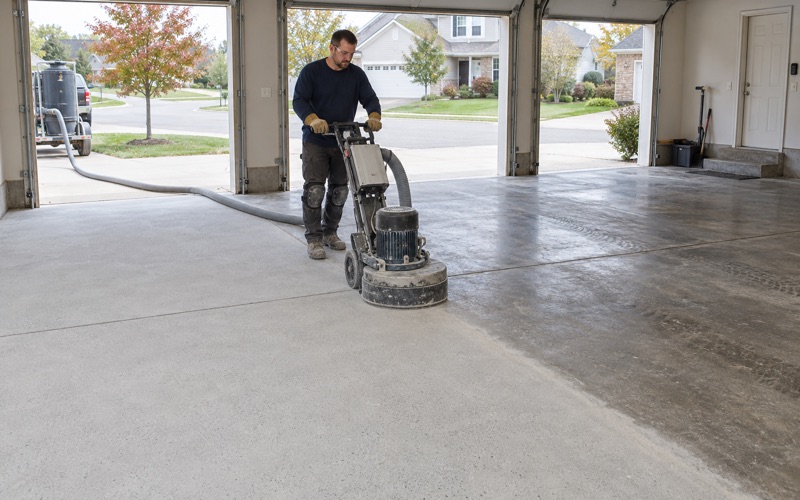
Large planetary diamond grinders and the dust extractors that serve them need circuits at the right voltage and amperage, and not every small bay has them near the floor. We walk the building before quoting to find the panel, confirm what power is available and see how far cords must run to reach the far corners. If the building cannot carry the grinder we would normally bring, we say so, and either the equipment is sized to the circuits or the owner’s electrician adds capacity before we arrive.
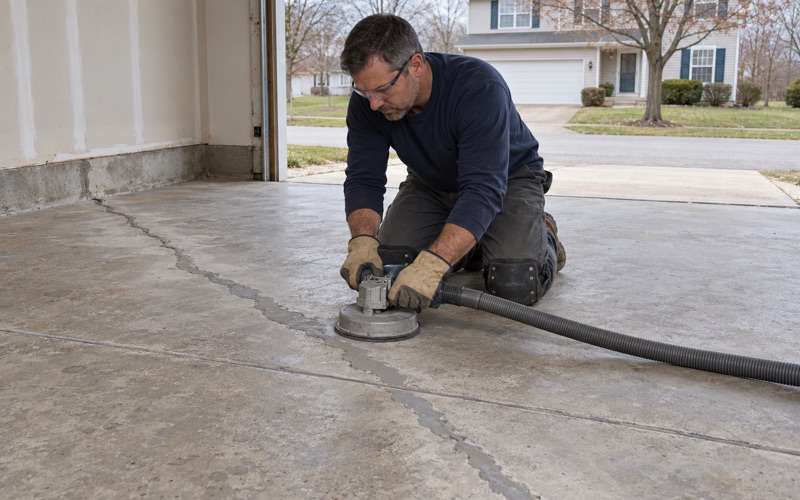
That survey also shapes how the slab is prepared. A smaller grinder or a shot blaster may suit a bay with limited power, and we aim for the surface profile the coating needs on the ICRI CSP scale rather than whatever the biggest machine would leave. The slab is still opened mechanically every time, and we do not acid etch.
Dust caught where it is made
With the collector inside instead of on a trailer, hose runs stay short and the dust is pulled off at the grinder head. We vacuum as we cut and bag the waste inside the building, so nothing is swept out the door or rinsed toward a floor drain or storm inlet. The bay ends the grinding day clean enough to prime.
Indoor collection also makes the crack and joint work cleaner. Old coating, failed patches and open joints show up clearly on a freshly ground slab, and we tell the owner plainly if a section needs repair or replacement before it can be coated. Joints that move get a semi-rigid polyurea filler rather than being buried under resin.
Letting the building set the cure
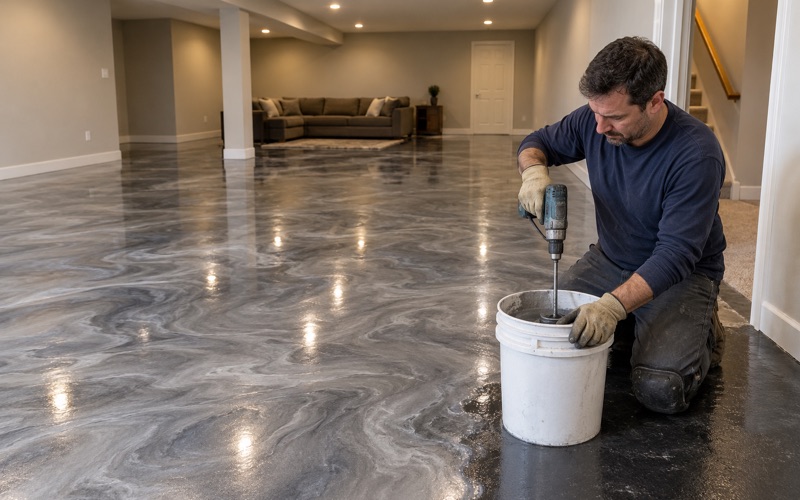
Once resin is down, the building’s own heat and air control how it cures. We read slab temperature and the dew point spread at the surface before each mix and schedule the next coat against those readings rather than the clock. That matters more indoors than people expect, since a cold bay with the overhead door shut can hold moisture at the surface long enough to cause amine blush.
Moisture in the slab itself is tested before any of this starts, with calcium chloride or in-situ relative humidity readings as the floor calls for. Warranty exclusions are read out before the job is sold, with moisture named first.
Deliveries, staging and the lot line
Unloading counts as loading
The 150-foot rule allows the time needed to load or unload, and we run our deliveries to fit inside that allowance. Resin kits, aggregate and machines come off the truck, go inside and the engine goes off; the truck does not sit at the door idling while we work. We set delivery times with the owner in advance so they fit the building’s dock schedule and the neighbors’ day.
Nothing we bring stays outdoors. Materials are staged inside the bay or an adjacent room, which also keeps resin in the temperature range it needs before mixing. That follows the same logic as the proposed rule that contractors’ equipment and materials be stored within enclosed structures.
Noise, odor and dust at the property line
The 2023 draft proposed limits on noise, odor and particulate detectable at the zoning lot line, with construction noise and particulate exempted. Whatever final form those standards took, a bay beside homes is a place to keep all three low regardless. Dust collected at the grinder and doors kept shut handle most of it.
For odor, the coating choice does part of the work. We select products within the Illinois limits on VOC content, which bind the installer as well as the manufacturer, and we talk through how long the bay should be ventilated after each coat. A 100% solids epoxy base with a polyaspartic topcoat is a common build for shop floors, and we explain the trade-offs before anything is ordered.
Before the job goes on the calendar
A Deerfield address does not settle every question on its own. Lake-Cook Road is the county line, and a business south of it sits in Cook County, outside the territory the Deerfield-Bannockburn Fire Protection District describes as its own. Illinois issues no state license for coating work, so we confirm the village’s registration, bond and insurance requirements before scheduling.
The proposal you receive names the resin, the system build and the finished thickness, and it prices the floor per square foot for the system actually proposed. It also states where the equipment will run and when deliveries will arrive. In this district, that plan is part of the job rather than an afterthought.
- 20+ Years on Local Concrete
- Moisture Testing in Every Scope
- Written Per-Square-Foot Quotes