
Crystal Lake Epoxy Flooring provides concrete grinding in Crystal Lake, IL, serving surrounding cities including Lakewood, Lake in the Hills, Cary, Algonquin and Fox River Grove. After more than 20 years of preparing local slabs, we treat grinding as the most important step in any floor job, because every coating and polish depends on what the concrete looks like when it is done.
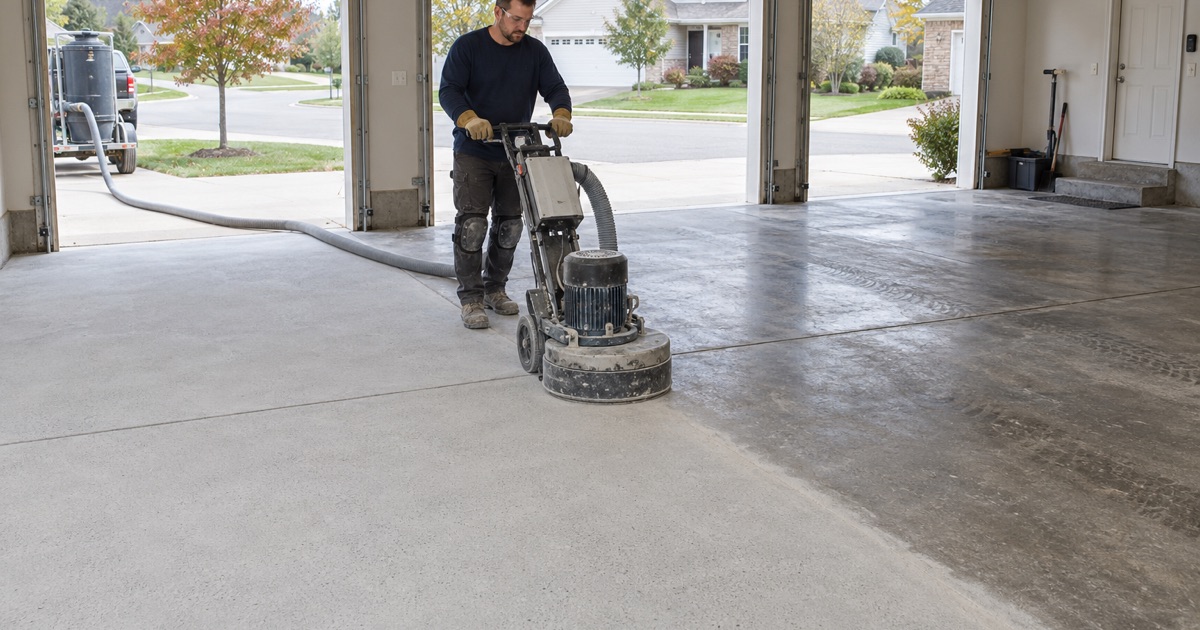
Concrete grinding uses heavy machines fitted with diamond tooling to remove the top layer of a slab. It takes off the smooth trowel finish, curing compounds, sealers, paint, old coatings and adhesives, and it opens the concrete to a measured surface profile that a primer can grip. Shot blasting does a similar job on large commercial floors by firing steel shot at the surface and recovering it.
Every slab we coat is opened mechanically this way, and we do not acid etch. Our grinders run with dust collection at the tool, and grinding dust is never washed toward a floor drain or a storm inlet.
Why Surface Preparation Decides Everything
What Coatings Need to Bond
Floor coatings bond by flowing into the pores and texture of the concrete and locking in as they cure. A smooth, sealed or dirty surface gives them nothing to grab, so they sit on top and eventually let go.
Grinding removes the weak cream layer at the surface and exposes sound concrete with a consistent texture. That clean, open surface is what gives a coating its long-term bond.
The ICRI Surface Profile Scale
The International Concrete Repair Institute rates surface texture on a scale from CSP 1, nearly flat, to CSP 10, very rough. Each coating system calls for a range, with thin sealers needing a light profile and thick broadcast or mortar systems needing a heavier one.
We grind or blast to the profile the products call for and check it against the ICRI reference chips. Too smooth and the coating will not bond; too rough and a thin coating can leave peaks exposed.
Why We Never Acid Etch
Acid etching dissolves a thin layer of cement paste but leaves inconsistent results, cannot remove sealers or paint, and leaves salts in the pores that must be neutralized and rinsed away. Done poorly, it causes exactly the failures it is meant to prevent. Mechanical grinding gives a predictable, repeatable profile across the whole floor, from the middle of the slab to the last inch along the wall.
Grinding and Blasting Methods
Diamond Grinding
Walk-behind and ride-on grinders spin heads fitted with diamond segments. Coarse metal-bond diamonds remove coatings and create profile, and finer diamonds smooth the surface for thin coatings or polishing. Edge grinders and hand tools handle the perimeter, corners and around columns, so the profile is consistent everywhere the coating will go.
Shot Blasting
On large warehouse and plant floors, shot blasting can prepare big areas quickly. The machine throws steel shot at the floor, knocks off the surface layer and recycles the shot through a built-in vacuum.
Shot blasting leaves a heavier profile that suits thick coatings and urethane cement. It is less suited to thin coatings or polished concrete, so we choose the method by the system that follows.
Scarifying and Scraping
Very thick coatings, rubbery membranes and heavy adhesives can clog diamond tooling. In those cases we may use a scarifier, a floor scraper or both before grinding to the final profile.
What Grinding Removes
Old Coatings and Paint
Peeling garage paint, failed epoxy, and worn sealers all have to come off before a new system can bond. Coarse diamonds and, where needed, scrapers take them down to clean concrete.
We test adhesion in a few spots first. Well-bonded coatings are sometimes left as a base, but anything loose or incompatible is removed.
Carpet Glue, Tile Mastic and Thinset
Basements and commercial spaces often have carpet adhesive, black tile mastic or thinset under the old flooring. Grinding removes these residues so the new floor sits on concrete rather than on a layer that can soften or release.
Some older black mastics can contain asbestos. When a building’s age or the material suggests that, we recommend testing before any grinding begins.
Salt-Damaged and Weak Surface Concrete
On garage floors and loading areas, years of salt and freeze-thaw can leave a weak, scaling surface. Grinding removes that damaged layer down to sound concrete, which is then repaired and coated.
Preparing for What Comes Next
Preparation for Coatings
For epoxy, polyaspartic and urethane cement systems, we grind to the profile the products call for, repair cracks and spalls, and vacuum the floor clean. Moisture testing happens at this stage, so the primer can be chosen from the actual readings.
Preparation for Polished Concrete
Grinding for polished concrete goes further. We step through progressively finer diamonds after the initial grind, densify the slab and refine the surface until it reaches the agreed sheen.
Preparation for Other Flooring
Tile, vinyl and wood installers often need a clean, flat slab without adhesive or high spots. We grind to the specification they give, and we can fill dips or apply self-leveling underlayment where needed.
Residential and Commercial Grinding
Garages and Basements
Home jobs usually involve a garage or basement, where we grind wall to wall, including the edges, and keep dust contained with vacuums and plastic sheeting where needed. Most residential grinding is completed in a day or less.
Warehouses, Shops and Kitchens
Commercial grinding often covers thousands of square feet and must fit around operations. We phase the work, run machines overnight or on weekends when needed, and coordinate with managers so the building can keep running.
- 20+ Years on Local Concrete
- Moisture Testing in Every Scope
- Written Per-Square-Foot Quotes