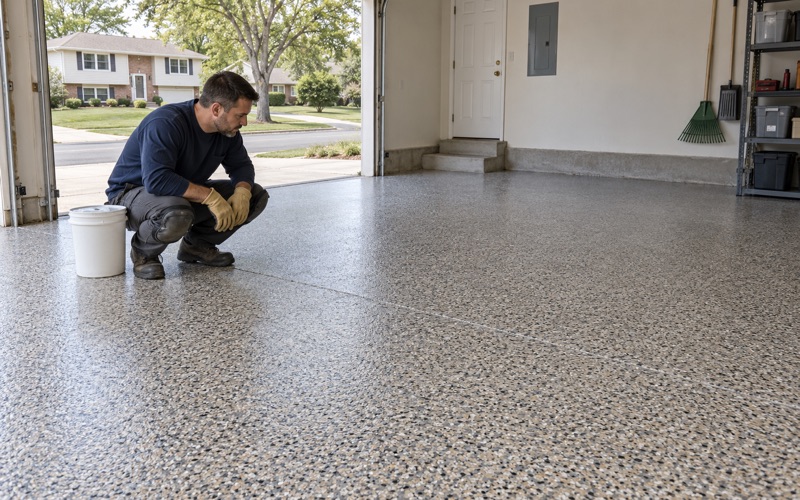
Crystal Lake Epoxy Flooring has spent more than 20 years on epoxy-flooring in Beach Park and across northern Illinois, and the floors we get asked about here are mostly working floors: repair bays, service shops and fleet garages. On those slabs the hardest square yard is rarely the open driving lane. It is the few feet around the bench where parts get cleaned, because what drips there does not dry on its own.
That one corner changes how we specify a shop floor. A system that shrugs off tire traffic can still soften or go glassy under a cleaning solvent that sits on it for hours, so we build the washer zone as its own piece of the job, with its own resin choice and its own texture. The rest of the bay gets what the rest of the bay needs.
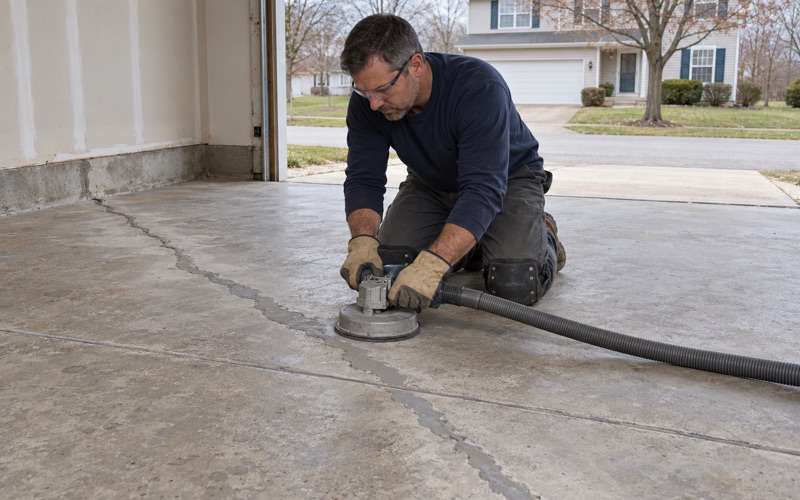
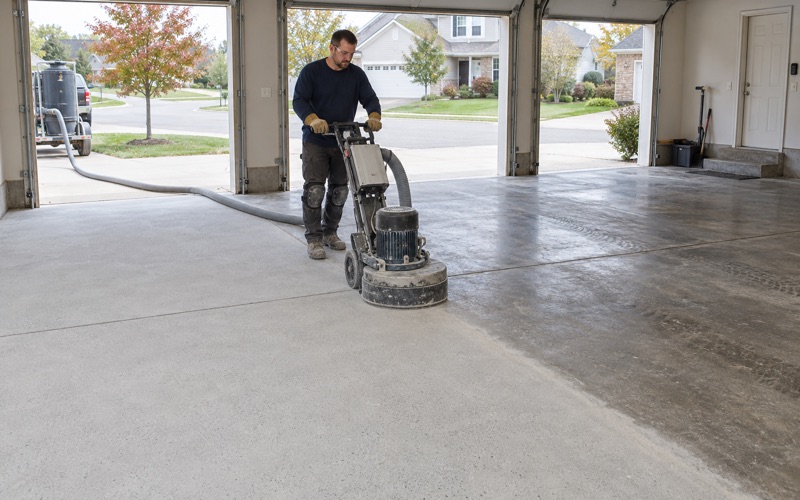
Before anything goes down, the concrete is opened with a diamond grinder or a shot blaster, never acid, and the proposal states the product, the build and the finished thickness. If the slab around an old washer station is oil-soaked or cracked beyond what a coating can carry, we say so in the quote rather than after the floor fails.
The Fleet Garage on Glendale Road and the Shops Around It
What Public Works keeps running
Beach Park’s Public Works department works out of 40185 Glendale Road, inside the village and in Benton Township. Its Streets Division lists fleet maintenance among its duties, alongside snow and ice control, traffic signs, streetlights and pavement work on village right-of-ways.
That pairing says a lot about what a municipal shop floor goes through. Plow trucks come in off treated roads in winter, and between storms the same bays turn wrenches on the trucks and equipment behind programs like chipping and street sweeping. We have no work history with the village; we name the garage because it is the clearest local example of a floor that has to do both jobs.
Lewis Avenue and Sheridan Road repair shops
The village business directory lists a run of private repair trades as well. Pat’s Repair and Barranco Services and Towing are on Lewis Avenue, Small Car Motors and Euro Line Auto Repair are on Sheridan Road, and Magnus Automotive is on Beach Road.
None of those shops describe their floors online, so we make no assumption about the equipment any of them runs, or about which of them would ever want a coated floor. What we can say is that a working repair bay in this village faces the same question a fleet garage does wherever cleaning solvent is part of the routine. The answer starts with a state air rule most owners know from the label on the tank.
Why the washer corner gets its own line in the quote
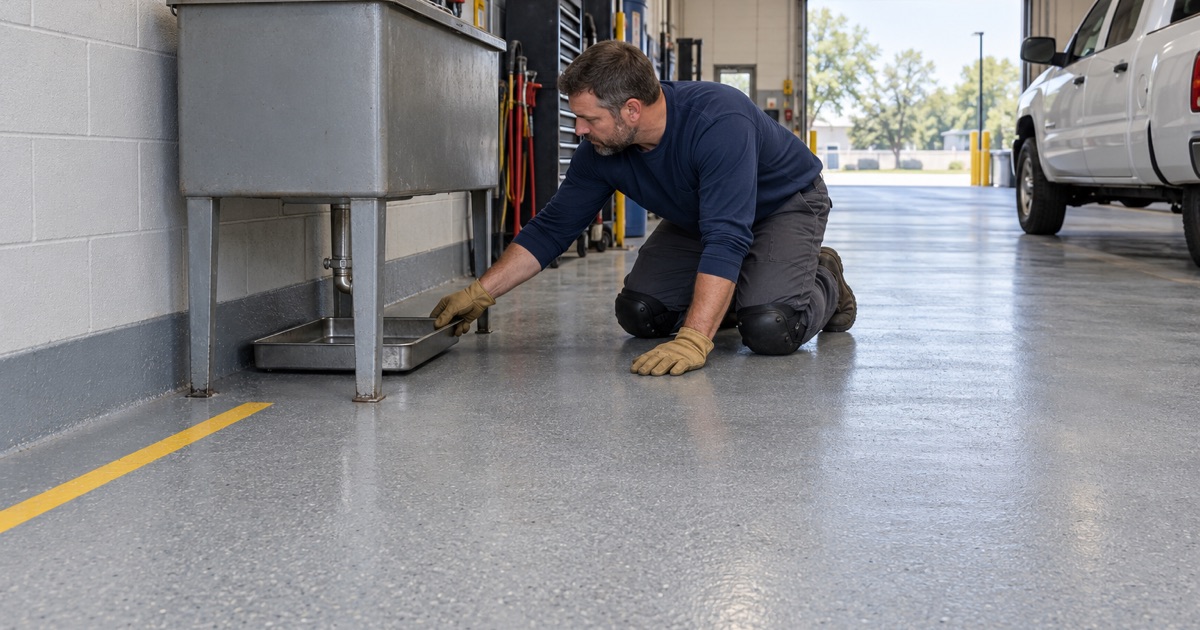
In a typical bay the parts washer sits against a wall near the bench, where a technician stands for long stretches. The floor there sees standing work, dropped parts, drips from a wet part set down for a moment, and the absorbent that cleans it all up.
We price and build that zone separately because the failure there looks different from the failure in a drive lane. Tire marks and hot tire pickup show up where trucks park, while softening, staining and slick spots show up where solvent lands.
Splitting the quote that way also keeps the price honest. We quote per square foot for the system actually proposed in each zone, so a shop owner can see what the washer corner costs on its own instead of paying for a heavy chemical build across a whole bay that only needs it in one spot.
Looking for epoxy-flooring closer to Bensenville? See Bensenville Epoxy-Flooring.
Illinois’ Parts-Washer Rule in the Chicago Area
Lake County sits inside the Chicago-area rules
Illinois writes a separate set of air rules for the Chicago area, Part 218 of the Illinois Administrative Code, and it names Lake County among the counties it covers. Beach Park, as a Lake County village, falls inside that boundary along with Cook, DuPage, Kane, McHenry and Will counties.
One section of Part 218, Section 218.182, governs cold cleaning, the regulatory name for a solvent parts washer. It sets how the washer is run and what solvent may go in it. It says nothing about floors, and we would never tell a shop owner that the rule requires a coated slab.
What Section 218.182 asks of a shop
The rule caps the solvent’s vapor pressure at 1.0 mmHg at 20 degrees C, unless add-on controls capture and control at least 95 percent of emissions. Parts are drained until dripping ceases, the cover stays closed when parts are not being handled, and waste solvent is stored in covered containers only.
A permanent label summarizing the operating procedure goes on the degreaser itself. Read together, these are housekeeping rules written to keep solvent in the tank and out of the air. Followed faithfully, they also keep most of it off the concrete.
Solvent tanks and water-based units are different floors
Many shops have moved to water-based parts washers, and we have not checked which Beach Park bays use which kind. Everything on this page about solvent applies where a shop runs a solvent parts washer; an aqueous unit raises different questions about rinse water and slip.
If you are not sure what is in your tank, the label and the supplier’s data sheet will tell you. We ask for that sheet before we choose a topcoat, the same way we ask for a moisture reading before we choose a primer.
Why a Low-Vapor-Pressure Solvent Stays Wet on the Floor
Slow evaporation by design
Vapor pressure is a measure of how readily a liquid evaporates. A solvent held under 1.0 mmHg is chosen precisely because it evaporates slowly, which is how it stays in the washer instead of drifting into the shop air.
The same property follows the solvent onto the floor. A splash of a fast-flashing solvent disappears in minutes, but a drip of a low-vapor-pressure cleaner beside the washer tends to stay wet until somebody wipes it up.
What hours of contact do to a coating
A coating that resists a quick splash can behave very differently under a puddle that sits through a shift. Dwell time is what separates the two, and systems that look identical on day one can diverge after repeated soaking as the surface dulls, softens or takes a stain that will not clean out.
That is why we treat chemical resistance at the washer as a consequence of the rule rather than a sales line. We compare the solvent’s data sheet against the resin maker’s resistance data for long contact, and where a standard garage build falls short, the washer zone gets a tougher topcoat.
We also look at what the bay already has on it. An older coating that has been softened by years of drips usually has to come off down to sound concrete, because a fresh coat laid over a weakened one fails with it.
Slip is the other half of the problem
A wet film of solvent on a smooth, glossy coating is slippery, and a technician standing at a washer often has parts in both hands. Slip resistance in this corner matters as much as the chemistry.
We handle it with a quartz aggregate broadcast locked into the coat, so the texture stays when the surface is wet. A gritty floor holds dirt more than a smooth one, so we size the texture to the zone rather than spreading it across the whole bay.
Building and Caring for the Floor Around the Washer
The system we build at a washer station
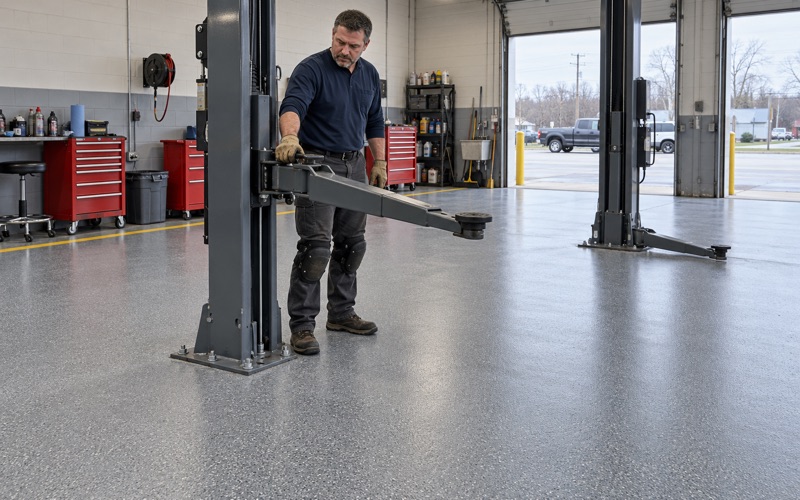
At the station we usually start from a 100% solids epoxy base over a ground profile, then finish with a topcoat matched to the solvent and the traffic. Out in the drive lane, where hot tire pickup is the bigger worry, a polyaspartic or polyurea topcoat may make sense while the washer zone gets the build the solvent demands.
Joints and cracks in that corner get a semi-rigid polyurea joint filler so solvent does not wick into the slab. Old staining from years of drips is ground out and checked before coating, since a contaminated surface can keep a new coat from bonding.
We usually carry the textured, solvent-rated build a few feet past the footprint of the washer and the spot where the waste container sits. Drips travel on boots and on parts carried to the bench, and a clear edge to the zone shows the crew where the tougher floor begins and ends.
Drain over the tank, wipe with absorbent
The cleanest washer floor is the one that rarely gets wet. Draining each part over the tank, keeping the lid down and keeping waste solvent closed up are what the rule asks, and they do more to protect a coating than any topcoat can.
When a drip does land, absorbent is the right tool, swept up and handled with the shop’s other solvent waste. Hosing that corner toward a floor drain or out the door is never the answer: the village runs a stormwater permit with illicit-discharge reporting through Public Works, and neither solvent nor our grinding slurry belongs in a storm inlet.
Scheduling a shop that cannot close
A fleet garage or a busy repair bay rarely has a week to spare. We schedule shop floors around the hours the building has to keep running, including overnight and weekend windows, and we can phase the work so the washer corner or a single bay is finished while the others stay in service.
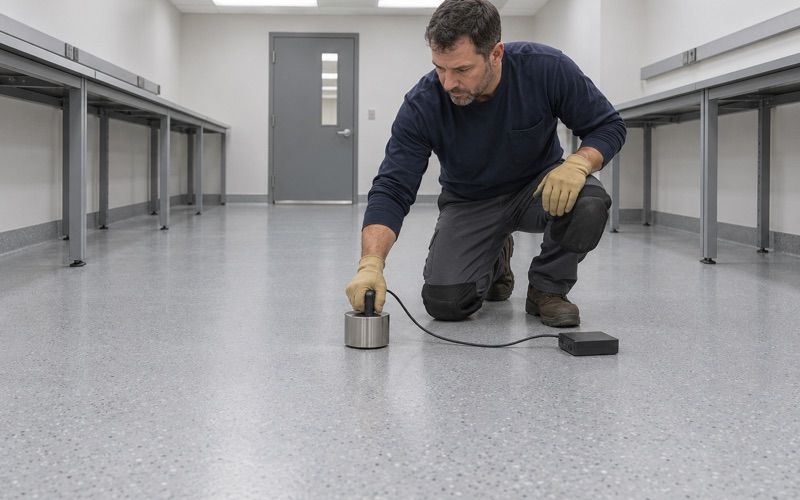
Curing follows slab temperature and dew point rather than the calendar, which matters in a garage that sits cold between plow runs. Moisture testing is in the scope from the start, and the warranty exclusions, moisture first, are read out before the job is signed.
- 20+ Years on Local Concrete
- Moisture Testing in Every Scope
- Written Per-Square-Foot Quotes